Thursday, 29 August 2024

NEW WAVE OF THE BRITISH FANTASTIC FILM 2024 #3: Reviews of The Moor (UK 2023), Starve Acre (UK 2023), The Deadly Swarm (UK 2024), The Jack in the Box Rises (UK 2024), The Beast Within (UK 2024) and Ouija Castle (UK 2024)

The Moor (UK 2023: Dir Chris Cronin) Back in 1996, during a so called ‘Summer of Fear’ in a northern town (so named because of a rash of disappearances of young people causing the townsfolk to become overly protective of their sons and daughters) little Claire eggs on her young friend Danny to distract a shopkeeper while she secretly nicks sweets. But the jape goes wrong when Danny is mysteriously snatched, joining the ranks of the missing. And dead.

25 years later Claire (Sophia La Porta), now an entertainment podcaster, still harbours guilt, particularly when it appears that the man jailed for the crimes is set for release. She is approached by Danny’s father Bill (David Edward Robertson) to use her communication skills to help keep alive the search for the little boy’s body and the man responsible in prison; perhaps preying on that guilt he ropes in Claire, alongside psychic friend Alex (Mark Peachey) and Alex’s equally spiritually gifted daughter Eleanor (Elizabeth Dormer-Phillips), to comb the moors, which he believes is Danny’s resting place. But as the wild terrain begins to exert an eerie hold on the group, and Bill’s obsessiveness increases, Claire begins to feel that something more than human could be behind the mystery.

Chris Cronin’s debut feature isn’t afraid to take things slow; for most of its running time, The Moor is a prolonged but beautifully acted study in grief and the need to achieve closure in the face of the most horrific emotional suffering. Only in the film’s last third do the supernatural elements really introduce themselves, but the director handles this transition seamlessly; he may save his most shocking reveal until the film’s closing moments, but the sense of dread he builds up means that The Moor’s climax is both alarming and, strangely, satisfying.

La Porta and Robertson excel in their roles; the former a woman existing via a defining life moment in her past which dictates her present, and the latter consumed with the need to find both justice and solace. There’s a nagging sense of history throughout the movie; Bill’s search recalls the desperation of the family of Moors Murders victim Keith Bennett to find the location of his burial. As such an accusation of insensitivity could be levelled at the filmmakers, but The Moor is a considered and affecting film which strikes a powerful and horrifying balance between the human and the supernatural.

A version of this review was previously published on the Bloody Flicks site.

Starve Acre (UK 2023: Dir Daniel Kokotajlo) Kokotajlo's debut feature, 2017's stunning Apostasy, dealt with a crisis of faith facing a Jehovah's Witness mother. Faith of a very different kind is at the heart of his latest film.

Richard (Matt Smith), a teacher and archeologist, and his partner Juliette (Morfydd Clark) live in rural seclusion, at some point in the early 1970s (the time period is never specified beyond the visual clues of car registrations). Their young son is a troubled soul; as the film opens he has blinded a horse - recalling the character of Alan Strang in Peter Shaffer's 'Equus' - and his sleep talk is full of references to a character called Jack. Richard is concerned that his child may have learned this by listening too much to the folklore ramblings of his neighbour, Gordon (Sean Glider) and possibly Gordon's otherwordly wife (Melanie Kilburn).

One day when Richard is at work in the slightly stuffy school where he teaches, Juliette experiences something overwhelming when outside; in a possibly unrelated tragedy (although everything in Starve Acre is connected) at the same time her son dies, unaccountably. The death drives a wedge between the two parents; Richard seeks solace in archeological digs, uncovering and bringing home the skeleton of a large hare, whereas Juliette seeks the comfort of her practical sister Harrie (Erin Richards).

Richard's discovery of journals kept by his father Neil, entitled 'Starve Acre' and containing details of ceremonies in which Richard thinks he was forced to participate when younger, brings about something miraculous. Quite how much of what follows is the result of genuine magick or the mental state of two deeply traumatised people is never made clear; but Richard and Juliette find a way to heal their wounds and celebrate the cycle of existence.

It's a bold move for Kokotajlo to venture down the road of f*lk horror, and his movie can't help conjure up (no pun intended) memories of Ben Wheatley's In the Earth from 2021, Mark Jenkin's 2022 movie Enys Men, and also 1970s genre TV, specifically the 'Baby' episode from Nigel Kneale's Beasts TV plays all the way back in 1976. And indeed so familiar are the cultural signposts here - woodcuts, scenes of rural desolation, scratchy soundtrack (from Matthew Herbert) - that the film threatens to become overfamiliar very quickly. But it's saved from that fate by superb performances from Smith and Clark as the couple who lose everything but learn to recover their love, and the sheer level of care lavished by the director in creating a hermetically sealed world which may increasingly seem unhinged but remains totally plausible to those involved. It's a haunting little bit of cinema and I liked it a lot.

The Deadly Swarm (UK 2024: Dir David Gregory) Vampire flies, anyone? Yep, you read that right. On the surface Gregory's latest is yet another of those painful home grown horror movies with inept acting, youth hostel location doubling as country house setting and pitiful CGI. And while The Deadly Swarm has all those, it does at least attempt to recapture the fun of squishy 1980s monster flicks.

Four hapless twenty somethings - and for a change not a faux American accent between them, as is usual with these things - sign up to be human guinea pigs in a flu cure test. They are invited to the home/laboratory of Dr Holger Feldman (Richard Kovacs, whose insane performance not so much chews the scenery as devours it). The doc is cagey about the experiments; and rightly so. He's actually been breeding a 'Dracula fly', an insect so old it was responsible for wiping out the dinosaurs; it also may hold the cure for the disease which killed his wife and has now infected his son.

It's not long before the unsuspecting twenty somethings are having to battle swarms of CGI flies - make that murderous CGI flies - and the ever enlarging queen of the swarm gets to do battle with the Doc, who's slowly turning into a fly himself.

This is about as good as it sounds, but Gregory's creature feature is a little gorier than usual, so even if you're struggling to make sense of what you're watching, you can at least enjoy some reasonably well mounted splattery set pieces. But overall, Mr Gregory, I'm afraid your flies are undone.

The Jack in the Box Rises (UK 2024: Dir Lawrence Fowler) Now I quite liked Fowler's first two entries in his 'Jack in the Box' franchise, but for the most part this is just awful.

A shifty bloke called Harvey (Derek Nelson) wants to get hold of the Jack in the Box, so he sends Raven (Isabella Colby Browne), only survivor of a previous and ill starred recovery expedition, to go in and retrieve it. She's been chosen in part for her survival skills, but also that the estate, Rosewood Manor, where the JitB is hidden, has now been converted into an all girl's school; and Raven is all girl.

So for most of the movie we have Raven interacting with a bunch of bitchy classmates, while dealing with the school's hard as nails head honcho Principal Hinch (Lisa Antrobus); Hinch's best line, when describing conditions in her place of education, is to encourage her pupils not to think of the school as a prison because “in prison you’re allowed visitors”.

For those unfamiliar with the previous JitB films, when the Jack - the powerful demon whose full name is Jackestamara - is released from his box he must claim six victims, after which he grants the person who released him a wish. We learn a lot of this from a book found at the school, hand drawn but not proof read (a section is titled 'Encarceration of the Demon'). Things improve slightly when the Jack is released from his prison, but not that much; like all franchises, their success lives and dies by the ability to bring something new to a formula we've seen a few times before, and sadly there's nothing here to grab the attention. 

I do like it that these are productions of Fowler Media which seems to be the whole Fowler family employed in various duties; hats off to them, there aren't many families who could manage that. But come on, if you're going to go to the effort of adding to the canon of the independent British horror film, please have a good script, fleshed out characters and, oh yeah; pacing. 

The Beast Within (UK 2024: Dir Alexander J. Farrell) 10-year-old Willow (Caoilinn Springall from Stopmotion) lives an unusual life; a sickly child, relying on regular oxygen from a cannister she carries around with her, Willow shares her home with her mother Imogen (Ashleigh Cummings), grandfather Waylon (James Cosmo)...and her often absent father, Noah (Kit Harington). When dad's home he's more often than not locked in his room, or bundled in the back of a van.

Willow experiences the dysfunctional operation of the household through young innocent eyes, struggling to understand why her mother is protective of Noah but at the same time keen to escape, particularly around the time of the full moon; Waylon meanwhile remains barely tolerant of Noah's behaviour. Things continue in this way until an intervention from Willow's father provides the details of his family history and brings matters to a fiery conclusion.

Ultimately little is what it seems in The Beast Within, and there's a fairytale quality to the film which renders the events somewhat dreamlike and oblique. 'There are two wolves inside of us...they are always at war' states the proverb at the movie's beginning, setting out its metaphoric take on the traditional werewolf story. In the final analysis, despite some solid acting (particularly from Springall as the child whose eyes provide the window to the sights onscreen), Farrell's movie is more impressive visually than narratively; relationships between family members remain muddy and unresolved, and the film's USP - the conflation of lycanthropy with the unpredictability of a violent man within the household, becomes overlaboured.

The Beast Within is released on digital platforms from 19 August.

Ouija Castle (UK 2024: Dir Louisa Warren) Of the five features released this year by the prolific Ms Warren, two have been 'fantastic' films and both - this one and Cinderella's Curse - are horrific riffs on well known fairy tales.

The genesis of the oddly named Ouija Castle (ok there's a Ouija board and a sort of castle in the movie but huh?) is the story of Sleeping Beaty, but that's just the jumping off point for some very dark shenanigans.

Princess Thalia, whose claim to royalty has failed following the death of her father, is a pure soul in love with the dashing Prince Edison. But Edison's mother, Queen Primrose, cannot agree to the match and would prefer her son to marry Sofia, who has better prospects; Sofia's mother Velma, a particularly odious person desperate for power, has a ouija board seemingly made out of human skin, which when played conjures a demon, Zazid, who does her bidding.

Velma, keen for her daughter to marry, thus securing her own future, causes Thalia to prick herself with a strong sleeping potion that keeps her out of the way, while also impregnating her courtesy of the awful family doctor, Leland. But the sleeping potion doesn't last, and eight months after it was administered, Thalia regains consciousness, finds out that Primrose has been murdered, and plans her revenge against the whole bally lot of them.

Like Cinderella's Curse, this film shows a considerable step up in Warren's filmmaking and, like its companion movie, also increases the bloodletting and overall carnage. Ouija Castle features baby boiling, a scalping, a face being ripped off, and various other grisly touches; concluding with, as does CC, a bloody party/revenge finale (both films sharing the same location, south London's Rivoli Ballroom). At over 90 minutes there are moments where the movie drags a little, but Ouija Castle revels in its nastiness and high body count. Warren is getting better and better at this.

Monday, 19 August 2024

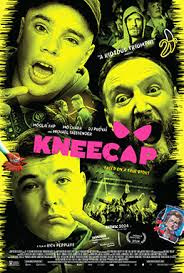
Kneecap (Ireland 2024: Dir Rich Peppiatt)

For anyone thinking that Ireland has become a quiet place after 'The Troubles', think again. The setting of Kneecap may look like the 1970s, but it's actually West Belfast in 2019. Arló Ó Cairealláin (Michael Fassbender), an IRA sympathiser, decides to do a runner when his activities draw the attention of the powers that be. Faking his death, he leaves behind his wife Dolores (Simone Kirby) who gradually falls into depression, and two young sons, played by Liam Óg Ó Hannaidh and Naoise Ó Cairealláin.

Neither lad is set for a career of academic excellence, but two things which they do well are selling (and taking) drugs, and having a penchant for writing lyrics, controversially in the Irish language (the film's legislative background is the formation of, and opposition to, what would eventually become the Identity and Language (Northern Ireland) Act 2022). 

When local music teacher and part time DJ JJ Ó Dochartaigh (who is brought in to interpret for the authorities when Liam refuses to speak English) comes across the pair's notebook, full of Irish Gaelic verse which he can convert into raps over his beats (and help his agenda to spread the word - literally - about the use of the indigenous tongue and counter British imperialism), an unlikely alliance between the three begins. The straight laced teacher, reborn as DJ Próvai (the name derives from the Provo mask he's forced to wear onstage to avoid being recognised) is thrown into a world of new experiences, chemical and musical.

Meanwhile the police, in the stern form of Josie Walker's hard nosed Detective Ellis (also, awkwardly, the mother of Liam's Protestant girlfriend, a relationship that brings its own problems), pursues her relentless enquiries as to the real story behind Ó Cairealláin's disappearance: as the trio, who name themselves 'Kneecap' after the popular skill used by the police for extracting confessions, rise to bigger heights.

The obvious jumping off point for an appreciation of Kneecap is Danny Boyle's 1996 movie Trainspotting, but I'm sure that Peppiatt would tell me to fuck off as that movie is nearly thirty years old. But in its use of fantasy sequences, candid scenes of drug use (or 'misuse' as the BBFC description would have it) and scattergun editorial approach I think the comparison still holds. Kneecap uses splitscreen, ruthless and anarchic editing and, in a scene which made me laugh out loud, claymation to replicate a Ketamine wigout. The three members of 'Kneecap' aka Móglaí Bap, Mo Chara and DJ Próvai all play themselves and there's a lot to like about their rudimentary performances and natural humour.

At times the scrappiness threatens to be the film's defining feature and there's a certain episodic quality to Kneecap which occasionally gets in the way of telling the story. But overall this is a riot of a film and Kneecap's music, unknown to this writer and, I suspect, a lot of the viewing audience, carries the whole thing through to its middle finger flipping end. It may be a drug fuelled musical rags to (sort of) riches story, but at its heart Kneecap is something a lot fiercer.

Kneecap is released in UK cinemas on 23 August.

Wednesday, 10 July 2024

Sleep aka Jam (South Korea 2023: Dir Jason Yu)

In Yu's clever and impeccably acted debut feature, successful actor Hyun-su (Lee Sun-kyun) and his heavily pregnant estate agent wife Soo-jin (Jung Yu-mi) live happily in their small apartment, eagerly awaiting their new bundle of joy.

Their life becomes disrupted when Hyun-su begins showing signs of sleep disturbance, deeply scratching his face during the night, the wounds resulting in him losing the acting role to which he aspired. Added to this their downstairs neighbour, somewhat bafflingly, complains about excess noise from the couple's flat.

Hyun-Su's symptoms get worse; Soo-jin wakes up one night to find her somnambulous husband eating raw meat, eggs and fish straight from the fridge, narrowly stopping him throwing himself out of the window. Even more horrifyingly, one morning she finds their cute little Pomeranian dog in the freezer.

While her husband seeks a medical solution for his condition, which is diagnosed as REM sleep behaviour disorder - and medicated accordingly - things don't seem to be improving. On the advice of her mother, and concerned about the potential safety of their now just born baby, Soo-jin consults a shaman, and from there a supernatural element creeps into proceedings; the battle for Hyun-Su's recovery - and indeed soul - has begun.

The genius of Sleep is its transformation from light comedy to domestic drama to, well, something a lot darker, achieved effortlessly and, for the most part, in the confines of the couple's modest apartment. Much of the credit for this is due to the perfect casting of Sun-kyun and Yu-mi; this is, essentially, a two hander requiring, by the end, a massive suspension of disbelief, which the pair effortlessly manage.

This is also a film which, in quite an extreme way, details the way in which cracks can appear in otherwise sound relationships. In other dramas the tensions here would arise from, perhaps, the change wrought by the arrival of a new baby. Sleep turns this on its head by those changes coming from an existing member of the household. Words contained on a plaque on the couple's wall remind them that, as a married couple, they are able to face problems together; but when the problem is outside of their control, watching their attempts to adhere to the message are both tragic and, on occasion, darkly humorous.

Yu's previous experience includes AD work on Bong Joon Ho's excellent 2017 movie Okja, and there's something of that director's humanity amid the fantastic - and of finding comedy in situations rather than dialogue - at work here. I look forward to seeing what he comes up with next.

Sleep is in UK cinemas from 12 July.

Tuesday, 2 July 2024

In A Violent Nature (Canada 2024: Dir Chris Nash)

The slasher genre continues to throw up examples of movies which show there's still life blood left in a format which has basically been following the same template for decades. The Terrifier franchise, the third instalment of which is due in cinemas this year, and the evergreen Scream movies - six entries in and counting - are living proof that there's still an audience - indeed a new generation - for masked killers.

But here comes Canadian Chris Nash with his debut feature, which has taken the genre in a rather different direction. On the surface the template remains unbroken; a group of young people in the woods, looking to party, get picked off one by one by a powerful, unstoppable human monster. 

But In a Violent Nature, from its obscure title to its whole mis en scene, turns the familiar on its head. The teen victims are in this case entirely background characters; IaVN front and centres its killer in a way that hasn't been attempted since Scott Glosserman's underrated 2006 movie Behind the Mask: The Rise of Leslie Vernon.

When we first meet the slasher in question, Johnny (Ry Barrett), he's rising from a woodland grave, his corpse previously kept in place by a locket which is draped over the struts of a fire tower, under which his body is contained. When the locket is purloined by one of the kids (and I'll let you watch the movie to find out why the piece of jewellery is important) Johnny is free to roam - and kill.

If you ever spent any time wondering what Jason Vorhees or Michael Myers did in the scenes when they weren't on screen in those seminal 1980s movies, IaVN kind of answers it, 'Rosencrantz and Guildenstern Are Dead' style (Tom Stoppard's 1966 play which foregrounds two minor characters in 'Hamlet'). We spend a lot of time, POV style, with the camera behind our killer as he trudges through the undergrowth, seeking out people to kill, a lonely furrow which is, amusingly, only sometimes purposeful. 

And those kills, when they come, are generally of the mind boggling, practical Terrifier type variety (in fact their extremity, bordering on the ludicrous, is possibly the only sour note in the whole thing). Far more effective, in my eyes, is a scene where Johnny disappears into a wide lake with one of the kids swimming, almost off camera, on the far side. There's an agonising delay while we wait for the inevitable; little is shown but the sheer oddness of the sequence makes it much more unsettling than the overt stuff.

Props also to the extended final girl section, almost an anticlimax, which ratchets up the tension, letting the viewer's mind do the work, and questioning our expectations about what we expect from a film like this.

IaVN has been reviewed as an arthouse horror movie, and while that's not an unfair comment, it shouldn't be dismissed by those naturally turned off by the concept of el*vated horror. Beautifully shot in academy ratio, containing the tension and the POV nature of the footage, the film eschews the traditional fright flick soundtrack usual for this sort of thing, letting nature and the sound of the woods provide the audio. Johnny's quest is slow, relentless and claustrophobic; the fact that the town authorities are aware of the threat, but powerless to do much about it, makes the film more powerful. Excellent stuff.

In a Violent Nature is released in UK cinemas on 12 July.

Saturday, 22 June 2024

"From the subterranean vaults of New York City..." 45 years on: The Cramps at the Nashville Rooms, 22 June 1979


On the evening of the 21st June 1979 I was at the Marquee in London's Wardour St, for the first of two gigs on consecutive evenings by The Human League. I'd seen 'The League' once before, at the infamous Lyceum Ballroom gig in March of the same year; notorious not because of anything the boys from Sheffield had done, but actually down to an incident involving near bottom of the bill band that evening, the legendary The Fall. The Ballroom line up was extraordinary - from Stiff Little Fingers via The Gang of Four to the South Yorkshire electro-pioneers - offering something for everybody; but it seemed that nobody wanted The Fall's cantankerous racket. 

So as the band played on, pissing off increasing numbers of the audience, a guy next to me became particularly vexed. History has probably caused my memory to do funny things, but in my recollection I recall this guy being so enraged with what was happening in front of him ("You don't love repetition") that he pushed his way to the front of the auditorium, leapt over the barriers (the Lyceum being an old school dance hall, the stage was pretty high) and slugged singer Mark E. Smith a few times. In a rather balletic (or should that be bathetic?) move - I kid you not - the guy then jumped off the stage again and landed pretty much where he'd started from. "I'm going to get the keyboard player next" he shouted to his mate (the petrified Yvonne Pawlett, who would leave the band later the same year) but didn't - contrary to some reports though, the lad involved did not get 'twatted', such was the level of indifference to The Fall. Standing next to me, witnessing the weirdness, was a woman named Jane, who returns to this story later.

I want to digress again at this point (don't worry, I'll get to The Cramps). the 21st of June was the last day of my seventeenth year. What was I like as a person at that point? Well I'd been in my first full time job for seven months, so on the one hand I was feeling quite grown up; I had money in my pocket and had been seeing bands regularly from mid 1978 onwards, so I was in one way a seasoned gig goer. But on the other hand I was really just an awkward 17 year old kid. The DIY ethos of punk rock, rather than the music itself, appealed to me, but I instead sought out the weirder end of things - Cabaret Voltaire, Throbbing Gristle, The Residents - and nightly listens to Radio 1's John Peel show provided loads of prompts for my weekly forays to the Rough Trade shop in Westbourne Park Road.

I also loved monster movies. Loved monster movies. Of course in 1979, pre streaming and a revolution in physical media - even before VHS started to serve up its roster of dubious horror titles - it was far harder to see these movies than read about them (it was also decidedly uncool to be a creature feature fan). And it was because of this that the 'idea' of the monster movie, fed by endless stills of films in books and magazines, created something in me which watching those films almost couldn't match. 

So back to 21st June, the day before my 18th birthday. The Human League were, at that point, exemplars of the 'other' music that I loved; it's hard to believe now, watching footage of their revival gigs, that the band were then considered obscure and, well, revolutionary. 'The League' had been a highlight of the March Lyceum gig (in fact I went home after their set, congratulating the chaps afterwards as they attempted to cram their not inconsiderable gear into a waiting car in The Strand) so I was looking forward to seeing them again in the more intimate setting of the Marquee.  

Unexpectedly I met someone at the gig who would be instrumental in what was to happen next. It was  Jane again: I recall her appearing rather indifferent about the prospect of seeing the electro trio (who were good, as I recall, but not great that night) and also rather surprised that I intended to return on the 22nd for their second London date. "You should come and see The Cramps," Jane remarked as we waited for the 'band' to come on stage. "I saw them when I was in New York and they're crazy. They're playing tomorrow at the Nashville [a long gone club in West Kensington, although the venue still stands]". Now I had the first two singles by The Cramps (wish I had them now; they're worth a fortune) and thought they were ok, grungy but basically rockabilly. which I wasn't really into.

But, as the next day was my 18th birthday (and without a planned party) I reasoned that I was free to do what I wanted, so I accepted her invitation, and bade farewell to 'The League'. 

The first thing I remember about the night of the 22nd was the crowd. Support came from Vermilion and the Aces (Vermilion Sands was a biker girl who worked for Illegal Records, UK distributors of The Cramps, and the Aces were former members of punk group Menace who had just lost their singer; that band would split just under a month later, As V at A went through their paces the numbers in the room increased exponentially. Jane and I did that thing where you locate yourself at the front of the stage when the venue is fairly empty, then stand your ground as it fills up, to the point where you basically can't move. That was our position when a voice over the PA announced the headliners..."From the subterranean vaults of New York City...The Cramps!" 

OK let's stop there. Three of four years after this gig I was in a car crash, in which I was a back seat passenger in an old Mini Cooper. The car was a write off (we had swerved off the road in the rain, jumped the kerb and ended up in the middle of a newly built mini roundabout) but I and my fellow passengers/driver remained largely - and amazingly - unscathed. As The Cramps began their set, with the deafening guitars winding into the opening tumult of 'Mystery Plane',  I had a foretaste of those same joint feelings of fear and elation which I'd experience years later mid flight in the Mini. I have never, before or since, experienced a band so immediately exciting. Singer Lux Interior, dressed in what I think was a dinner suit (and more on that in a bit) blessed the audience with a chicken foot dipped in white wine, and then howled into the song, bending low to the audience as he delivered the first line "My daddy drives a UFO, drops me off and then he goes" and giving us a whiff of cologne; how debonair! 

Within two songs the following had happened; firstly Lux had managed to almost completely disrobe. The Nashville stage wasn't that big and the sleight of hand involved in divesting himself of an evening suit was evidently impressive, although I don't recall those details. The second was the lights; he had trashed most of the lights at his feet, the broken shards covering the stage. Meanwhile the passive backline of Nick Knox's drums, Bryan Gregory's fuzz guitar and 'Poison' Ivy Rorschach's demented Duane Eddy riffs just kept going, song after song, as Lux hiccupped through a cover of Roy Orbison's 'Domino', then 'Weekend on Mars' and 'Garbageman'.

By this point the crush of the audience was so immense I think Lux may have tried to manage some crowd control. In any event Jane, being a little under 5 ft, was really struggling at the front of the stage; a roadie noticed this and cleanly plucked her out of the crowd, plonking her down at the side where, lucky her, she had a full view of the proceedings without the fear of being bisected.

By the time the band were coasting to a finish, via a cover of the Ronnie Dawson song 'Rockin' Bones' and the triple whammy of 'Human Fly', 'I Was a Teenage Werewolf' and 'Sunglasses After Dark', I'd got it. Witnessing the ferocity of their melding of punk/ down 'n' dirty rock and roll was itself a revelation, but it was the embracing and celebration of horror and trash, bundled up in this maelstrom of noise out of which came perfect three minute crowd pleasers, that pulled it all together for me. You could like the kinds of movies I liked, and noisy music, and knit them together. That they were not mutually exclusive was a revelation to me. It was fitting that I'd made the connection while still an actual teenager.

The Cramps went on through a number of incarnations, but always with Ivy and Lux as the core, for the next near thirty years, until the latter's tragic death in 2009 (it didn't occur to me that he would have been 33 years old when I saw him that night, not much older than my mum at the time). Over the years they' would define and refine their mix of trash and rock 'n' roll to an almost parodic degree, shaping as they went the whole 'psychotronic' movement in which, dear reader, I was a more than willing participant.

As a footnote, nearly 40 years after this event I managed to acquire a vinyl recording of the momentous evening. Horrendous though the bootleg sound is, on first spin it was quite the aural Proustian moment to hear that point in history again preserved on vinyl; remembering being stood, crushed at the front of the stage, my whole life about to change. It's a shame I can't find any photos of that gig (the one on the cover of the album is, I'm fairly sure, from another event). But also maybe that's a good thing; what's held in the mind remains a precious thing.

Wednesday, 8 May 2024

Riddle of Fire (USA 2023: Dir Weston Razooli)

Do you remember when you were young, when the summers stretched out in endless days of carefree splendour, when you and your mates plundered your collective imaginations to create play stories that you adapted and constantly changed in response to what was happening around you?

Yeah, me neither, but Weston Razooli does and in his first meandering, witty and at times almost formless feature, he brings that childish sense of wonder to our screens.

In Ribbon, Wyoming, three young people - Alice (Phoebe Ferro), Hazel (Charlie Stover) and Jodie (Skyler Peters) - going by the collective name of 'The Three Immortal Reptiles', break into a warehouse and liberate a brand new interactive video game. 

When they get it home and plug it in, they find out that the host TV has been passworded; and only Hazel and Jodie's mother (Danielle Hoetmer) knows what it is, but she's sick in bed. Mum does a deal with the kids; if they can bring her back a blueberry pie from the local store, she'll fess up with what they need.

But a simple task becomes effortlessly complicated. First the store has no pies; the baker is off sick, and a visit to her house for the recipe ends up in a quest for the ingredients, including a special egg. There's some stowing away, a trip to Magic Mountain and a run in with The Enchanted Blade Gang, led by Anna-Freya Hollyhock, an evil witch (Lio Tipton) and her daughter Petal, a forest sprite (Lorelei Mote).

The Three Immortal Reptiles
If all this sounds rather whimsical you bet it is, but the blissed out 16mm photography and the Sid and Marty Krofft style setup, not to mention fabulous performances from the three kids, make this one a real oddity. 

Granted at nearly two hours the shaggy dog story, which runs out of steam more than once, could do with a little grooming, but there's always something going on in the corners of the frame, and Ferro, Stover and Peters are fabulously natural (actually it feels like most of this was ad libbed). 

In fact Riddle of Fire has something of the feel of an early John Waters movie except that everyone keeps their clothes on and nobody licks dog shit. There's a certain knowingness that undercuts the charm here, and the inclusion of Riz Ortolani's rather out of place theme from Cannibal Holocaust supports this. 

Riddle of Fire will be released in UK cinemas on 7 June 2024.

Oh and you can play a Riddle of Fire shoot 'em up game over on Razooli's website here.

Tuesday, 7 May 2024

Founders Day (USA 2023: Dir Erik Bloomquist)

Bloomquist's previous features have included some smart takes on the horror genre, including 2020's Ten Minutes to Midnight and the following year's Night at the Eagle Inn

Founders Day is a slasher fashioned in a decidedly post Scream way, fitting right in with the most recent instalments of that franchise.

Against a political backdrop in the small fictional town of Fairwood (in reality New Milford in upstate New York), two politicians are slugging it out in the lead up to Mayoral elections and a forthcoming tricentennial. Present incumbent Blair Gladwell (Amy Hargreaves) is facing opposition from the slick Harold Faulkner (Jayce Bartok) who is worried about the impact on his reputation from his out lesbian daughter Melissa (Olivia Nikkanen) and her girlfriend - who is also black - Allison (Naomi Grace). The Montague and Capulets situation is exacerbated by Melissa's brother Adam (Devin Druid) having dated Gladwell's daughter Lilly (Emilia McCarthy)

When Melissa is attacked by a killer with a mask, her body thrown over a bridge into the fast moving river, everyone assumes that she's dead; the town responds with horror and there's a request to postpone the tricentennial celebrations. But the (political) show must go on, and as the subplots pile up, and characters reveal their collective back stories, it looks like no-one in the town is safe.

The movie wears its cynical heart very much on its sleeve; despite the attempts of the politicians to engender respect, small town life seems to revolve around petty rivalries and people being mean to other people. No one is likeable here.

The killer - sporting a Founders wig and wielding a gavel that doubles as a knife - is a threatening presence, but the overall animosity on display means that his actions become just one more nasty thing in a community of horrible people; clearly the social media trend of forcing binary opposites  - pick a side! - seems to be a significant contributor. A lollipop sucking (please!) police chief, Commissioner Peterson (Catherine Curtin) proves fairly useless as the body count rises, but in the end that's irrelevant; the killer reveal comes too quickly in the movie, ruining the pacing and making the thing about half an hour too long. 

Where Founder's Day does have something to say is in the inanity of contemporary political discourse, although its script isn't smart enough to fully exploit this, and it doesn't have the resources to convince the audience of a town in crisis, what with sparsely populated crowd scenes and a shallow plot. Rather disappointing.