Porno (USA 2019: Dir Keola Racela) Set in a bible belt suburban cinema, Racela's feature debut has nods to anything from Lamberto Bava's Demons (1985) to 1993's Last Action Hero. Set in 1992, Mr Pike, the theatre's religious boss, promises his staff that they can watch any movie they want at the end of the week after the cinema closes - it's a tough choice between the Pauly Shore flick Encino Man (which most know as California Man) and Penny Marshall's A League of Their Own - tough choice for the team.
Said team are made up of a group of Christian students: Abe (Evan Daves), Todd (Larry Saperstein), newly appointed assistant manager Chastity aka Chaz (Jillian Mueller) and Ricky (Glenn Stott). They may be devout but they have human urges, witnessed in the first scene we see Todd and Ricky spying on a couple having sex. Completing the group is manic projectionist 'heavy metal' Jeff (Robbie Tann), who has renounced smoking in return for loving God.
An interloper in the auditorium causes the staff to give chase and they end up in a previously undiscovered basement screen, where they come across an old canister of film, title-less but marked with a strange symbol. When Jeff reluctantly threads the film, what appears on screen looks like an art movie with an Italian horror soundtrack (or "European titty movie" as the projectionist describes it). The central character is a gorgeous young woman (Katelyn Pearce) who, at the climax of the ritual in which she participates on screen, manifests in the cinema; for she is a succubus, conjured by magic, and she is hellbent on phallic destruction.
Porno is an enjoyable mess of a movie. The succubus's seduction of the innocent gives rise to some interesting character revelations, and while the film is light on gore, there's one scene that will have the men in the audience crossing their legs (this one certainly did). The title suggests something stronger than is actually shown, but the mix of sex and religion is still salacious enough to raise the odd eyebrow. But the staff are a likeable bunch and even if I didn't really get much of a sense of threat from Ms Pearce, I wanted them to escape with all their bits intact.
The Ascent aka Stairs (UK 2019: Dir Tom Paton) In Eastern Europe a crack British Special Ops team called ‘The Hell Bastards’ are on a mission; to kill the members of an outpost battalion and any prisoners, gather up all the information held in the camp, and get out. They achieve this, but only after one of the team – Kia Clarke (Samantha Schnitzler, also in Paton’s last film, Black Site) - is reluctantly forced by fanatical squad leader Will Stanton (Shane Ward) to kill the battalion’s lone live captive, an ethereal woman who it is later learned is named ‘The Prophet of Death’; before she is executed she tells the group “Don’t go down!” which at the time means nothing to them.
Back at HQ for their debrief, the six members of the squad attempt to access the lift to the top floor office, but it’s out of order. So they have to take the stairs. But after walking up innumerable flights, with no sight of the floor they need to reach, they realise something is dreadfully wrong. One of their group descends to a lower floor, just as the Prophet of Death’s final words are remembered, and lets out a scream.
Seeking exit from the floor they’re on, the group go through a door which is actually a portal back to the same outpost battalion; confused, they repeat their mission but end up on the same set of stairs. The team realise that they are stuck in a time loop, and that the only way to break it is to ensure that the Prophet of Death, whose blood drenched spirit haunts them relentlessly, does not die. Which should be easy, right? But things are way more complex than that.
As you’ll have gathered from the synopsis, The Ascent takes elements from any number of ‘time on repeat’ movies where the repetition of events gives breathing space for those stuck within them to refine their actions on each cycle (think 2014’s Edge of Tomorrow and even 1993’s Groundhog Day). But Paton plays this one for the action, not the characterisation, and so little is learned about the members of the squad as they replay the mission, although we’re left in no doubt about the sheer physicality of what they’re going through, and the cliché ‘war is futile’ takes on a new meaning.
For a film on a slim budget – the two settings are a dressed field and a flight of stairs – The Ascent remains remarkably diverting. It’s brilliantly edited, and the reference by one of the team to Back to the Future 2 shows the awareness of cinematic subtext which curiously aids the enjoyment of the film. A little shorter would have been good, but that’s a minor quibble: I think this is probably Paton’s best yet.
This review first appeared on the Bloody Flicks website.
Blood & Flesh: The Reel Life & Ghastly Death of Al Adamson (USA 2019: Dir David Gregory) This is an infinitely more fulfilling documentary than Gregory's assessment of Dan Curtis, Master of Dark Shadows, which also played at FrightFest 2019. I think this is partly due to the diverse characters surrounding the late Mr Adamson being such interesting people, and also the rubbernecking lure of the schlock director's horrific demise.
In some ways Al Adamson's filmmaking story matches that of Ray Dennis Steckler, whose career I covered here and here (hey he even used future award winning cinematographers Laszlo Kovacs and Vilmos Zsigmond on his early pictures, as did Steckler). He never saw himself as a bigshot and was happy to make films which pleased the audience, often giving the stars of tomorrow an early break and providing much needed work to those that Hollywood had forgotten.
Adamson comes across as a generally well liked but idiosyncratic guy who realised, after his first dream of being a dancer in musicals failed because he basically couldn't dance, that what he really wanted to do was make movies. The sheer incoherence of many of his 32 features, which kicked off with the largely ignored 1960 western Half Way to Hell, is explained by an extended look at a film which started off as one thing and then became something else: Echo of Terror was a thriller starring singer turned actress Tacey Robbins, which morphed into Psycho-A-Go-Go after he decided to include some dancers, then Blood of Ghastly Horror with the addition of the Frankenstein monster, Dracula and veteran horror actor John Carradine (with all but a few scenes from Echo of Terror now excised). The director's unrequited obsession with his leading ladies is also documented (although Regina Carroll, who first appeared in BoGH, became his wife), as was his delight at anybody who would work with him without being paid, and his brief association with Charles Manson (so was Adamson depicted in Tarantino's Once Upon A Time...in Hollywood?)
The documentary takes a darker turn with the arrival on the scene of builder Fred Fulford, who moved into Adamson's ranch house to help redesign it and ended up living the director's life then killing him following an argument about money, and burying him under two feet of concrete in an area created by a hastily removed Jacuzzi. The rather predictable headlines of the time - that Adamson had suffered a fate straight out of the plot of one of his movies - was pretty cruel, and masked the fact that although the director had been painted as something of an oddball, nearly all of his films had made money and he was, by all accounts, a fairly wealthy man. While Adamson the man is not exactly brought back to life by his friends' accounts - most of the interviewees being industry men not given to letting their guard down - it's great to see so much love and respect given to someone whose movies have, until recently, been relegated to the cinematic dumpster.
The Deeper You Dig (USA 2019: Dir John Adams, Toby Poser) The opening credits proclaim that this is a production by The Adams family, and you better believe it. Married couple Adams and Poser wrote, directed, filmed and starred in this intense little oddity, Adams wrote the discordant soundtrack and their daughter Zelda is in it too. The perfect setup to allow for future film projects in a time of lockdown, then.
Poser is single mum Ivy, who lives deep in the snowy Catskills in upstate New York (actually Adams and Poser's home) with her daughter Echo (Zelda Adams). They have an unusual relationship: Ivy is a once successful medium who has lost her psychic mojo and now fleeces clients to keep the cash rolling in: Echo is an independent 14 year old, who lives a fairly free life, including taking her sled out alone at night. Elsewhere in town Kurt (Adams) is in a bar, and after a few drinks drives home. On the road he hits Echo, out on her sled. She's not dead but Kurt, instead of taking her to a hospital, kills her, takes her home and unceremoniously dumps her body in a bath, which is located in an abandoned property which he's slowly doing up. But Kurt remains troubled, not least because he's visited by Echo's ghost, but also feels that he hasn't hidden the body sufficiently (he first transfers it from the bathtub to a shallow grave in the woods).
Meanwhile Ivy, who is investigating Echo's disappearance, tries to reconnect with her psychic abilities; she's fairly sure that Echo is dead but wants to find out who's responsible. Little does she know that Kurt, who she gets to know as a result of those investigations, is the murderer.
The Deeper You Dig is not without problems. Towards the end things get very muddled, and the visual abstractions hint at a cinematic vision not quite matched by resources. But for the most part this intimate ghost story excels at the things it doesn't front and centre: the economic gloom in which the characters live their lives, and the fact that a small community can remain so distant from each other, underscore the more fantastical elements of the story. “All of our movies are about broken Americans, [they’re] not trying [to] get fixed, but just get by as good as they can,” commented Adams in a recent interview. And there's some striking imagery here too (the poster hints at one of them, which reminded me of some of the shots in Jordan Graham's 2019 movie Sator). All of the Adams family deliver powerful, understated performances, even if their motivations at times seem a little confused. Very good though and I'm keen to see more of their work.
True Fiction (Canada 2019: Dir Braden Croft) True Fiction is one of those movies that plot wise can't be described in any detail, suffice to mention that it's one twist after another, which I confess started to bore me after a while.
Its the story of Lea Michelle lookalike Avery Malone (Sara Garcia), a young writer who secures an interview for her dream job; personal assistant to her favourite writer Caleb Conrad (John Cassini). The role requires her to live in at his reclusive snowbound hideaway and, well, help him seek inspiration. Conrad is an author who feels that his best years are behind him and needs a certain inspiration to get his writing mojo back again.
And, through a series of tests, librarian Malone will be his muse, as she helps him by delving in to what makes her scared; having to offer up her mobile at the door should have been a giveaway. She's hooked up to a lie detector and asked if she's ever murdered anyone; "yes," she answers, immediately correcting herself. Later she's strapped into what can only be described as a gimp suit and subjected to sensory deprivation experiments; makes a change from dealing with overdue fees I suppose.
But Malone starts to question everything she sees and hears; Conrad has never been seen in public. So how does she know it's really the author she's with? Certainly his signature doesn't seem to match the one in the signed copy of one of his books that she holds onto almost talismanically. And Malone discovers that there wasn't much of a shortlist for the job - she was chosen."You're prone to paranoia, suspicion and doubt," Conrad tells her, which makes her the perfect candidate for his games.
True Fiction at times feels like borderline t*rture porn, and while she's often feisty, watching Malone go through it for the 'pleasure' of an older man feels a little unnecessary. But the biggest issue was that I struggled to see the point of the thing, and the succession of twists and turns in the last third felt contrived and ultimately unsatisfying. Not my thing really.
Why Don't You Just Die? (Russia 2018: Dir Kirill Sokolov) Matvey (Aleksandr Kuznetsov) comes to visit the parents of his girlfriend Olya (Evgeniya Kregzhde) carrying a hammer instead of the usual bunch of flowers. Inside there's no Olya but there is mum and dad, the appalling Andrey (Vitaliy Khaev) and his timid wife Tasha (Elena Shevchenko). Andrey's a cop and loves how that makes people nervous, but even he's a little rattled when Matvey tries to kill him, a struggle which sees half the apartment wrecked, and a shotgun blast which dislodges a shower of banknotes from a stolen stash. It's a brilliant combination of gore and slapstick, with a plundered Sergio Leone soundtrack as a musical backdrop, and it's one of the finest pre credit sequences I've seen for quite some time.
The rest of the movie doesn't quite match that opening, but as Why Don't You Die? unfolds enjoyably and quirkily, in a well told network of interconnecting stories that gradually reveal what's going on, with 'chapters' named after the key players. Most of the 'action' takes place in Andrey and Tasha's now ruined apartment, into which Andrey's work colleague and friend Yevgenich (Michael Gor) arrives to help his mate out with his human dilemmas; the pair's back story, involving the need for Yevgenich to get some ready cash to fund his wife's cancer treatment, is yet another narrative thread running through the film.
This is fast and frantic stuff, more amusing than laugh out loud funny (although some exposition regarding handcuff technology made me smile) and there's a Coen-esque feel to the thing, full of odd characters that are not without charm despite their flaws. Why Don't You Just Die? is at its heart a story of a dysfunctional family, but it's smart and well done, even if it does drag a bit towards the end, mainly down to its limited setup, rather than its persistent energy.
Showing posts with label FrightFest 2019. Show all posts
Tuesday, 16 June 2020
Films from FrightFest #9: Reviews of Porno (USA 2019), The Ascent aka Stairs (UK 2019) NEW WAVE OF THE BRITISH FANTASTIC FILM 2020, Blood & Flesh: The Reel Life & Ghastly Death of Al Adamson (USA 2019), The Deeper You Dig (USA 2019), True Fiction (Canada 2019) and Why Don't You Just Die? (Russia 2018)
Wednesday, 13 May 2020
Films From FrightFest 2019 #8: Reviews of The Sonata (France/UK/Russia/Latvia 2018), Eat Brains Love (USA 2019), Dark Light (USA 2019), Sadistic Intentions (USA 2018), The Wretched (USA 2019) and The Perished (Ireland 2019)
It's touch and go whether FrightFest will take place this year, but no matter, because I'm still catching up on the films that played at last year's festival. A mixed bag this time round, and I'd have been disappointed if I'd chosen to get a ticket for most of them.
The Sonata (France/UK/Russia/Latvia 2018: Dir Andrew Desmond) If indeed the devil has all the finest tunes, you can also use them to summon him. That's the premise in this very gothic confection with a big dollop of Euro pudding.
Talented violinist Freya Tingley (Rose Fisher) inherits a rambling turreted mansion in France, on the death of her long lost composer father Richard Marlowe (Rutger Hauer) who, we see in a prologue, has expired by setting fire to himself. Her brusque manager Charles (Simon Abkarian), who's clearly a wrong 'un, is keen to maintain his preofessional attachment to Rose, who feels that she's outgrown him.
When Rose installs herself in the mansion, she discovers the sheet music for a sonata, her father's last work, presumed unfinished. The music is punctuated with red symbols, hinting at some arcane code. Are they there to stop the music performed or do they serve a more dangerous purpose? As Rose and Charles gradually solve the clues to the symbols on the score, she learns of their origin: a sect who believed that some pieces of music are able to open the portal to other worlds, and even communicate with the Antichrist, and of the horrors that her father perpetrated in service of the devil's music.
The almost otherwordly Latvian locations of Desmond's debut feature do much to give the film a fairytale feel, and it's probably the best way to view the movie. Its quaint, vaguely Lovecraftian plot, sequences of our tortured heroine descending stone staircases in a diaphanous nightgown, ghost children and disconcerting dream sequences all place The Sonata in the category of old school gothic horror, heightened by Alexis Maingaud's lush score, all rising strings and trilling flutes. To be fair there's not much to this, but the style over substance accusation is abated by the trickiness of the clues, some nasty although not overdone touches, a rousing finale and a running time that doesn't outstay its welcome.
Eat Brains Love (USA 2019: Dir Rodman Flender) A peppy zom-rom-com, underneath the gore and the gags this is a rather old fashioned - and faintly sexist - tale of a guy torn between brains and beauty (the cinematic take on this being that both are beautiful in different ways), although one's a psychic and the other's a zombie.
A flashback-y introduction has Jake (Jake Cannavale), a no hope student, making the unlikeliest of couples with cheerleader Amanda (Angelique Riviera). The reason? There's been a zombie outbreak, and both have been bitten, respectively by regrettable sexual partners, the transference of the virus being linked to, well, sex. Jake can't believe his luck that the class hottie has finally acknowledged him, even if their friendship has been achieved by chowing down on the rest of their class.
And now Jake and Amanda are on the run, being tracked down by representatives from a government agency (who call the infected 'necros'), including a trained psychic, Ripley-from-Alien-a-like Cass (Sarah Yarkin), who is able to project herself into other's minds. After spending some time in Jake's, a form of attraction begins, at the same time as Cass begins to question the motives of her boss. Of course the pair have to eat and, in one of the film's funnier plot points, map out their meals by using a guide which plots the locations of people who have fallen foul of the law.
In true modern comedy horror style the gags in Eat Brains Love come thick and fast; most raise a wry smile but rarely a belly laugh. As well as the rather outmoded two gals and one guy scenario, there are also a couple of lesbian characters who are written from a (jock) male perspective, and after a while I began to think this felt like a zombie version of 1978's Lemon Popsicle, and missed the smarts of something like either of the Zombieland movies.
Eat Brains Love would probably work better as a crowd movie than a lone viewing experience (which is how I watched it); its gory set pieces are perfect for a beer and popcorn audience. At times it zips along but for large parts the movie feels a bit baggy, with smart lines and little else. OK but overfamiliar fare.
Dark Light (USA 2019: Dir Padraig Reynolds) Annie (Jessica Madsen) retreats to her late mother's house amid the flat cornfields of mid America, to escape a failing marriage. With her is daughter Emily (Opal Littleton). It's the house in which Annie grew up, but the peace is only temporary: husband Paul turns up (Ed Brody) to remind Annie that it was her poor mental health that led him to have an extra marital affair: "I'm sorry you're back here again," he tells her.
But Annie's anxieties seem to have a physical form, in the shape of a figure - or figures - glimpsed in the house and the cornfields. She ropes in the local sheriff (Kristina Clifford) who is as disbelieving of the perceived threat as her husband.
But, as we have seen in the film's prologue, the danger is real, and has kidnapped her daughter. Annie, under threat, mistakenly shoots her husband and is arrested for the crime. She is taken into custody but manages to escape when the police van in which she is being transported crashes. Annie must then face down her inner demons, and the exterior ones too, to get her daughter back.
Dark Light plays like an extended episode of The X Files, and the explanation for the figures - indigenous life forms driven into hiding - struggles to make a political point but really becomes just another creature feature with a lot of wandering around, flashlights shining in the darkness. Admittedly the rather strange creature designs are effective when glimpsed sparingly, but their impact fades with overexposure; they're still men in suits with TV screens for heads.
Reynolds has a track record of making low budget horror films which attempt something higher than their premise, and Dark Light is more of the same; explanations are in short supply and characters are sketched in rather than fully formed. Ultimately this is a bit of a trudge, and some last reel excitement can't really compensate for the rather pedestrian nature of the bulk of the film.
Sadistic Intentions (USA 2018: Dir Eric Pennycoff) Pennycoff's first feature is a real mixed bag, partly explained by the fact that the script changed completely after the actors had been cast and the single location was found.
Chloe (Taylor Zaudtke) and Stu (Jeremy Gardner), both unknown to each other, are separately invited to meet up with Kevin (Michael Patrick Nicholson), who is respectively Chloe's dealer and Stu's fellow death metal band member. We already know from a rather confusing opening scene that Kevin has blood on his hands - seemingly the slaughter of an entire family (his own? We probably do need to talk about Kevin then) - so when the pair show up at the house, it's surprising that Kevin isn't home. Or is he?
Chloe and Stu gradually get to know each other, and a growing friendship blossoms, fuelled by Chloe's weed consumption. Stu remains the rather taciturn band member. He plays a full-on track by his group, called 'Morbid Annihilator', but feels that their music is just not extreme enough: Chloe counters this by choosing some of her favourite soft rock off the internet, and asks Stu to dance ("I'd rather die in a fucking house fire," he responds), but shows some signs of thawing when Stu invites Chloe into the garden for some death metal screaming (intentionally or not this scene reminded me of Liza Minnelli and Michael York under the railway arches in 1972's Cabaret).
But around half way through the movie the whole thing gets turned on its head when Kevin arrives: the slaughter we saw at the beginning of the movie was real, and Stu's mate is now a fully fledged psychopath, who feels that their latest recording session could be significantly pepped up with some more human sacrifice.
In interviews both Pennycoff and his stars want the audience's takeaway from their film to be an investment in the characters. And while it's true that the director spends some time fleshing out Chloe and Stu's stories, in the accurately faltering way of an opposites attract couple getting to know each other for the first time, that doesn't count for much when those same characters start acting contra to what we expect in the rather draggy second half.
Sadistic Intentions is probably best seen as a three hander extended ode to how rubbish men are; for different reasons Stu and Kevin are not keepers. It has its moments, but the thriller/ horror movie elements come off like a luke warm rehash of the last couple of reels of Scream (1996), and not very successfully.
The Wretched (USA 2019: Dir Brett Pierce, Drew T. Pierce) On the surface The Wretched could be seen as just another YA folk-horroresque fright flick. Its central character is a young guy, Ben (John-Paul Howard), who arrives to spend the summer working at dad's marina. His parents are separated, and Ben's been getting into a little trouble back home (his arm is in a cast as the result of a little breaking and entering). It's hoped some time with dad will put him right.
But any hope of a reconciliation between the parents now seems unlikely, as dad Liam (Jamison Jones) has met a new woman, Sara (Azie Tesfai), to whom Ben does not warm. Ben too meets someone, the rather sweet and down to earth Mallory (Piper Curda) but louses that up at a party when first he gets caught with someone else and then throws up all over her.
But when a family move into the holiday rental next door to Liam's home, Ben begins to suspect things aren't right. The mum of the family, Abbie (Zarah Mahler), brings roadkill deer home and guts it. Later a strange figure emerges from the deer's body - has it been hiding there? And when Ben comes home one day to find the Abbie's son hiding in his house, scared of his mother, he decides to investigate further.
So far, so PG-13. And while The Wretched isn't loaded with gore, it doesn't need to be. There is a real sense of unease created by the odd goings on circling around Ben. And the heart of the movie - the story of the dark mother, 'born from rock, root and tree' who 'feasts on the forgotten' - is genuinely unsettling: an entity who has the ability to make people forget their loved ones is a subtle take on the usual 'being in the woods' story. This adds a supernatural twist to what would otherwise seem like normal events. Who can say whether Liam's careful folding of a family photograph to exclude his wife is simply moving on with his own, or something more sinister? It's quite an Invasion of the Bodysnatchers approach to things, and works effectively for the same reason; normal people acting in a way that seems normal and yet...isn't. There's also an off 1980s feel to the whole thing: while the prologue is set 35 years previously, time doesn't seem to have moved on much in that part of the woods. The Wretched is an excellent little film, well acted and effective in subverting viewers' expectations. It's well worth 90 minutes of your time.
The Perished (Ireland 2019: Dir Paddy Murphy) The haunted history of Ireland's Magdalene laundries - hostels for unmarried mothers and their children which functioned as little more than workhouses, and where the women's children often met early deaths, possibly at the hands of the people running the institutions - permeates writer/director Murphy's brooding and grim latest feature.
Sarah (Courtney McKeon, excellent) falls pregnant by her boyfriend Shane (Fiach Kunz) but before she can tell him, he breaks up with her. Unable to obtain an abortion in Ireland, she flees the tyranny of her religious mother Elaine (Noelle Clarke) and supportive but downtrodden father Richard (Conor Lambert) and travels to England to undergo the procedure.
Returning to Ireland she holes up with her best friend, gay Davet (Paul Fitzgerald) in his parents' large house. But Sarah, who hasn't always been the strongest of people - as evidenced by Shane's sister Rebecca (Lisa Tyrell) reminding him of Sarah's examples of flakiness - is clearly incapacitated by guilt over the abortion, even though she knew she had no choice, and failing to discuss the issue with Shane first.
But what Sarah doesn't know is that the property in which she's staying was formerly a Magdalene house, and the spirits of the dead children - embodied in a strange stripped-flesh half human creature, initially crying in the darkness but then emerging from the shadows - want to reach out to Sarah.
While by no means perfect, what I admired about The Perished was, firstly, that it refused to become just another creature feature. The drama of the film's first two thirds is not sacrificed for a final reel gross out. The second thing is the ambiguity of the piece. Other films on the same subject have located themselves in the past, as if almost to say that history couldn't repeat itself. But in the very believable character of Sarah's mother Elaine is the contemporary reality of the use of religious judgement in a harmful way. It's also a film which doesn't show Sarah to be without fault: someone who, despite making her own choices, is left with guilt for what she's done. The 'monster' element was for me the least persuasive thing in the film - I would have preferred the 'haunting' to be more inferred than made explicit. But this is bold stuff, tense, generally well acted, and very, very sad.
The Sonata (France/UK/Russia/Latvia 2018: Dir Andrew Desmond) If indeed the devil has all the finest tunes, you can also use them to summon him. That's the premise in this very gothic confection with a big dollop of Euro pudding.
Talented violinist Freya Tingley (Rose Fisher) inherits a rambling turreted mansion in France, on the death of her long lost composer father Richard Marlowe (Rutger Hauer) who, we see in a prologue, has expired by setting fire to himself. Her brusque manager Charles (Simon Abkarian), who's clearly a wrong 'un, is keen to maintain his preofessional attachment to Rose, who feels that she's outgrown him.
When Rose installs herself in the mansion, she discovers the sheet music for a sonata, her father's last work, presumed unfinished. The music is punctuated with red symbols, hinting at some arcane code. Are they there to stop the music performed or do they serve a more dangerous purpose? As Rose and Charles gradually solve the clues to the symbols on the score, she learns of their origin: a sect who believed that some pieces of music are able to open the portal to other worlds, and even communicate with the Antichrist, and of the horrors that her father perpetrated in service of the devil's music.
The almost otherwordly Latvian locations of Desmond's debut feature do much to give the film a fairytale feel, and it's probably the best way to view the movie. Its quaint, vaguely Lovecraftian plot, sequences of our tortured heroine descending stone staircases in a diaphanous nightgown, ghost children and disconcerting dream sequences all place The Sonata in the category of old school gothic horror, heightened by Alexis Maingaud's lush score, all rising strings and trilling flutes. To be fair there's not much to this, but the style over substance accusation is abated by the trickiness of the clues, some nasty although not overdone touches, a rousing finale and a running time that doesn't outstay its welcome.
Eat Brains Love (USA 2019: Dir Rodman Flender) A peppy zom-rom-com, underneath the gore and the gags this is a rather old fashioned - and faintly sexist - tale of a guy torn between brains and beauty (the cinematic take on this being that both are beautiful in different ways), although one's a psychic and the other's a zombie.
A flashback-y introduction has Jake (Jake Cannavale), a no hope student, making the unlikeliest of couples with cheerleader Amanda (Angelique Riviera). The reason? There's been a zombie outbreak, and both have been bitten, respectively by regrettable sexual partners, the transference of the virus being linked to, well, sex. Jake can't believe his luck that the class hottie has finally acknowledged him, even if their friendship has been achieved by chowing down on the rest of their class.
And now Jake and Amanda are on the run, being tracked down by representatives from a government agency (who call the infected 'necros'), including a trained psychic, Ripley-from-Alien-a-like Cass (Sarah Yarkin), who is able to project herself into other's minds. After spending some time in Jake's, a form of attraction begins, at the same time as Cass begins to question the motives of her boss. Of course the pair have to eat and, in one of the film's funnier plot points, map out their meals by using a guide which plots the locations of people who have fallen foul of the law.
In true modern comedy horror style the gags in Eat Brains Love come thick and fast; most raise a wry smile but rarely a belly laugh. As well as the rather outmoded two gals and one guy scenario, there are also a couple of lesbian characters who are written from a (jock) male perspective, and after a while I began to think this felt like a zombie version of 1978's Lemon Popsicle, and missed the smarts of something like either of the Zombieland movies.
Eat Brains Love would probably work better as a crowd movie than a lone viewing experience (which is how I watched it); its gory set pieces are perfect for a beer and popcorn audience. At times it zips along but for large parts the movie feels a bit baggy, with smart lines and little else. OK but overfamiliar fare.
Dark Light (USA 2019: Dir Padraig Reynolds) Annie (Jessica Madsen) retreats to her late mother's house amid the flat cornfields of mid America, to escape a failing marriage. With her is daughter Emily (Opal Littleton). It's the house in which Annie grew up, but the peace is only temporary: husband Paul turns up (Ed Brody) to remind Annie that it was her poor mental health that led him to have an extra marital affair: "I'm sorry you're back here again," he tells her.
But Annie's anxieties seem to have a physical form, in the shape of a figure - or figures - glimpsed in the house and the cornfields. She ropes in the local sheriff (Kristina Clifford) who is as disbelieving of the perceived threat as her husband.
But, as we have seen in the film's prologue, the danger is real, and has kidnapped her daughter. Annie, under threat, mistakenly shoots her husband and is arrested for the crime. She is taken into custody but manages to escape when the police van in which she is being transported crashes. Annie must then face down her inner demons, and the exterior ones too, to get her daughter back.
Dark Light plays like an extended episode of The X Files, and the explanation for the figures - indigenous life forms driven into hiding - struggles to make a political point but really becomes just another creature feature with a lot of wandering around, flashlights shining in the darkness. Admittedly the rather strange creature designs are effective when glimpsed sparingly, but their impact fades with overexposure; they're still men in suits with TV screens for heads.
Reynolds has a track record of making low budget horror films which attempt something higher than their premise, and Dark Light is more of the same; explanations are in short supply and characters are sketched in rather than fully formed. Ultimately this is a bit of a trudge, and some last reel excitement can't really compensate for the rather pedestrian nature of the bulk of the film.
Sadistic Intentions (USA 2018: Dir Eric Pennycoff) Pennycoff's first feature is a real mixed bag, partly explained by the fact that the script changed completely after the actors had been cast and the single location was found.
Chloe (Taylor Zaudtke) and Stu (Jeremy Gardner), both unknown to each other, are separately invited to meet up with Kevin (Michael Patrick Nicholson), who is respectively Chloe's dealer and Stu's fellow death metal band member. We already know from a rather confusing opening scene that Kevin has blood on his hands - seemingly the slaughter of an entire family (his own? We probably do need to talk about Kevin then) - so when the pair show up at the house, it's surprising that Kevin isn't home. Or is he?
Chloe and Stu gradually get to know each other, and a growing friendship blossoms, fuelled by Chloe's weed consumption. Stu remains the rather taciturn band member. He plays a full-on track by his group, called 'Morbid Annihilator', but feels that their music is just not extreme enough: Chloe counters this by choosing some of her favourite soft rock off the internet, and asks Stu to dance ("I'd rather die in a fucking house fire," he responds), but shows some signs of thawing when Stu invites Chloe into the garden for some death metal screaming (intentionally or not this scene reminded me of Liza Minnelli and Michael York under the railway arches in 1972's Cabaret).
But around half way through the movie the whole thing gets turned on its head when Kevin arrives: the slaughter we saw at the beginning of the movie was real, and Stu's mate is now a fully fledged psychopath, who feels that their latest recording session could be significantly pepped up with some more human sacrifice.
In interviews both Pennycoff and his stars want the audience's takeaway from their film to be an investment in the characters. And while it's true that the director spends some time fleshing out Chloe and Stu's stories, in the accurately faltering way of an opposites attract couple getting to know each other for the first time, that doesn't count for much when those same characters start acting contra to what we expect in the rather draggy second half.
Sadistic Intentions is probably best seen as a three hander extended ode to how rubbish men are; for different reasons Stu and Kevin are not keepers. It has its moments, but the thriller/ horror movie elements come off like a luke warm rehash of the last couple of reels of Scream (1996), and not very successfully.
The Wretched (USA 2019: Dir Brett Pierce, Drew T. Pierce) On the surface The Wretched could be seen as just another YA folk-horroresque fright flick. Its central character is a young guy, Ben (John-Paul Howard), who arrives to spend the summer working at dad's marina. His parents are separated, and Ben's been getting into a little trouble back home (his arm is in a cast as the result of a little breaking and entering). It's hoped some time with dad will put him right.
But any hope of a reconciliation between the parents now seems unlikely, as dad Liam (Jamison Jones) has met a new woman, Sara (Azie Tesfai), to whom Ben does not warm. Ben too meets someone, the rather sweet and down to earth Mallory (Piper Curda) but louses that up at a party when first he gets caught with someone else and then throws up all over her.
But when a family move into the holiday rental next door to Liam's home, Ben begins to suspect things aren't right. The mum of the family, Abbie (Zarah Mahler), brings roadkill deer home and guts it. Later a strange figure emerges from the deer's body - has it been hiding there? And when Ben comes home one day to find the Abbie's son hiding in his house, scared of his mother, he decides to investigate further.
So far, so PG-13. And while The Wretched isn't loaded with gore, it doesn't need to be. There is a real sense of unease created by the odd goings on circling around Ben. And the heart of the movie - the story of the dark mother, 'born from rock, root and tree' who 'feasts on the forgotten' - is genuinely unsettling: an entity who has the ability to make people forget their loved ones is a subtle take on the usual 'being in the woods' story. This adds a supernatural twist to what would otherwise seem like normal events. Who can say whether Liam's careful folding of a family photograph to exclude his wife is simply moving on with his own, or something more sinister? It's quite an Invasion of the Bodysnatchers approach to things, and works effectively for the same reason; normal people acting in a way that seems normal and yet...isn't. There's also an off 1980s feel to the whole thing: while the prologue is set 35 years previously, time doesn't seem to have moved on much in that part of the woods. The Wretched is an excellent little film, well acted and effective in subverting viewers' expectations. It's well worth 90 minutes of your time.
The Perished (Ireland 2019: Dir Paddy Murphy) The haunted history of Ireland's Magdalene laundries - hostels for unmarried mothers and their children which functioned as little more than workhouses, and where the women's children often met early deaths, possibly at the hands of the people running the institutions - permeates writer/director Murphy's brooding and grim latest feature.
Sarah (Courtney McKeon, excellent) falls pregnant by her boyfriend Shane (Fiach Kunz) but before she can tell him, he breaks up with her. Unable to obtain an abortion in Ireland, she flees the tyranny of her religious mother Elaine (Noelle Clarke) and supportive but downtrodden father Richard (Conor Lambert) and travels to England to undergo the procedure.
Returning to Ireland she holes up with her best friend, gay Davet (Paul Fitzgerald) in his parents' large house. But Sarah, who hasn't always been the strongest of people - as evidenced by Shane's sister Rebecca (Lisa Tyrell) reminding him of Sarah's examples of flakiness - is clearly incapacitated by guilt over the abortion, even though she knew she had no choice, and failing to discuss the issue with Shane first.
But what Sarah doesn't know is that the property in which she's staying was formerly a Magdalene house, and the spirits of the dead children - embodied in a strange stripped-flesh half human creature, initially crying in the darkness but then emerging from the shadows - want to reach out to Sarah.
While by no means perfect, what I admired about The Perished was, firstly, that it refused to become just another creature feature. The drama of the film's first two thirds is not sacrificed for a final reel gross out. The second thing is the ambiguity of the piece. Other films on the same subject have located themselves in the past, as if almost to say that history couldn't repeat itself. But in the very believable character of Sarah's mother Elaine is the contemporary reality of the use of religious judgement in a harmful way. It's also a film which doesn't show Sarah to be without fault: someone who, despite making her own choices, is left with guilt for what she's done. The 'monster' element was for me the least persuasive thing in the film - I would have preferred the 'haunting' to be more inferred than made explicit. But this is bold stuff, tense, generally well acted, and very, very sad.
Friday, 3 January 2020
Films from FrightFest 2019 #6: Reviews of Red Letter Day (Canada 2019), Bloodline (USA 2018), A Serial Killer's Guide to Life (UK 2019), Harpoon (Canada 2019), Mary (USA 2019) and Stalked (UK 2019)
Help! I'm still stuck in FrightFest! The doors are bolted and the only thing to eat is popcorn, but I do at least have the benefit of not having to sit next to anyone. And I get to watch even more Festival films.
Red Letter Day (Canada 2019: Dir Cameron Macgowan) The Purge movies, or more accurately the first instalment in that franchise, is the obvious influence for this satire of small town Canadian citizenry breaking down.
Divorced mum Melanie (Dawn Van de Schoot) has just moved into Aspen Ridge, a development of new cookie cutter homes, with her son Tim (Kaeleb Zain Gartner) and late teenage daughter Madison (Hailey Foss) who is, against mum's wishes, dating an older guy, Luther (Roger Le Blanc). Someone has been delivering mysterious letters in red envelopes to the development's homes, the contents of which all identify a different person in the neighbourhood with an exhortation for the receiver to kill them.
Melanie's contains a photo of her friend Alice (Arielle Rombough), to whom she decides to pay a visit to discuss the letters, leaving her kids home alone; unbeknownst to her, Tim has sneaked a carving knife into mum's bag, just in case. While Melanie manages to assure her friend that she harbours no murderous intentions, Alice's husband Lewis (Michael Tan), already no big fan of Melanie, discovers the hidden knife and assumes the worst. A fight ensues which demonstrates the key theme of the film - that civilised society can break down incredibly swiftly - and Lewis ends up with a knife in the neck. Meanwhile Tim's pursuer has arrived at the house.
From here on in Red Letter Day ups a gear into full on Purge territory, as people act on the letters' invitations and seek out their targets; there's also some sinister social media people wearing masks who may be orchestrating things (they're not - the culprit is far more prosaic). But those movies handled a problematic premise - would people really descend into anarchy and murder that quickly? - far more believably. And despite a very credible performance from Van de Schoot and the bizarre location (a new homes community seemingly in the middle of absolutely nowhere) Macgowan's first feature tests the patience despite its slim hour and a quarter running time. The satire isn't original and falls very flat, and the set piece action is all rather clumsy.
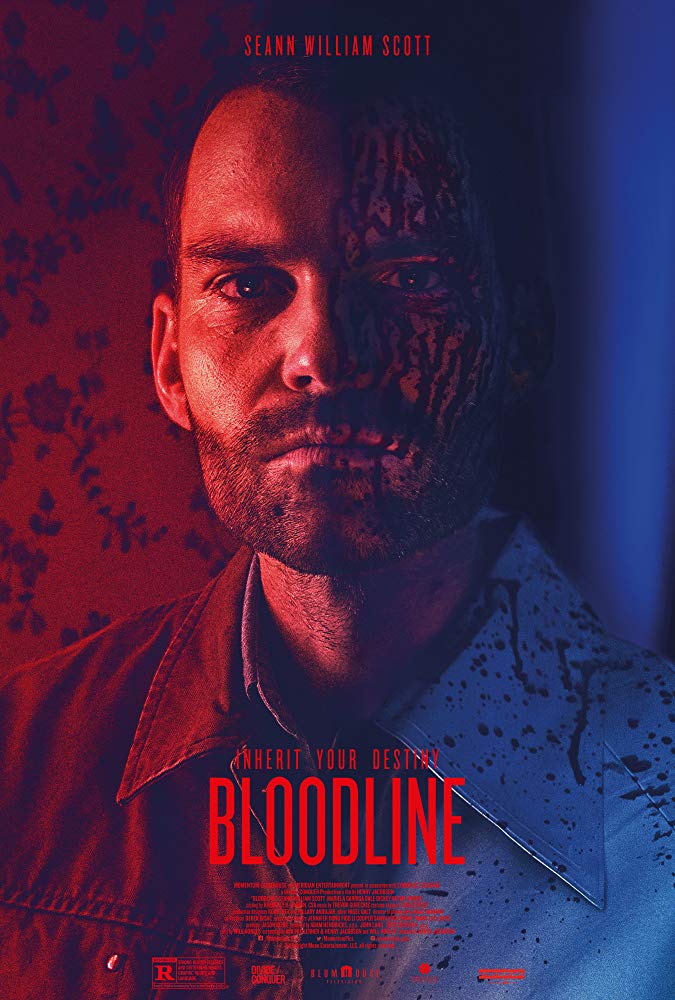
Bloodline (USA 2018: Dir Henry Jacobson) There's more than a whiff of the TV show Dexter in this ice cool study of psychopaths who keep it in the family, which concentrates on troubled new dad Evan (Seann William Scott) struggling to do the best for his new baby and his 'delicate' wife Lauren (Mariela Garriga).
Evan has grown up in an abusive household, his father violent and his mother over controlling (there's a faint suggestion of incest here too). In the film's prologue we see a nurse being knifed to death in the showers at work. The rest of the film takes place three months earlier (this plot approach is now as familiar as the omnipresent drone shot). Evan's attendance at the 'business end' of his wife's birth triggers flashbacks of people being killed, and we see the new parents struggle with their bundle of joy, a situation not considerably assisted by the arrival on scene of Evan's clingy mother Marie (Dale Dickey). Evan's a killer alright, but we learn that he focuses his murderous tendencies only on those who 'deserve' it. In his day job as a high school counsellor all those who seek him out have a story to tell, usually involving deadbeat dads being violent towards them. Using his role to give him access to information about the parents, Evan seeks them out late at night, using an empty housing estate as his killing room, and dumping their bodies in makeshift graves.
But this concentration of his victim selection is a little shortsighted, as it's not long before the police make a connection between the deaths. And the nurse we saw in the prologue? Well she's not so innocent, being the member of staff on duty after the birth, whose caustic tongue belittles Lauren's already limited confidence as a new mother. But is Evan the only murderer in town?
While Bloodline does fall apart a little in the last third - it sort of runs out of steam and the ending does it no favours - for the most part Jacobson's debut feature is a bone dry, darkly humorous study of a killing family - is Evan a natural born killer or, wait for it, a nurtural one? Superb performances from Seann William Scott - whose grin is a very sinister thing - and Dale Dickey as Evan's quite 'off' mum make this film. It's very watchable, and at times convincingly gory. I liked it a lot.
A Serial Killer's Guide to Life (UK 2019: Dir Staten Cousins-Roe) NEW WAVE OF THE BRITISH HORROR FILM 2020 Staten Cousins Roe’s debut feature is a kind of Nietzschean study of the self, filtered through Ben Wheatley’s Sightseers, in which we meet eternally drab Lou (Katie Brayben), a young woman who is the unofficial carer for her domineering mother. Lou is addicted to self help books, including those by Tony Robbins-a-like Chuck Knoah (Ben Lloyd-Hughes), although there are no signs yet of any self-improvement going on: but a mood board in her bedroom tells us that Lou desires a life beyond the four walls of her home.
While watching a flared trousered motivational speaker she meets icy Val (Poppy Roe), herself a self help guru, but with a difference: Val is also a serial killer. After a brief meeting/grooming session, Lou takes the drastic step of agreeing to accompany her new life coach on a road trip to meet Chuck Knoah in person. Lou abandons her mother and the pair take off. On the way to Knoah’s country retreat they encounter a succession of dodgy therapists, including an outward bound tree hugger and a couple using sound as their way back to health, who spike their drinks and get the dildos out.
Lou is rather slow to pick up on the fact that before they move on from each therapist Val (rather bloodlessly as it happens – it’s not that kind of film) despatches them, and the pair soon become the subject of a (wo)man hunt across the south coast area, as they move closer and closer to the self-important Knoah, who it seems isn’t quite the confident self-improver he makes himself out to be.
A Serial Killer’s Guide to Life is an uncompromising film that offers laughs when you feel you shouldn't be, with some killer one liners (pun very intended); set in a world of static caravans and the quiet beauty of the south coast of England (it was filmed in the hinterlands of Brighton) it has a decidedly 'off' charm. But as in any film where content is slender, it’s all about the performances really. As Val Poppy Rose remains staunchly one note in her performance, and if the audience were expecting Lou’s caterpillar to emerge as a self-discovered butterfly, well the director isn’t about to do that. What he does is to take the spirit of Thelma & Louise in capturing the freedom and nihilism of the girls’ trip. There may only be one way out for them, but they’re enjoying the ride on the way.
Harpoon (Canada 2019: Dir Rob Grant) In Rob Grant's aquatic chamber piece we're thrown in with three friends and an unnamed (and unseen) narrator, on board a boat. Munro Chambers is Jonah, a guy who, when we meet him, is trying to make ends meet after his parents have both died penniless and in debt. Along comes Christopher Gray as Richard (that name will be important later), a chap with full on anger management issues, intent on bashing several shades out of Jonah for - as he supposes - fooling around with his girlfriend Sasha (Emily Tyra). Luckily it seems that it was all a misunderstanding, and the three head off in Richard's boat to patch it all up, together with Rich's harpoon, a present from Sasha.
But what starts out as a reasonable pleasant afternoon trip turns into a nightmare when the trio find themselves snarking at each other again, and before we know it Jonah has a harpoon sized hole in his hand, and the boat has conked out and drifted into unknown waters with few provisions on board. With no hope of recovery, and Jonah's wound beginning to infect his arm, Richard mentions the story of his namesake, Richard Parker - a young shipboy in the 19th century sacrificed as food while adrift to feed two other sailors (the lot of the unfortunate decided by the drawing of straws) - and suggests they do the same.
This largely one set three hander draws on the hopeless waterlogged scenarios of Open Water (2003) and Adrift (2018), and the claustrophobia of Knife in the Water (1962) and Dead Calm (1989). Its cross and double cross plot makes the most of a limited setup, and the 'Richard Parker' story element lends a frisson of repeating history to the proceedings. Harpoon is graced with three strong central performances (it would be fairly tedious if that wasn't the case) and the narrator's voice and inter title cards hint that the whole thing could be read as one big morality play. It's quite fun while it lasts and some of the gore scenes (surgery by broken bottle neck, anyone?) had this reviewer's toes curling.
Mary (USA 2019: Dir Michael Goi) Goi has been around for a while but most of his directorial output in the last decade has been TV based (his last feature was the controversial 2011 found footage movie Megan is Missing concerning child abduction). Mary front and centres two A list-ish stars (Gary Oldman and Emily Mortimer) and dumps them into a well made but pretty trashy B movie about a haunted boat.
Oldman is David Green, a yachtsman keen to own his own rig. He's patching up his life after his wife Sarah (Mortimer) had an affair, and hopes that a boat trip with his family, which also includes teenage daughter Lindsey (Stefanie Scott) and her younger sister Mary (Chloe Perrin), will achieve this. At a boat auction Green ignores all the classier vessels in favour of a beaten up yacht. The family are appalled at the fixer upper he's purchased, but after a bit of elbow grease and the name 'Mary' applied to the craft to honour his daughter, the family, together with Lindsey's slacker boyfriend Tommy (Owen Teague) and David's first mate Mike (Manual Garcia-Rulfo) set sail; destination? The Bermuda Triangle.
Told in flashback from inside a Florida police station where Sarah and her kids are the only survivors, it's pretty obvious from the start that this is one trip nobody should have taken. and when Sarah explains to the rather incredulous agent carrying out the interview that "evil needs a body to exist, and the body was a boat", we know we're in the realms of the silly. For it appears that the craft has some history: previous crews of 'Mary' have all gone missing, and each time the boat has been chartered in the past it always ends up in the same Bermuda location, one where something awful has occurred. While Mary is full of the usual cliches (possessed crew members, watery footprints, lank haired spirits, that sort of thing) it's refreshing that the central characters are adults rather than teens for a change, and also that Mortimer's character doesn't succumb to the usual emotional distress that we're used to seeing in films like this; she's a tough cookie desparate to remain practical through the supernatural hi-jinx, and to convince her husband that she's back on track fidelity-wise. Goi should be thanked for not reducing the conclusion to a CGI fest (although he may have done if he had a bigger budget) and for only giving us glimpses of the creature haunting the boat. "The thing about boats is that there's nowhere to run" explains Mortimer at one point; but while Oldman and Mortimer give it all they've got in generating the claustrophobic tension needed, their classy turns can't disguise the essentially thinness of the whole thing. Nevertheless Mary remains a bit of a guilty pleasure.
Stalked (UK 2019: Dir Justin Edgar) A remarkably well constructed and tense thriller shot on a micro budget that conjures something out of, well, not much at all really. Stalked is the story of marine commando Sam (Rebecca Rogers); single mum with a feckless ex, landed with a sick child, she leaves the baby home alone while making a dash to the chemist. Only to find herself abducted and imprisoned in a factory that turns out to be home to Epsilon Military Solutions.
The twist here is that her abducter is wearing a stealth suit, making him invisible to her unless she catches him on CCTV or her phone. Sam isn't the first person to be kidnapped by the (near) invisible man; she runs into others who are also trying to escape, none of them very successfully.
Most of Stalked is a cat and mouse between the resourceful, ultra limber Sam ( a very visceral performance by Rogers, particularly effective when she has to act against someone invisible) and her pursuer. Oh and a drone; we haven't had many killer drones before and then two come along at once (FrightFest's other murderous drone flick being, er, The Drone). The effects are a little shonky but that's what you get on a low budget and the now you see him, now you don't appearance of the guy in the stealth suit remains rather unbelievable. But it's mastefully edited considering it's mainly one woman running around something that looks more like the packing area in your local B&Q, and mask any inconsistencies well. It's not going to bother anyone's memories of similar setups in Predator (1987) or a myriad 'Invisible Man' movies, but Stalked is effective, not overlong, and gets the job done.
Red Letter Day (Canada 2019: Dir Cameron Macgowan) The Purge movies, or more accurately the first instalment in that franchise, is the obvious influence for this satire of small town Canadian citizenry breaking down.
Divorced mum Melanie (Dawn Van de Schoot) has just moved into Aspen Ridge, a development of new cookie cutter homes, with her son Tim (Kaeleb Zain Gartner) and late teenage daughter Madison (Hailey Foss) who is, against mum's wishes, dating an older guy, Luther (Roger Le Blanc). Someone has been delivering mysterious letters in red envelopes to the development's homes, the contents of which all identify a different person in the neighbourhood with an exhortation for the receiver to kill them.
Melanie's contains a photo of her friend Alice (Arielle Rombough), to whom she decides to pay a visit to discuss the letters, leaving her kids home alone; unbeknownst to her, Tim has sneaked a carving knife into mum's bag, just in case. While Melanie manages to assure her friend that she harbours no murderous intentions, Alice's husband Lewis (Michael Tan), already no big fan of Melanie, discovers the hidden knife and assumes the worst. A fight ensues which demonstrates the key theme of the film - that civilised society can break down incredibly swiftly - and Lewis ends up with a knife in the neck. Meanwhile Tim's pursuer has arrived at the house.
From here on in Red Letter Day ups a gear into full on Purge territory, as people act on the letters' invitations and seek out their targets; there's also some sinister social media people wearing masks who may be orchestrating things (they're not - the culprit is far more prosaic). But those movies handled a problematic premise - would people really descend into anarchy and murder that quickly? - far more believably. And despite a very credible performance from Van de Schoot and the bizarre location (a new homes community seemingly in the middle of absolutely nowhere) Macgowan's first feature tests the patience despite its slim hour and a quarter running time. The satire isn't original and falls very flat, and the set piece action is all rather clumsy.
Bloodline (USA 2018: Dir Henry Jacobson) There's more than a whiff of the TV show Dexter in this ice cool study of psychopaths who keep it in the family, which concentrates on troubled new dad Evan (Seann William Scott) struggling to do the best for his new baby and his 'delicate' wife Lauren (Mariela Garriga).
Evan has grown up in an abusive household, his father violent and his mother over controlling (there's a faint suggestion of incest here too). In the film's prologue we see a nurse being knifed to death in the showers at work. The rest of the film takes place three months earlier (this plot approach is now as familiar as the omnipresent drone shot). Evan's attendance at the 'business end' of his wife's birth triggers flashbacks of people being killed, and we see the new parents struggle with their bundle of joy, a situation not considerably assisted by the arrival on scene of Evan's clingy mother Marie (Dale Dickey). Evan's a killer alright, but we learn that he focuses his murderous tendencies only on those who 'deserve' it. In his day job as a high school counsellor all those who seek him out have a story to tell, usually involving deadbeat dads being violent towards them. Using his role to give him access to information about the parents, Evan seeks them out late at night, using an empty housing estate as his killing room, and dumping their bodies in makeshift graves.
But this concentration of his victim selection is a little shortsighted, as it's not long before the police make a connection between the deaths. And the nurse we saw in the prologue? Well she's not so innocent, being the member of staff on duty after the birth, whose caustic tongue belittles Lauren's already limited confidence as a new mother. But is Evan the only murderer in town?
While Bloodline does fall apart a little in the last third - it sort of runs out of steam and the ending does it no favours - for the most part Jacobson's debut feature is a bone dry, darkly humorous study of a killing family - is Evan a natural born killer or, wait for it, a nurtural one? Superb performances from Seann William Scott - whose grin is a very sinister thing - and Dale Dickey as Evan's quite 'off' mum make this film. It's very watchable, and at times convincingly gory. I liked it a lot.
A Serial Killer's Guide to Life (UK 2019: Dir Staten Cousins-Roe) NEW WAVE OF THE BRITISH HORROR FILM 2020 Staten Cousins Roe’s debut feature is a kind of Nietzschean study of the self, filtered through Ben Wheatley’s Sightseers, in which we meet eternally drab Lou (Katie Brayben), a young woman who is the unofficial carer for her domineering mother. Lou is addicted to self help books, including those by Tony Robbins-a-like Chuck Knoah (Ben Lloyd-Hughes), although there are no signs yet of any self-improvement going on: but a mood board in her bedroom tells us that Lou desires a life beyond the four walls of her home.
While watching a flared trousered motivational speaker she meets icy Val (Poppy Roe), herself a self help guru, but with a difference: Val is also a serial killer. After a brief meeting/grooming session, Lou takes the drastic step of agreeing to accompany her new life coach on a road trip to meet Chuck Knoah in person. Lou abandons her mother and the pair take off. On the way to Knoah’s country retreat they encounter a succession of dodgy therapists, including an outward bound tree hugger and a couple using sound as their way back to health, who spike their drinks and get the dildos out.
Lou is rather slow to pick up on the fact that before they move on from each therapist Val (rather bloodlessly as it happens – it’s not that kind of film) despatches them, and the pair soon become the subject of a (wo)man hunt across the south coast area, as they move closer and closer to the self-important Knoah, who it seems isn’t quite the confident self-improver he makes himself out to be.
A Serial Killer’s Guide to Life is an uncompromising film that offers laughs when you feel you shouldn't be, with some killer one liners (pun very intended); set in a world of static caravans and the quiet beauty of the south coast of England (it was filmed in the hinterlands of Brighton) it has a decidedly 'off' charm. But as in any film where content is slender, it’s all about the performances really. As Val Poppy Rose remains staunchly one note in her performance, and if the audience were expecting Lou’s caterpillar to emerge as a self-discovered butterfly, well the director isn’t about to do that. What he does is to take the spirit of Thelma & Louise in capturing the freedom and nihilism of the girls’ trip. There may only be one way out for them, but they’re enjoying the ride on the way.
Harpoon (Canada 2019: Dir Rob Grant) In Rob Grant's aquatic chamber piece we're thrown in with three friends and an unnamed (and unseen) narrator, on board a boat. Munro Chambers is Jonah, a guy who, when we meet him, is trying to make ends meet after his parents have both died penniless and in debt. Along comes Christopher Gray as Richard (that name will be important later), a chap with full on anger management issues, intent on bashing several shades out of Jonah for - as he supposes - fooling around with his girlfriend Sasha (Emily Tyra). Luckily it seems that it was all a misunderstanding, and the three head off in Richard's boat to patch it all up, together with Rich's harpoon, a present from Sasha.
But what starts out as a reasonable pleasant afternoon trip turns into a nightmare when the trio find themselves snarking at each other again, and before we know it Jonah has a harpoon sized hole in his hand, and the boat has conked out and drifted into unknown waters with few provisions on board. With no hope of recovery, and Jonah's wound beginning to infect his arm, Richard mentions the story of his namesake, Richard Parker - a young shipboy in the 19th century sacrificed as food while adrift to feed two other sailors (the lot of the unfortunate decided by the drawing of straws) - and suggests they do the same.
This largely one set three hander draws on the hopeless waterlogged scenarios of Open Water (2003) and Adrift (2018), and the claustrophobia of Knife in the Water (1962) and Dead Calm (1989). Its cross and double cross plot makes the most of a limited setup, and the 'Richard Parker' story element lends a frisson of repeating history to the proceedings. Harpoon is graced with three strong central performances (it would be fairly tedious if that wasn't the case) and the narrator's voice and inter title cards hint that the whole thing could be read as one big morality play. It's quite fun while it lasts and some of the gore scenes (surgery by broken bottle neck, anyone?) had this reviewer's toes curling.
Mary (USA 2019: Dir Michael Goi) Goi has been around for a while but most of his directorial output in the last decade has been TV based (his last feature was the controversial 2011 found footage movie Megan is Missing concerning child abduction). Mary front and centres two A list-ish stars (Gary Oldman and Emily Mortimer) and dumps them into a well made but pretty trashy B movie about a haunted boat.
Oldman is David Green, a yachtsman keen to own his own rig. He's patching up his life after his wife Sarah (Mortimer) had an affair, and hopes that a boat trip with his family, which also includes teenage daughter Lindsey (Stefanie Scott) and her younger sister Mary (Chloe Perrin), will achieve this. At a boat auction Green ignores all the classier vessels in favour of a beaten up yacht. The family are appalled at the fixer upper he's purchased, but after a bit of elbow grease and the name 'Mary' applied to the craft to honour his daughter, the family, together with Lindsey's slacker boyfriend Tommy (Owen Teague) and David's first mate Mike (Manual Garcia-Rulfo) set sail; destination? The Bermuda Triangle.
Told in flashback from inside a Florida police station where Sarah and her kids are the only survivors, it's pretty obvious from the start that this is one trip nobody should have taken. and when Sarah explains to the rather incredulous agent carrying out the interview that "evil needs a body to exist, and the body was a boat", we know we're in the realms of the silly. For it appears that the craft has some history: previous crews of 'Mary' have all gone missing, and each time the boat has been chartered in the past it always ends up in the same Bermuda location, one where something awful has occurred. While Mary is full of the usual cliches (possessed crew members, watery footprints, lank haired spirits, that sort of thing) it's refreshing that the central characters are adults rather than teens for a change, and also that Mortimer's character doesn't succumb to the usual emotional distress that we're used to seeing in films like this; she's a tough cookie desparate to remain practical through the supernatural hi-jinx, and to convince her husband that she's back on track fidelity-wise. Goi should be thanked for not reducing the conclusion to a CGI fest (although he may have done if he had a bigger budget) and for only giving us glimpses of the creature haunting the boat. "The thing about boats is that there's nowhere to run" explains Mortimer at one point; but while Oldman and Mortimer give it all they've got in generating the claustrophobic tension needed, their classy turns can't disguise the essentially thinness of the whole thing. Nevertheless Mary remains a bit of a guilty pleasure.
Stalked (UK 2019: Dir Justin Edgar) A remarkably well constructed and tense thriller shot on a micro budget that conjures something out of, well, not much at all really. Stalked is the story of marine commando Sam (Rebecca Rogers); single mum with a feckless ex, landed with a sick child, she leaves the baby home alone while making a dash to the chemist. Only to find herself abducted and imprisoned in a factory that turns out to be home to Epsilon Military Solutions.
The twist here is that her abducter is wearing a stealth suit, making him invisible to her unless she catches him on CCTV or her phone. Sam isn't the first person to be kidnapped by the (near) invisible man; she runs into others who are also trying to escape, none of them very successfully.
Most of Stalked is a cat and mouse between the resourceful, ultra limber Sam ( a very visceral performance by Rogers, particularly effective when she has to act against someone invisible) and her pursuer. Oh and a drone; we haven't had many killer drones before and then two come along at once (FrightFest's other murderous drone flick being, er, The Drone). The effects are a little shonky but that's what you get on a low budget and the now you see him, now you don't appearance of the guy in the stealth suit remains rather unbelievable. But it's mastefully edited considering it's mainly one woman running around something that looks more like the packing area in your local B&Q, and mask any inconsistencies well. It's not going to bother anyone's memories of similar setups in Predator (1987) or a myriad 'Invisible Man' movies, but Stalked is effective, not overlong, and gets the job done.
Wednesday, 6 November 2019
Films from FrightFest 2019 #5 - Reviews of Darlin' (USA 2019), Nekrotronic (Australia 2018), Satanic Panic (USA 2019), Bliss (USA 2019), Rabid (Canada 2019) and Tales From the Lodge (UK 2019)
Darlin' (USA 2019: Dir Pollyanna McIntosh) There's a certain sense of satisfaction in McIntosh helming the third instalment of the most unlikely cinema franchise ever, mainly because it's one which she has consistently imbued with life and vigour. For those not in the know, McIntosh's feral, cannibalistic 'The Woman' character first popped up in the 2009 movie Offspring. Based on the book by Jack Ketchum, Lucky McKee made a sequel of sorts, The Woman, two years later. As well as giving McIntosh's character front and centre casting position, the movie also served as a damning study of a certain type of maledom in mid America.
Darlin' is something else again, proving the franchise's flexibility. Actually the movie is lots of things, which don't always hang together that smoothly.
At the end of McKee's film 'The Woman' had walked off with some of the family who had initially captured her, including their youngest little girl. As Darlin' opens it seems that only 'The Woman' and the young girl are left. Previously a normal walking talking youngster, Darlin' (as she is now known) has become as silent and feral as her surrogate mother. But deep down Darlin' has desires to rejoin the real world, and breaks into a hospital where she is captured and farmed out to a girl's home run by nuns. Seeing the opportunity to attract necessary funding by publicising the successful taming of a feral child into young womanhood, the Bishop puts the nuns to work.
Meanwhile 'The Woman' maintains a constant search for her child, snacking on the odd passerby to keep her strength up, until she finds some temporary sanctuary with a group of homeless people roughly as convincing as Alice Cooper's bunch of down and outs in John Carpenter's 1987 flick Prince of Darkness. Back in school, Darlin' has been (re?) taught to speak and read, and is a hit both with the class and kindly Sister Jennifer (Norah-Jane Noone) who has taken the girl under her wing. But the school has a dark secret, and the truth is about to come out.
Darlin' is ambitious (perhaps overly so) and fires off in all directions. It's held together by a terrific performance from Lauryn Canny as our heroine (the grown up version) and Noone's Sister Jennifer, who finds out the awful truth behind the goings on in the school. McIntosh wisely pushes herself in the background, but also gives her character more colour this time round (a scene where she travels in a car for the first time and leans her head out of the window like a dog is pretty funny). The thing is, I didn't like the film that much, although I admired McIntosh's directorial vision.
Darlin' is something else again, proving the franchise's flexibility. Actually the movie is lots of things, which don't always hang together that smoothly.
At the end of McKee's film 'The Woman' had walked off with some of the family who had initially captured her, including their youngest little girl. As Darlin' opens it seems that only 'The Woman' and the young girl are left. Previously a normal walking talking youngster, Darlin' (as she is now known) has become as silent and feral as her surrogate mother. But deep down Darlin' has desires to rejoin the real world, and breaks into a hospital where she is captured and farmed out to a girl's home run by nuns. Seeing the opportunity to attract necessary funding by publicising the successful taming of a feral child into young womanhood, the Bishop puts the nuns to work.
Meanwhile 'The Woman' maintains a constant search for her child, snacking on the odd passerby to keep her strength up, until she finds some temporary sanctuary with a group of homeless people roughly as convincing as Alice Cooper's bunch of down and outs in John Carpenter's 1987 flick Prince of Darkness. Back in school, Darlin' has been (re?) taught to speak and read, and is a hit both with the class and kindly Sister Jennifer (Norah-Jane Noone) who has taken the girl under her wing. But the school has a dark secret, and the truth is about to come out.
Darlin' is ambitious (perhaps overly so) and fires off in all directions. It's held together by a terrific performance from Lauryn Canny as our heroine (the grown up version) and Noone's Sister Jennifer, who finds out the awful truth behind the goings on in the school. McIntosh wisely pushes herself in the background, but also gives her character more colour this time round (a scene where she travels in a car for the first time and leans her head out of the window like a dog is pretty funny). The thing is, I didn't like the film that much, although I admired McIntosh's directorial vision.
Nekrotronic (Australia 2018: Dir Kiah Roache-Turner) Since the dawn of time demons have been operating in the world, taking over human bodies and souls, their only opposition being the Necromancers who have a similarly long pedigree. But the demons have found a new way into their human hosts - via the internet, or more precisely a virally successful Pokemon Go like game, where the player spots ghosts (actually the demons) who then latch on to the gamer. The demon activity is master (or should that be mistress?) minded by uber evil Finnegan (Monica Bellucci, having a great time hamming it up) and the Necromancers fight a hi tech battle with the demons to stop them possessing all of the city's souls.
Howard and Rangi, a couple of sewage disposal engineers, get swept up into these events courtesy of the fact that Howard is actually a powerful Necromancer himself. Inducted into the ranks of the demon battlers, and with dim Rangi killed but returning as a spirit guide like sidekick, most of the movie consists of noisy set pieces which rapidly turn Nekrotronic into something resembling a minor entry in the Marvel universe movies.
The film also borrows from Ghostbusters with its demon trapping paraphernalia and The Matrix by way of its slightly dated 'hacking into the mainframe' plot. It's certainly a colourful and fast moving romp, but it fails to sustain interest and the script, which aims for but fails in delivering the smarts of something like Guardians of the Galaxy, would have benefitted from some better one liners. The characters of Howard (Ben O'Toole) and Rangi (Epine Bob Salva) - the latter of whom aims for gormless but comes off as offensive as the only cast member of colour in the movie - are not particularly inspiring, and are rather shown up by the Necromancer sisters Molly (Caroline Ford) and Torquel (Tess Haubrich) who both kick some serious ass. Passable by no means essential.
Howard and Rangi, a couple of sewage disposal engineers, get swept up into these events courtesy of the fact that Howard is actually a powerful Necromancer himself. Inducted into the ranks of the demon battlers, and with dim Rangi killed but returning as a spirit guide like sidekick, most of the movie consists of noisy set pieces which rapidly turn Nekrotronic into something resembling a minor entry in the Marvel universe movies.
The film also borrows from Ghostbusters with its demon trapping paraphernalia and The Matrix by way of its slightly dated 'hacking into the mainframe' plot. It's certainly a colourful and fast moving romp, but it fails to sustain interest and the script, which aims for but fails in delivering the smarts of something like Guardians of the Galaxy, would have benefitted from some better one liners. The characters of Howard (Ben O'Toole) and Rangi (Epine Bob Salva) - the latter of whom aims for gormless but comes off as offensive as the only cast member of colour in the movie - are not particularly inspiring, and are rather shown up by the Necromancer sisters Molly (Caroline Ford) and Torquel (Tess Haubrich) who both kick some serious ass. Passable by no means essential.
Satanic Panic (USA 2019: Dir Chelsea Stardust) Stardust's debut feature was one of my favourites at this year's FrightFest. A genuinely funny, occasionally scary and definitely very subversive take on witchcraft movies of the 1970s, with a lot to say about class divisions in suburban USA.
Sam (Hayley Griffith) has taken a job as a pizza delivery girl, but finds out the hard way that the tips, which is where she should be making her money, are pretty hard to find. Taking on a job to deliver food to the swanky out of town Mill Basin area, Sam's funky little scooter and black leather jacket look rather out of place among the suburb's gated community. When the recipients of the pizza order fail to tip, and with her scooter out of gas, Sam, annoyed with being snubbed, takes it on herself to enter the house and ask for the gratuity herself. But the glamorous occupants within are actually Satanists, and, bad news for sweet and innocent Sam, the coven are in need of a virgin to kick start their rites to summon Baphomet. Luckily she teams up with previous sacrificial victim turned non virgin Judy (Ruby Modine) whose mum is Danica, coven leader, and therefore knows her witchcraft stuff - "these demons have more rules than Yahtzee" she tells Sam - and the scene is set for a fight to escape the coven's devilish clutches.
"I know girls like you. You go to public school. And eat Government cheese. And get pregnant in the sixth grade." This diss to Sam is typical of the haves/have littles tension between classes in Stardust's film, which are taken to extremes by the extent of the power and wealth grabbing Satanists, who see the worth of people like our heroine only as sacrifices or incubators for demon babies."Welcome to the world behind the world," summarises Judy, a character who has grown up needing nothing but who sees through the conspicuous consumption and petty squabbling of Mill Basin's nouveau riche. That Satanic Panic works as biting satire and is hugely funny is largely down to Grady ('My Best Friend's Exorcism') Hendrix, one of the smartest writers working in the genre today. Hendrix is unafraid to mine his horror roots - 80s trash cinema (Brian Yuzna's 1989 movie Society was definitely an influence), witchcraft movies - hell there's even a vengeful bedsheet scene which must be a nod to M R James's story and its TV adaptation 'O Whistle and I'll Come to You My Lad.'
As Sam Hayley Griffith shows considerable gumption and great comic timing. She's funny, not that smart, but very determined. And as sassy Judy Roby Modine gets all the best lines. Praise too for Rebecca Romijn as coven leader Danica, all cheekbones and withering looks. If there's one thing that slightly lets the movie down it's a rather muddled and abrupt last reel, but most of the movie is so good this can ultimately be forgiven. See it.
Bliss (USA 2019: Dir Joe Begos) I'm really not sure what all the fuss was about at FrightFest on this one. Begos seems to have made a sort of Gaspar Noe-like ramped up remake of Abel Ferrara's 1995 urban vampire movie/metaphor The Addiction. It's noisy, frantic, but actually not nearly as deviant as he thinks it is.
Opening with edgy, scratchy credits underscored by The Nymphs' 1991 track 'Revolt' (also used on the soundtrack to 1992's Pet Sematary II, fact fans), we meet down on her luck artist Dezzy (a performance by Dora Madison which would once have been called 'brave' mainly because she's naked a lot of the time and gets covered in blood regularly) who's late on the rent and whose agent is about to drop her because of a lack both of new product and public interest in the existing pieces: Dezzy is suffering from artist's block and her latest work, a floor to ceiling painting which looks like the entrance to hell behind the Tower of Babel, isn't progressing.
She visits her dealer who sells her a new strain of the popular 'Bliss' drug called 'Diablo,' and while he advises her to take it easy with the powder, Dezzy goes for it, hoping to unblock her creative juices. Teaming up with her friends Courtney (Tru Collins) and Ronnie (Rhys Wakefiled) the evening spirals into a hedonistic wipeout of sex and drugs. And blood. But recovering the following morning, Dezzy's artisitic inspiration may have returned, but with it has come a craving for sustenance that no normal food will satisfy. Dezzy's needs can only be met by the consumption of one thing - human blood - and that makes her a danger to all around her.
Begos deliberately keeps the link between art, drugs and vampirism loose in Bliss, inviting the audience to lose themselves in Dezzy's increasingly abstracted and angry life. One is to believe that the sacrifices Dezzy suffers are all in the name of art, but as is often the case with the expression of the creative painting urge on film - and Bliss is no different - the central piece of art which drives her urges is, well, not very good. Madison is believable as Dezzy, surrounded and increasingly annoyed by the clubflies and sleazebags that surround her. But for all the noise, blood and dizzying camerawork, this felt like rather a conservative film dressed up as something more dangerous, and left me rather cold.
Rabid (Canada 2019: Dir Jen and Sylvia Soska) The Soska sisters' latest is a love letter to Canadian horror and specifically the influence of David Cronenberg, whose 1977 feature they have chosen to re-boot. The original film was full of atmosphere but a little light on narrative coherence, and therefore ripe for re-interpretation, but Jen and Sylvia's take is, although defiantly modern, far more crass and lacking in nuance.
Laura Vandervoort, taking on the role of Rose - previously played by Marilyn Chambers in the original - is a shy fashion designer who suffers a face mangling accident, hit by a car following an angry walkout from a party. She already has imperfections in the form of facial scars, the result of being in a motor accident which killed the rest of her family. As Rose works in the fashion industry it's important to look perfect, so when she receives an email from the Burroughs Institute (just one of a number of groan inducing nods to Cronenberg during the movie) promising experimental stem cell manipulation surgery that will provide full facial recovery, she agrees, despite the warnings of side effects.
But while Rose's post op recovery seems complete she's left with cravings for blood and raw meat, and her body is clearly undergoing some form of change. Those that she attacks turn into rabid monsters, and when she returns to the Institute for help it's clear that those in charge of the procedure have a deeper motive for performing the surgery.
"True beauty lies within the things we've yet to uncover" is just one of the silly lines of dialogue that purports to elevate this trashy and very cheap looking B movie to something more than it is. While those sorts of lines worked in early Cronenberg movies because his films were oblique, the Soska sisters' take on things accentuates the literal, and the homages to their favourite director - the scarlet robes the doctors wear during Rose's op are direct steals from those in Dead Ringers, and the art on the wall of the Burroughs Institute including preparatory sketches for The Naked Lunch, for example - are just crass.
While Jen and Sylvia deserve points for trying, and despite the welter of practical effects which usually get the thumbs up from me, I really didn't like this film. I found it pointless, cold, and all surface - just like the fashion business that provides the setting. Maybe that was the point.
Tales from the Lodge (UK 2019: Dir Abigail Blackmore) If the title of this film suggests to you the portmanteau movies of the 1960s and 1970s, well you'd be right: Tales from the Lodge is a portmanteau film, except here the stories told are more of a sidebar to the central plot.
A group of friends come together to celebrate the life of a mutual chum, Jonesy, who took his life in the lake next to the lodge where they're all staying. They are Martha (Laura Fraser), her seriously ill husband Joe (Mackenzie Crook), Russell (Jonny Vegas) and Emma (Sophie Thompson) having a welcome break from their three kids, and serial womaniser Paul (Dustin Demri-Burns) who has brought along his latest girlfriend Miki (Kelly Wenham), the odd one out among the circle of close friends.
As Miki struggles to integrate, the group make an aborted attempt to scatter Jonesy's ashes (predictably the wind blows them back into Paul's face) and then retire to the lodge for drinks, reminiscing and storytelling. As the alcohol flows the tales told by each of the cast become slightly more bizarre - a ransomed car, a woman who becomes possessed with an insatiable sexual appetite, and the funniest, told by Russell, about a survivor of a zombie apocalypse played by Vegas dressed up as 80s Keifer Sutherland. Like all portmanteau movies, these segments are slight, but the real meat here is the wraparound story, which by the end of the movie shows a different side to all the otherwise likeable cast. Others have commented that the setup is rather similar to Lawrence Kasdan's 1983 movie The Big Chill, but there's something of Kenneth Branagh's 1992 flick Peter's Friends in there too. It's all terribly British (not sure what the Americans will make of it all), quite fun while it lasts, but ultimately rather slight and, with the exception of Emma's impassioned speech about the horrors of child rearing, slightly uninvolving.
Sam (Hayley Griffith) has taken a job as a pizza delivery girl, but finds out the hard way that the tips, which is where she should be making her money, are pretty hard to find. Taking on a job to deliver food to the swanky out of town Mill Basin area, Sam's funky little scooter and black leather jacket look rather out of place among the suburb's gated community. When the recipients of the pizza order fail to tip, and with her scooter out of gas, Sam, annoyed with being snubbed, takes it on herself to enter the house and ask for the gratuity herself. But the glamorous occupants within are actually Satanists, and, bad news for sweet and innocent Sam, the coven are in need of a virgin to kick start their rites to summon Baphomet. Luckily she teams up with previous sacrificial victim turned non virgin Judy (Ruby Modine) whose mum is Danica, coven leader, and therefore knows her witchcraft stuff - "these demons have more rules than Yahtzee" she tells Sam - and the scene is set for a fight to escape the coven's devilish clutches.
"I know girls like you. You go to public school. And eat Government cheese. And get pregnant in the sixth grade." This diss to Sam is typical of the haves/have littles tension between classes in Stardust's film, which are taken to extremes by the extent of the power and wealth grabbing Satanists, who see the worth of people like our heroine only as sacrifices or incubators for demon babies."Welcome to the world behind the world," summarises Judy, a character who has grown up needing nothing but who sees through the conspicuous consumption and petty squabbling of Mill Basin's nouveau riche. That Satanic Panic works as biting satire and is hugely funny is largely down to Grady ('My Best Friend's Exorcism') Hendrix, one of the smartest writers working in the genre today. Hendrix is unafraid to mine his horror roots - 80s trash cinema (Brian Yuzna's 1989 movie Society was definitely an influence), witchcraft movies - hell there's even a vengeful bedsheet scene which must be a nod to M R James's story and its TV adaptation 'O Whistle and I'll Come to You My Lad.'
As Sam Hayley Griffith shows considerable gumption and great comic timing. She's funny, not that smart, but very determined. And as sassy Judy Roby Modine gets all the best lines. Praise too for Rebecca Romijn as coven leader Danica, all cheekbones and withering looks. If there's one thing that slightly lets the movie down it's a rather muddled and abrupt last reel, but most of the movie is so good this can ultimately be forgiven. See it.
Bliss (USA 2019: Dir Joe Begos) I'm really not sure what all the fuss was about at FrightFest on this one. Begos seems to have made a sort of Gaspar Noe-like ramped up remake of Abel Ferrara's 1995 urban vampire movie/metaphor The Addiction. It's noisy, frantic, but actually not nearly as deviant as he thinks it is.
Opening with edgy, scratchy credits underscored by The Nymphs' 1991 track 'Revolt' (also used on the soundtrack to 1992's Pet Sematary II, fact fans), we meet down on her luck artist Dezzy (a performance by Dora Madison which would once have been called 'brave' mainly because she's naked a lot of the time and gets covered in blood regularly) who's late on the rent and whose agent is about to drop her because of a lack both of new product and public interest in the existing pieces: Dezzy is suffering from artist's block and her latest work, a floor to ceiling painting which looks like the entrance to hell behind the Tower of Babel, isn't progressing.
She visits her dealer who sells her a new strain of the popular 'Bliss' drug called 'Diablo,' and while he advises her to take it easy with the powder, Dezzy goes for it, hoping to unblock her creative juices. Teaming up with her friends Courtney (Tru Collins) and Ronnie (Rhys Wakefiled) the evening spirals into a hedonistic wipeout of sex and drugs. And blood. But recovering the following morning, Dezzy's artisitic inspiration may have returned, but with it has come a craving for sustenance that no normal food will satisfy. Dezzy's needs can only be met by the consumption of one thing - human blood - and that makes her a danger to all around her.
Begos deliberately keeps the link between art, drugs and vampirism loose in Bliss, inviting the audience to lose themselves in Dezzy's increasingly abstracted and angry life. One is to believe that the sacrifices Dezzy suffers are all in the name of art, but as is often the case with the expression of the creative painting urge on film - and Bliss is no different - the central piece of art which drives her urges is, well, not very good. Madison is believable as Dezzy, surrounded and increasingly annoyed by the clubflies and sleazebags that surround her. But for all the noise, blood and dizzying camerawork, this felt like rather a conservative film dressed up as something more dangerous, and left me rather cold.
Rabid (Canada 2019: Dir Jen and Sylvia Soska) The Soska sisters' latest is a love letter to Canadian horror and specifically the influence of David Cronenberg, whose 1977 feature they have chosen to re-boot. The original film was full of atmosphere but a little light on narrative coherence, and therefore ripe for re-interpretation, but Jen and Sylvia's take is, although defiantly modern, far more crass and lacking in nuance.
Laura Vandervoort, taking on the role of Rose - previously played by Marilyn Chambers in the original - is a shy fashion designer who suffers a face mangling accident, hit by a car following an angry walkout from a party. She already has imperfections in the form of facial scars, the result of being in a motor accident which killed the rest of her family. As Rose works in the fashion industry it's important to look perfect, so when she receives an email from the Burroughs Institute (just one of a number of groan inducing nods to Cronenberg during the movie) promising experimental stem cell manipulation surgery that will provide full facial recovery, she agrees, despite the warnings of side effects.
But while Rose's post op recovery seems complete she's left with cravings for blood and raw meat, and her body is clearly undergoing some form of change. Those that she attacks turn into rabid monsters, and when she returns to the Institute for help it's clear that those in charge of the procedure have a deeper motive for performing the surgery.
"True beauty lies within the things we've yet to uncover" is just one of the silly lines of dialogue that purports to elevate this trashy and very cheap looking B movie to something more than it is. While those sorts of lines worked in early Cronenberg movies because his films were oblique, the Soska sisters' take on things accentuates the literal, and the homages to their favourite director - the scarlet robes the doctors wear during Rose's op are direct steals from those in Dead Ringers, and the art on the wall of the Burroughs Institute including preparatory sketches for The Naked Lunch, for example - are just crass.
While Jen and Sylvia deserve points for trying, and despite the welter of practical effects which usually get the thumbs up from me, I really didn't like this film. I found it pointless, cold, and all surface - just like the fashion business that provides the setting. Maybe that was the point.
Tales from the Lodge (UK 2019: Dir Abigail Blackmore) If the title of this film suggests to you the portmanteau movies of the 1960s and 1970s, well you'd be right: Tales from the Lodge is a portmanteau film, except here the stories told are more of a sidebar to the central plot.
A group of friends come together to celebrate the life of a mutual chum, Jonesy, who took his life in the lake next to the lodge where they're all staying. They are Martha (Laura Fraser), her seriously ill husband Joe (Mackenzie Crook), Russell (Jonny Vegas) and Emma (Sophie Thompson) having a welcome break from their three kids, and serial womaniser Paul (Dustin Demri-Burns) who has brought along his latest girlfriend Miki (Kelly Wenham), the odd one out among the circle of close friends.
As Miki struggles to integrate, the group make an aborted attempt to scatter Jonesy's ashes (predictably the wind blows them back into Paul's face) and then retire to the lodge for drinks, reminiscing and storytelling. As the alcohol flows the tales told by each of the cast become slightly more bizarre - a ransomed car, a woman who becomes possessed with an insatiable sexual appetite, and the funniest, told by Russell, about a survivor of a zombie apocalypse played by Vegas dressed up as 80s Keifer Sutherland. Like all portmanteau movies, these segments are slight, but the real meat here is the wraparound story, which by the end of the movie shows a different side to all the otherwise likeable cast. Others have commented that the setup is rather similar to Lawrence Kasdan's 1983 movie The Big Chill, but there's something of Kenneth Branagh's 1992 flick Peter's Friends in there too. It's all terribly British (not sure what the Americans will make of it all), quite fun while it lasts, but ultimately rather slight and, with the exception of Emma's impassioned speech about the horrors of child rearing, slightly uninvolving.
Wednesday, 4 September 2019
Films from FrightFest 2019 #2 - Reviews of Knives and Skin (USA 2019), Kindred Spirits (USA 2019), I'll Take Your Dead (Canada 2018), Feedback (Spain/USA 2019), Extracurricular (Canada 2018) and The Dark Red (USA 2018)
The most obvious analog for Knives and Skin is Twin Peaks, not only in the centring of the story around a missing (and subsequently dead) girl, but also the air of sadness that envelops the town, the doomed lives of those living in it and the woozy manner in which the action of the film is played out (it also nods to Rivers Edge (1986) and to some extent 1988's Heathers), but Knives and Skin is a successful film in its own right.
Although the period in which the film is set, like so much of Knives and Skin, is hard to pin down, the music used is largely from the 1980s. Songs sung acapella by the school choir - managed by Lisa Harper - derive from mixtapes which Andy's father finds in the garage. A sense of the end of innocence threads through songs which should be joyous but instead are rendered mournfully and heartbreakingly. In essence this is a small town film where the kids long to escape and the adults are trapped in convoluted emotional nets of their own making. Perhaps because it was so different to pretty much everything else playing at FrightFest this year it couldn't help but stand out, although its languid plotting and narrative occlusion divided the audience.
Kindred Spirits (USA 2019: Dir Lucky McKee) Here's a real return to the b*nny b*iler movies of way back when, right down to the play on words title. Thora Birch stars as mum Chloe, whose daughter Nicole is approaching her 18th birthday, when Chloe's sister Sadie appears from nowhere after having lost contact with the family for the last 12 months.
In contrast to the rather staid Chloe, Sadie is, initially anyway, a breath of fresh air, teaming up with Nicole for joint shopping trips where she's delighted to be mistaken for Nicole's sister. But as usual with this type of thing, Chloe's sister slowly transforms from trendy aunt to something way more psychotic, and it's not long before Sadie's bedding Nicole's nice but dim boyfriend Alex, and getting between Chloe and her new beau Shay - Alex's dad. And then things get really nasty.
McKee's first film since the 2017 thriller Blood Money thematically develops the concept of the raging female first unveiled in his debut feature, 2007's May, and front and centred in his extraordinary The Woman (a 2011 sequel of sorts to 2009's Offspring). Like the movies it references (Single White Female I'm looking at you) Kindred Spirits doesn't offer up a particularly positive view of women, but it's rattlingly well made: the soundtrack's Bernard Hermannisms and excerpts from 'Swan Lake' invite you to have fun, but Sadie's motivations aren't straightforward. In hands less talented than McKee's this could merely have been a clumsy homage, but instead it's a very entertaining love letter to some of the movies that inspired the director to get behind a camera, a movie that knows exactly what it's doing.
I'll Take Your Dead (Canada 2018: Dir Chad Archibald) This rather odd little thriller, the latest from the director of 2017's The Heretics, may never quite make up its mind what kind of a film it wants to be, but is nevertheless a diverting if slightly unsatisfying jumble of styles and genres.
William aka The Candy Butcher (Aidan Devine), a former farmer who has somehow got into the trade of being paid to chemically dispose of dead bodies left for him by local gangs, lives on a remote homestead with his daughter Gloria (Ava Preston). Gloria is fully witting of dad's sideline but understands that "good people sometimes do bad things." She also has the ability to see dead people: or is it her guilty conscience manifesting the angry spirits of the dismembered?
When one gang leader drops off a load of corpses for disposal, William is surprised when one of them, Jackie (Jess Salgueiro) isn't actually dead. William chains her to the bed until he can decide what to do with her, but a bond forms between Jackie and Gloria, whose mother died of cancer and for whom Jackie becomes a surrogate parent. But the gang finds out that one of their consignment is alive and kicking, forcing this new found family to do battle with the bad guys.
For most of I'll Take Your Dead, the film is a reasonably tense thriller, with some impressively gruesome severed limbs FX by James Anthony Young. Where it slightly comes apart is the injection of supernatural elements which jar rather than satisfy. The three central performances of Devine, Salgueiro and Preston are arguably better than the material they're offered, the latter particularly fine as a young girl on the threshold of puberty determined to see the good in her father despite the way he makes his living.
When one gang leader drops off a load of corpses for disposal, William is surprised when one of them, Jackie (Jess Salgueiro) isn't actually dead. William chains her to the bed until he can decide what to do with her, but a bond forms between Jackie and Gloria, whose mother died of cancer and for whom Jackie becomes a surrogate parent. But the gang finds out that one of their consignment is alive and kicking, forcing this new found family to do battle with the bad guys.
For most of I'll Take Your Dead, the film is a reasonably tense thriller, with some impressively gruesome severed limbs FX by James Anthony Young. Where it slightly comes apart is the injection of supernatural elements which jar rather than satisfy. The three central performances of Devine, Salgueiro and Preston are arguably better than the material they're offered, the latter particularly fine as a young girl on the threshold of puberty determined to see the good in her father despite the way he makes his living.
Atmospherically photographed in wintry Canada, while the movie never drags it's overall just a bit too bitty to really admire, but there's enough going on to sustain interest.
Feedback (Spain/USA 2019: Dir Pedro C Alonso) Eddie Marsan excels as controversial talk radio host Jarvis Dolan in this tense, pared down thriller. Dolan, a kind of James O'Brien type figure, used to baiting Brexiteers live on the radio, and who has recently been abducted and returned (presumably for his stance on political issues), is facing a tough time with station boss Norman Burgess (Anthony Head in a bit part). Burgess wants Dolan to dial down the rhetoric and re-unite with celebrity focused DJ Andrew Wilde (Paul Anderson) with whom he previously enjoyed a successful on air relationship. But although Dolan agrees to team up with his ex-radio partner, he still has one more opportunity to be the scourge of the airwaves. Or does he? Just as he's about to play a recording likely to get someone else in hot water, he's isolated in his booth, and two masked men overcome the staff at the studio, including rookie assistant Claire and producer Anthony. These men have an agenda involving both Dolan and Wilde and it most certainly isn't about leaving the European Union.
And that's the basic setup for Alonso's war of nerves which follows. Although the studio environment adds to the claustrophobia of the piece, the whole radio station setup is really just a McGuffin for events to follow, and I was expecting much more to be made of the whole 'are we on the air'? possibilities. Feedback is basically one long standoff of shifting allegiances and 'will they get out alive?' cliffhangers. The real motive behind the studio takeover, which eventually leads to the final reel revelation, can't be disclosed for spoiler reasons. But this is Marsan's film. By turns aggressive, pitiful, resourceful and downright cunning, it's fun seeing the power balances swing to and fro. But at its heart it's basically a one set thriller, no more, no less, diverting for its hour and a half run time and increasingly tense, but its effectiveness lies in the economy of its execution, rather than anything it might be trying to convey as a film. Good fun while it lasts though.
Extracurricular (Canada 2018: Dir Ray Xue) There's a danger these days that any film depicting lawlessness or moral redundancy can taken as a coded comment about where society is heading and perhaps more importantly the politics that's going to take us there: The Purge movies are a good case in point.
Ray Xue's sophomore feature concerning teen violence, which originally played at the 2018 Toronto After Dark festival, arguably dodges that bullet firstly by being set in that nice Canada, whose smartly dressed current President contrasts healthily with his more gauche, warmongering counterpart across the border, and who couldn't possibly ever be seen as being at the helm of societal destruction. And secondly its youthful killers are more likely to ally themselves to literary rather than chaos theory - think American Psycho rather than, er Psycho.
Extracurricular focuses on four students, who happen to share the same classes, and who find time in their hectic school schedule for a bit of the old ultra violence. Under cover of darkness, the quartet plan and execute (literally) attacks on unsuspecting dwellers in remote homes. The human choices are random but, once selected, meticulously thought out and scoped, right down to credit ratings - and none of their victims survive. Their only dilemma is the extent to which their deadly excursions are planned or improvised using whatever is available. Sensible Ian (Spencer Macpherson) wants to leave nothing to chance, whereas his brother Derek is increasingly interested in chance and randomness to drive events: "this is supposed to be fun, not school," he says. Derek's girlfriend Jenny and their friend Miriam make up the foursome, and their wholesome smugness and unlikeliness to profile as suspects - handy in that Ian and Derek's dad (Luke Goss) is the town sheriff - mean that they can effectively hide in plain sight, even planning their next attack in class during breaks.
Xue accentuates the intellectual underpinning of the quartet's credo of violence by drawing parallels with the colonial forces' extermination of the indigenous tribes in the Pequot Wars, which their teacher, Mr Vollman, discusses in class. "The moral argument is an illusion," responds one of the four, to which Vollman warns of the danger of "confusing Nietzsche with adolescent testosterone."
But Miriam is clearly starting to doubt the motives of her gang. She is just embarking on her first relationship - a same sex one with Layla, a classmate - and she's torn between loyalty to the group and her friend. At home the camera lingers on childhood photos of her, inviting us to speculate how someone from such a seemingly well adjusted family could get into this. Is it nature or nurture? It also brings forth the question as to how foursome ever broached the subject of their joint passion in the first place?
Extracurricular's second half, which moves firmly into You're Next style home invasion territory, isn't as satisfying as the cool as a cucumber first, and the characters of the four are never developed enough for the audience to really care about their outcomes. But it's good to see a post modern horror movie that doesn't play it for laughs or irony, and the moral dilemma running through Extracurricular is persuasive enough, even if one does ending up rooting for the killers and then feeling slightly dirty about it afterwards.
Feedback (Spain/USA 2019: Dir Pedro C Alonso) Eddie Marsan excels as controversial talk radio host Jarvis Dolan in this tense, pared down thriller. Dolan, a kind of James O'Brien type figure, used to baiting Brexiteers live on the radio, and who has recently been abducted and returned (presumably for his stance on political issues), is facing a tough time with station boss Norman Burgess (Anthony Head in a bit part). Burgess wants Dolan to dial down the rhetoric and re-unite with celebrity focused DJ Andrew Wilde (Paul Anderson) with whom he previously enjoyed a successful on air relationship. But although Dolan agrees to team up with his ex-radio partner, he still has one more opportunity to be the scourge of the airwaves. Or does he? Just as he's about to play a recording likely to get someone else in hot water, he's isolated in his booth, and two masked men overcome the staff at the studio, including rookie assistant Claire and producer Anthony. These men have an agenda involving both Dolan and Wilde and it most certainly isn't about leaving the European Union.
And that's the basic setup for Alonso's war of nerves which follows. Although the studio environment adds to the claustrophobia of the piece, the whole radio station setup is really just a McGuffin for events to follow, and I was expecting much more to be made of the whole 'are we on the air'? possibilities. Feedback is basically one long standoff of shifting allegiances and 'will they get out alive?' cliffhangers. The real motive behind the studio takeover, which eventually leads to the final reel revelation, can't be disclosed for spoiler reasons. But this is Marsan's film. By turns aggressive, pitiful, resourceful and downright cunning, it's fun seeing the power balances swing to and fro. But at its heart it's basically a one set thriller, no more, no less, diverting for its hour and a half run time and increasingly tense, but its effectiveness lies in the economy of its execution, rather than anything it might be trying to convey as a film. Good fun while it lasts though.
Extracurricular (Canada 2018: Dir Ray Xue) There's a danger these days that any film depicting lawlessness or moral redundancy can taken as a coded comment about where society is heading and perhaps more importantly the politics that's going to take us there: The Purge movies are a good case in point.
Ray Xue's sophomore feature concerning teen violence, which originally played at the 2018 Toronto After Dark festival, arguably dodges that bullet firstly by being set in that nice Canada, whose smartly dressed current President contrasts healthily with his more gauche, warmongering counterpart across the border, and who couldn't possibly ever be seen as being at the helm of societal destruction. And secondly its youthful killers are more likely to ally themselves to literary rather than chaos theory - think American Psycho rather than, er Psycho.
Extracurricular focuses on four students, who happen to share the same classes, and who find time in their hectic school schedule for a bit of the old ultra violence. Under cover of darkness, the quartet plan and execute (literally) attacks on unsuspecting dwellers in remote homes. The human choices are random but, once selected, meticulously thought out and scoped, right down to credit ratings - and none of their victims survive. Their only dilemma is the extent to which their deadly excursions are planned or improvised using whatever is available. Sensible Ian (Spencer Macpherson) wants to leave nothing to chance, whereas his brother Derek is increasingly interested in chance and randomness to drive events: "this is supposed to be fun, not school," he says. Derek's girlfriend Jenny and their friend Miriam make up the foursome, and their wholesome smugness and unlikeliness to profile as suspects - handy in that Ian and Derek's dad (Luke Goss) is the town sheriff - mean that they can effectively hide in plain sight, even planning their next attack in class during breaks.
Xue accentuates the intellectual underpinning of the quartet's credo of violence by drawing parallels with the colonial forces' extermination of the indigenous tribes in the Pequot Wars, which their teacher, Mr Vollman, discusses in class. "The moral argument is an illusion," responds one of the four, to which Vollman warns of the danger of "confusing Nietzsche with adolescent testosterone."
But Miriam is clearly starting to doubt the motives of her gang. She is just embarking on her first relationship - a same sex one with Layla, a classmate - and she's torn between loyalty to the group and her friend. At home the camera lingers on childhood photos of her, inviting us to speculate how someone from such a seemingly well adjusted family could get into this. Is it nature or nurture? It also brings forth the question as to how foursome ever broached the subject of their joint passion in the first place?
Extracurricular's second half, which moves firmly into You're Next style home invasion territory, isn't as satisfying as the cool as a cucumber first, and the characters of the four are never developed enough for the audience to really care about their outcomes. But it's good to see a post modern horror movie that doesn't play it for laughs or irony, and the moral dilemma running through Extracurricular is persuasive enough, even if one does ending up rooting for the killers and then feeling slightly dirty about it afterwards.
The Dark Red (USA 2018: Dir Dan Bush) Bush is a talented director/writer/producer who brought us the excellent movie The Signal back in 2007 (was it really 12 years ago?). In The Dark Red he's turned out another great, atmospheric low budget movie which fizzes with ideas.
Sybil Warren (a brilliant performance from April Billingsley) was taken into care as a child, and as we meet her is being interviewed by a psychiatric assessor, Dr Deluse (Kelsey Scott) to assess whether she can be released from the hospital where she's currently incarcerated. Via a series of interviews we hear of Sybil's life: her meeting with partner David (Conal Byrne); her perceived powers of mind reading; her pregnancy, and of the events that befell her after meeting David's parents, where she maintains that her baby was taken from her by C-Section for reasons which, for most of the movie, remain unclear.
Dr Deluse remains unconvinced, feeling that Sybil may be creating stories in her head to compensate for more fundamental mental health issues and childhood trauma. But Warren remains convinced that what she has recounted is true, and remains determined to find out the truth about her past.
The Dark Red is very much in thrall to early David Cronenberg - Scanners is clearly an influence - and much of the film is delivered in a deliberately distancing way, with flashbacks within flashbacks, Sybil's voiceover, or the cold analytical assessment sessions in which the story is pieced together. Its pace is slow but absorbing, and you're never quite sure where it's headed next. Arguably there are too many elements at work here and they don't all get room for full development, but the film is intriguingly dystopian and Billingsley's performance strikes the right balance between vulnerability and power. Recommended.
Tuesday, 3 September 2019
Films from FrightFest 2019 #1 - Reviews of Come to Daddy (Canada/New Zealand/ Ireland/USA 2019) Rock, Paper and Scissors (Argentina 2019), Dark Encounter (UK 2019), Dachra (Tunisia 2019), The Wind (USA 2018) and Girl on the Third Floor (USA 2019)
Come to Daddy (Canada/New Zealand/ Ireland/USA 2019: Dir Ant Timpson) Timpson's debut feature is a knowing, slyly funny comedy thriller, full of quirks and tics and with a mid point twist that I am unable to reveal but which is pivotal in transporting the movie from its somewhat awkward first half. Narval Greenwood (Elijah Wood who, like Leonardo Di Caprio, is an actor I can never unsee from his youth) is a supposed DJ and media star - although that might just be bluster - who is summoned by letter back to his dad's beachside home after thirty years of estrangement. Once he arrives, he finds that dad is a drunken wreck with little interest in his son, and concludes that the letter must have been written on one of pop's benders.
Narval isn't without problems himself - a recovering alcoholic, he's clearly trying to be a better person (a copy of 'The Celestine Prophecy' is his go to book) and because he was five when dad left the family home, he has no recollection of him. The pair fall out almost immediately and when dad drunkenly attacks him with a cleaver, it looks like the homecoming might be shortlived. But a fatal heart attack halts pop in his tracks, and Narval must deal with the aftermath. Things aren't helped by the coroners office having an oversupply of bodies, necessitating dad's embalmed corpse being returned to the family house prior to interment. A very distressed Narval struggles to cope with the situation, and when he hears noises suggesting that dad might be trying to communicate from beyond the grave...well the night is just getting started.
And there we must leave it plot wise. Come to Daddy's subsequent delights very much place it in the Friday-night-beer-with-your-mates category. It's definitely a film to see with an audience, and its feel is very much in Martin McDonagh territory, all one liners and quirky plot twists. But like McDonagh's work it sometimes feels that we're watching the results of clever scriptwriting sessions rather than a realistic film. Which is an issue as Come to Daddy struggles for emotional heft but misses its aim (Wood again, I'm afraid, whose continued state of saucer-eyed wonder never gives us anything more than constant surprise). It's great to see Martin Donovan and Michael Smiley enjoying themselves (again in roles I can't describe for spoiler reasons), and although, again like McDonagh's output there's an occasional whiff of misogyny, it's fun to watch but, despite its emotional pretensions, slightly insubstantial.
Rock, Paper and Scissors aka Piedra, papel y tijera (Argentina 2019: Dir Martín Blousson and Macarena García Lenzi) This rather extraordinary independent movie filters the spirit of Almodovar via Misery and Jack Clayton's 1967 feature Our Mother's House, in a story of three siblings who reunite after the death, by suicide, of their father.
As the title suggests, the trio of ill starred grown up children manage their lives together like the eponymous game, with each one taking it in turns to best the other. Magdalena (Augustina Cerviño), an actress, returns to the family home to deal with their father's estate and make sure she gets her part of the inheritance. On the surface she is the most sensible of the three, keen to sort things out and get on with her life as quickly as possible. Her half sister María José (Valeria Giorcelli) and brother Jesús (Pablo Sigal) seem to be almost housebound, ostensibly normal but gradually exposing themselves as barely developed adults.
Magdalena's attempts to wind up their affairs are thwarted when she falls downstairs (or was she pushed?) and is confined to bed with her injuries. She is tended to by Maria José who seems to have an obsession with The Wizard of Oz - and indeed the film is full of nods to that film, not least the characters milling round the bed-bound Magdalena/Dorothy. Meanwhile Jesús is making a shot on camcorder horror film, where the principal actor is María José. As the trio take it in turns to outwit each other, tensions in the household increase: it cannot end happily.
Adapted from a stage play by Garcia Lenzi, this is a claustrophobic and unsettling chamber piece, soporific in pace and profoundly weird. Both Cerviño and Giorcelli reprise their parts from the stage version and bring a thespian intensity to the proceedings. It's a film full of very odd little details, superbly and dully photographed in a confined space and with great attention to detail in the colour palette. It's not a film for everyone, but its sense of quiet menace makes it a worthy addition to the crazies-in-a-house genre that covers everything from Whatever Happened to Baby Jane? and Spider Baby through to Chabrol's La Ceremonie.
Dark Encounter (UK 2019: Dir Carl Strathie) Hot on the heels of Strathie's debut feature, the astronaut-stuck-in-a-space-capsule Solis, the Scottish director returns with his low budget take on Close Encounters of the Third Kind with added metaphysical elements.
Filmed as 'The Encounter', with the word 'Dark' added for additional marquee value (unnecessarily but rather fittingly as it turns out - the movie is pretty much all shot at night), it's set in Pennsylvania in 1983, one year to the day following the abduction of 8 year old Maisie from her parents' home. Mum and dad, Olivia and Ray, have gathered for dinner with Olivia's sister and other members of the family. While the search is still going on for the missing girl, tensions within the household continue to run high, exacerbated by the guilt felt by the parents in that they left Maisie home alone on the evening she disappeared.
But when a series of strange lights are witnessed in the forest, and all the electrics in the house begin to malfunction, it becomes clear that something extraterrestrial has visited them. And the inter-galaxy visitors have a specific purpose.
Like Solis before it, Dark Encounter was almost totally filmed in the modest Goldfinch studios in North Yorkshire (an enterprising studio that's in the process of launching its own streaming channel) and utilising the same FX team and soundtrack musician from the first film. The problem with Dark Encounter is that setting it in the US when it patently wasn't filmed in that country means that the film never rings true. Additionally a UK cast are all required to adopt US accents, some much more convincingly than others (the normally dependable Alice Lowe, as Olivia's sister Arlene, is particularly problematic here). But the movie's biggest problem - aside from that silly generic title that suggests a 1990s softcore thriller - is its unevenness: in setting up its last reel twist/reveal you have to sit through a rather dull first hour, interspersed with the FX team mounting a few incongruous set pieces. There's no doubt that Strathie is a competent, if not particularly exciting director who has assembled a good team to work with, but I feel everyone has just bitten off too much with this one. You have to wait a long time for something to happen, and when it does, it's both silly and in rather poor taste, and no amount of heavenly choirs and soaring strings can disguise that fact.
Dachra (Tunisia 2018: Dir Abdelhamid Bouchnak) At FrightFest last year South African chiller The Tokoloshe played to largely unmoved audiences, who remained divided over its effectiveness in telling the story of a demonic force preying on a young girl and a cleaning lady in urban Johannesburg. In keeping with the Festival's commitment to screen fright flicks from around the globe. Dachra shares with The Tokoloshe the uneasiness of the existence of primal and demonic fears within a continent's belief and economic systems. But where last year's film remained distinctly 'other' in its treatment of subject matter, Dachra appropriates the language of western horror movies to tell its story.
Supposedly based on a true story, a line which is harder to swallow as the movie progresses, the film revolves around the continued belief in witchcraft among rural communities, which is still an issue in parts of North Africa. Three journalism students, investigating potential subject matter for a final year video documentary, are introduced by one of their number, Walid (Aziz Jbali) to a story about Mongia (Hela Ayed), a hospitalised woman who for the 20 years of her incarceration has been regarded as a witch. Walid and his study partners Yassmine (Yassmine Dimassi) and Bilel (Bilel Slatnia) bribe their way into the hospital to interview Mongia, but all they come away with is the knowledge about Dachra, the village that the strange woman originally came from. The trio decide to locate the village, but when they arrive, after the initial friendliness of the occupants wears off, things take a darker turn when their car breaks down and they become isolated in the rural community: and of course there is no mobile signal. The students gradually piece together the truth about what's happening in the village, the evil that exists within the community and, equally worryingly, the inhabitants' dietary requirements.
As well as being Tunisia's first horror film Dachra scores a double whammy in being Bouchnak's first feature. This shows in places - it's about half an hour too long with a mid section that could do with some editing, and some of the casting is a little questionable (the students look a little long in the tooth, for example). But until it veers into grand guignol territory in the last half hour and a climax which ties up the plot points a little too tidily, it's an interesting meditation on a country that is keen to progress but is mired in traditional beliefs and customs, and it's to be praised for making religion key to the story rather than merely a plot device. Filmed in authentically bleak Tunisian locations, Dachra does well to remain gripping in the company of a cast of largely unlikeable characters. It also sat rather uneasily alongside some of FrightFest's more mainstream fare, but on reflection that was probably to the film's advantage.
The Wind (USA 2018: Dir Emma Tammi) Nothing is what it seems in Tammi's extremely eerie and atmospheric story of a frontier woman confronting a combination of ancient evil and the demons of her own mind in 1800s mid west America.
Caitlin Gerard is exceptional as Lizzy Macklin, who with her husband Isaac (Ashley Zukerman) has taken a plot of land and a farmhouse in a god forsaken (literally as it turns out) part of the prairies.
At some point afterwards a younger couple, Emma and Gideon Harper (Julia Goldani Telles and Dylan McTee) become their neighbours - well if you can call people living a mile away neighbours, that is. Lizzy and Isaac have suffered sadness in their lives, and the arrival of newcomers from St Louis, Missouri, also hoping for a new start, initially lifts Lizzy's spirits. But when Emma becomes pregnant she begins to fear the presence of something terrible in her midst, which in turns stirs Lizzy's memories of her own past.
Tammi chops up her narrative so that the viewer is never sure whether they're in the past or the present, but unlike, say Nic Roeg's frantic time slicing, The Wind's mood is at times almost elegiac. The movie begins with a terrible moment - the aftermath of the death of a child - and the mood scarcely rises above the deeply sombre, pausing only for scenes of a nascent friendship between the two women, before those are replaced with a sense of rising dread. Lizzy's mind becomes as fractured as the sequence of images before us, gradually unveiling a force older than the bible which stalks the prairies, sometimes appearing as little more than a shadow on the wall or a noise in the wind, other times as something far more visceral. It's quietly powerful stuff, framed by Lyn Moncreif's static, unflinching photography.
Based on a 2012 short film The Winter, made by The Wind's scriptwriter Teresa Sutherland, but not suffering the fate of many shorts developed into overstretched features, this is an impressive debut by anyone's standards. With the imposing and inhospitable wilds of New Mexico as a backdrop, and the war between superstition and progress being waged quietly but forcefully, it leaves a powerful impression.
Girl on the Third Floor (USA 2019: Dir Travis Stevens) This rather uneven comedy/horror sees dad to be Don Koch (a Jon Hamm-esque Phil Brooks aka C.M. Punk, sporting ink in places where other people don't have places) moving into a rather large fixer upper house, and deciding to take on all the home improvements himself. In the course of this he discovers an additional floor to his home - rather oddly including a minstrel gallery - when part of the second floor ceiling falls though. He's against the clock to get the house in shape as his wife Liz (Trieste Kelly Dunn) is about to become a mother.
But we soon learn that Dan is not exactly dad-of-the-year material when he gets it on with passing flirty neighbour Sarah (Sarah Yates) who just happens to stop by to hold his hammer. Dan's also a reformed alcoholic who has previously been prosecuted for fraud. So you know, all round good catch.
Realising that he may may made the wrong moral choice Dan subsequently 'ghosts' the girl, which is ironic as that's what she turns out to be (can you 'ghost' a ghost?). Sarah's not taking no for an answer, that's for sure, and Liz is due home at any moment. What's a guy to do?
I'm guessing Girl on the Third Floor was chosen for its festival friendly vibes, as it's not a movie to tax the intellect. There are elements of the Hammer House of Horror episode 'The House That Bled to Death' in the amount of gloop that pours out of the walls and light fittings. I was also reminded of George Wendt being menaced in Steve Miner's 1985 comedy House, and of course spooked caretaker Jack Torrance in The Shining. It's a rather laboured haunted house story that tries to say something about gender and alpha-maledom (the house's origin was a brothel) but despite this subtext and Mr Punk's very physical performance, it wasn't for me.
Narval isn't without problems himself - a recovering alcoholic, he's clearly trying to be a better person (a copy of 'The Celestine Prophecy' is his go to book) and because he was five when dad left the family home, he has no recollection of him. The pair fall out almost immediately and when dad drunkenly attacks him with a cleaver, it looks like the homecoming might be shortlived. But a fatal heart attack halts pop in his tracks, and Narval must deal with the aftermath. Things aren't helped by the coroners office having an oversupply of bodies, necessitating dad's embalmed corpse being returned to the family house prior to interment. A very distressed Narval struggles to cope with the situation, and when he hears noises suggesting that dad might be trying to communicate from beyond the grave...well the night is just getting started.
And there we must leave it plot wise. Come to Daddy's subsequent delights very much place it in the Friday-night-beer-with-your-mates category. It's definitely a film to see with an audience, and its feel is very much in Martin McDonagh territory, all one liners and quirky plot twists. But like McDonagh's work it sometimes feels that we're watching the results of clever scriptwriting sessions rather than a realistic film. Which is an issue as Come to Daddy struggles for emotional heft but misses its aim (Wood again, I'm afraid, whose continued state of saucer-eyed wonder never gives us anything more than constant surprise). It's great to see Martin Donovan and Michael Smiley enjoying themselves (again in roles I can't describe for spoiler reasons), and although, again like McDonagh's output there's an occasional whiff of misogyny, it's fun to watch but, despite its emotional pretensions, slightly insubstantial.
As the title suggests, the trio of ill starred grown up children manage their lives together like the eponymous game, with each one taking it in turns to best the other. Magdalena (Augustina Cerviño), an actress, returns to the family home to deal with their father's estate and make sure she gets her part of the inheritance. On the surface she is the most sensible of the three, keen to sort things out and get on with her life as quickly as possible. Her half sister María José (Valeria Giorcelli) and brother Jesús (Pablo Sigal) seem to be almost housebound, ostensibly normal but gradually exposing themselves as barely developed adults.
Magdalena's attempts to wind up their affairs are thwarted when she falls downstairs (or was she pushed?) and is confined to bed with her injuries. She is tended to by Maria José who seems to have an obsession with The Wizard of Oz - and indeed the film is full of nods to that film, not least the characters milling round the bed-bound Magdalena/Dorothy. Meanwhile Jesús is making a shot on camcorder horror film, where the principal actor is María José. As the trio take it in turns to outwit each other, tensions in the household increase: it cannot end happily.
Adapted from a stage play by Garcia Lenzi, this is a claustrophobic and unsettling chamber piece, soporific in pace and profoundly weird. Both Cerviño and Giorcelli reprise their parts from the stage version and bring a thespian intensity to the proceedings. It's a film full of very odd little details, superbly and dully photographed in a confined space and with great attention to detail in the colour palette. It's not a film for everyone, but its sense of quiet menace makes it a worthy addition to the crazies-in-a-house genre that covers everything from Whatever Happened to Baby Jane? and Spider Baby through to Chabrol's La Ceremonie.
Dark Encounter (UK 2019: Dir Carl Strathie) Hot on the heels of Strathie's debut feature, the astronaut-stuck-in-a-space-capsule Solis, the Scottish director returns with his low budget take on Close Encounters of the Third Kind with added metaphysical elements.
Filmed as 'The Encounter', with the word 'Dark' added for additional marquee value (unnecessarily but rather fittingly as it turns out - the movie is pretty much all shot at night), it's set in Pennsylvania in 1983, one year to the day following the abduction of 8 year old Maisie from her parents' home. Mum and dad, Olivia and Ray, have gathered for dinner with Olivia's sister and other members of the family. While the search is still going on for the missing girl, tensions within the household continue to run high, exacerbated by the guilt felt by the parents in that they left Maisie home alone on the evening she disappeared.
But when a series of strange lights are witnessed in the forest, and all the electrics in the house begin to malfunction, it becomes clear that something extraterrestrial has visited them. And the inter-galaxy visitors have a specific purpose.
Like Solis before it, Dark Encounter was almost totally filmed in the modest Goldfinch studios in North Yorkshire (an enterprising studio that's in the process of launching its own streaming channel) and utilising the same FX team and soundtrack musician from the first film. The problem with Dark Encounter is that setting it in the US when it patently wasn't filmed in that country means that the film never rings true. Additionally a UK cast are all required to adopt US accents, some much more convincingly than others (the normally dependable Alice Lowe, as Olivia's sister Arlene, is particularly problematic here). But the movie's biggest problem - aside from that silly generic title that suggests a 1990s softcore thriller - is its unevenness: in setting up its last reel twist/reveal you have to sit through a rather dull first hour, interspersed with the FX team mounting a few incongruous set pieces. There's no doubt that Strathie is a competent, if not particularly exciting director who has assembled a good team to work with, but I feel everyone has just bitten off too much with this one. You have to wait a long time for something to happen, and when it does, it's both silly and in rather poor taste, and no amount of heavenly choirs and soaring strings can disguise that fact.
Dachra (Tunisia 2018: Dir Abdelhamid Bouchnak) At FrightFest last year South African chiller The Tokoloshe played to largely unmoved audiences, who remained divided over its effectiveness in telling the story of a demonic force preying on a young girl and a cleaning lady in urban Johannesburg. In keeping with the Festival's commitment to screen fright flicks from around the globe. Dachra shares with The Tokoloshe the uneasiness of the existence of primal and demonic fears within a continent's belief and economic systems. But where last year's film remained distinctly 'other' in its treatment of subject matter, Dachra appropriates the language of western horror movies to tell its story.
Supposedly based on a true story, a line which is harder to swallow as the movie progresses, the film revolves around the continued belief in witchcraft among rural communities, which is still an issue in parts of North Africa. Three journalism students, investigating potential subject matter for a final year video documentary, are introduced by one of their number, Walid (Aziz Jbali) to a story about Mongia (Hela Ayed), a hospitalised woman who for the 20 years of her incarceration has been regarded as a witch. Walid and his study partners Yassmine (Yassmine Dimassi) and Bilel (Bilel Slatnia) bribe their way into the hospital to interview Mongia, but all they come away with is the knowledge about Dachra, the village that the strange woman originally came from. The trio decide to locate the village, but when they arrive, after the initial friendliness of the occupants wears off, things take a darker turn when their car breaks down and they become isolated in the rural community: and of course there is no mobile signal. The students gradually piece together the truth about what's happening in the village, the evil that exists within the community and, equally worryingly, the inhabitants' dietary requirements.
As well as being Tunisia's first horror film Dachra scores a double whammy in being Bouchnak's first feature. This shows in places - it's about half an hour too long with a mid section that could do with some editing, and some of the casting is a little questionable (the students look a little long in the tooth, for example). But until it veers into grand guignol territory in the last half hour and a climax which ties up the plot points a little too tidily, it's an interesting meditation on a country that is keen to progress but is mired in traditional beliefs and customs, and it's to be praised for making religion key to the story rather than merely a plot device. Filmed in authentically bleak Tunisian locations, Dachra does well to remain gripping in the company of a cast of largely unlikeable characters. It also sat rather uneasily alongside some of FrightFest's more mainstream fare, but on reflection that was probably to the film's advantage.
The Wind (USA 2018: Dir Emma Tammi) Nothing is what it seems in Tammi's extremely eerie and atmospheric story of a frontier woman confronting a combination of ancient evil and the demons of her own mind in 1800s mid west America.Caitlin Gerard is exceptional as Lizzy Macklin, who with her husband Isaac (Ashley Zukerman) has taken a plot of land and a farmhouse in a god forsaken (literally as it turns out) part of the prairies.
At some point afterwards a younger couple, Emma and Gideon Harper (Julia Goldani Telles and Dylan McTee) become their neighbours - well if you can call people living a mile away neighbours, that is. Lizzy and Isaac have suffered sadness in their lives, and the arrival of newcomers from St Louis, Missouri, also hoping for a new start, initially lifts Lizzy's spirits. But when Emma becomes pregnant she begins to fear the presence of something terrible in her midst, which in turns stirs Lizzy's memories of her own past.
Tammi chops up her narrative so that the viewer is never sure whether they're in the past or the present, but unlike, say Nic Roeg's frantic time slicing, The Wind's mood is at times almost elegiac. The movie begins with a terrible moment - the aftermath of the death of a child - and the mood scarcely rises above the deeply sombre, pausing only for scenes of a nascent friendship between the two women, before those are replaced with a sense of rising dread. Lizzy's mind becomes as fractured as the sequence of images before us, gradually unveiling a force older than the bible which stalks the prairies, sometimes appearing as little more than a shadow on the wall or a noise in the wind, other times as something far more visceral. It's quietly powerful stuff, framed by Lyn Moncreif's static, unflinching photography.
Based on a 2012 short film The Winter, made by The Wind's scriptwriter Teresa Sutherland, but not suffering the fate of many shorts developed into overstretched features, this is an impressive debut by anyone's standards. With the imposing and inhospitable wilds of New Mexico as a backdrop, and the war between superstition and progress being waged quietly but forcefully, it leaves a powerful impression.
Girl on the Third Floor (USA 2019: Dir Travis Stevens) This rather uneven comedy/horror sees dad to be Don Koch (a Jon Hamm-esque Phil Brooks aka C.M. Punk, sporting ink in places where other people don't have places) moving into a rather large fixer upper house, and deciding to take on all the home improvements himself. In the course of this he discovers an additional floor to his home - rather oddly including a minstrel gallery - when part of the second floor ceiling falls though. He's against the clock to get the house in shape as his wife Liz (Trieste Kelly Dunn) is about to become a mother.But we soon learn that Dan is not exactly dad-of-the-year material when he gets it on with passing flirty neighbour Sarah (Sarah Yates) who just happens to stop by to hold his hammer. Dan's also a reformed alcoholic who has previously been prosecuted for fraud. So you know, all round good catch.
Realising that he may may made the wrong moral choice Dan subsequently 'ghosts' the girl, which is ironic as that's what she turns out to be (can you 'ghost' a ghost?). Sarah's not taking no for an answer, that's for sure, and Liz is due home at any moment. What's a guy to do?
I'm guessing Girl on the Third Floor was chosen for its festival friendly vibes, as it's not a movie to tax the intellect. There are elements of the Hammer House of Horror episode 'The House That Bled to Death' in the amount of gloop that pours out of the walls and light fittings. I was also reminded of George Wendt being menaced in Steve Miner's 1985 comedy House, and of course spooked caretaker Jack Torrance in The Shining. It's a rather laboured haunted house story that tries to say something about gender and alpha-maledom (the house's origin was a brothel) but despite this subtext and Mr Punk's very physical performance, it wasn't for me.
Subscribe to:
Posts (Atom)