Showing posts sorted by relevance for query mother!. Sort by date Show all posts

Thursday, 7 September 2017

mother! (US 2017: Dir Darren Aronofsky)

In Darren Aronofsky’s deeply allegorical and stunning mother! Jennifer Lawrence is a young woman who has moved into a huge ‘fixer upper’ house in an unspecified location with her poet husband Javier Bardem – in the credits she is ‘mother’ and he is, well, ‘HIM.’ She’s done all the fixer-upping following a fire which has previously devastated the house, while he has been struggling with writer’s block, hasn’t written a thing for months, and seems rather distant from her.

Into this rather imbalanced and awkward setup an older guy (Ed Harris) arrives at the front door, mistakenly thinking it’s a B&B. Bardem quickly befriends the man and invites him to stay overnight – the first in a series of unwanted occupations of the house (at least by Lawrence’s character) that drive the drama of the film - and soon Harris is joined by his drunken wife (a superb, witty performance by Michelle Pfeiffer – so good to have her back on our screens again) and later their bickering sons.

Tragedy strikes when one of the offspring is seriously wounded following a fight about Harris's will (he is dying and has actually come to the house to meet ‘HIM’ being a big fan of the poet’s work). Harris subsequently becomes ill and the party, including Bardem, leave ‘mother’ alone to go in search of a hospital. Lawrence is left to mop up the blood from the fight and discovers a strange, almost fleshlike bleeding hole in the floor. Soon Bardem returns, not on his own but with a party of mourners; the wounded son has died. At Lawrence’s insistence the party are asked to leave the house, which seems to precipitate a defrosting between husband and wife – as a result ‘mother’ becomes, er, an expectant mother and Bardem's character starts writing again. But as Lawrence nears full term, the poet’s latest work, clearly the best thing he’s ever produced, draws a growing crowd of fans to the house to meet their hero. And then the third house invasion begins.

It’s probably best to watch mother! as a connected series of extended dream sequences, faithfully recreating the (il)logic and anxiety of the nightmare. Bunuel’s 1962 movie The Exterminating Angel, with its bourgeois dinner party guests reverting to their base instincts after being mysteriously trapped in a house, is clearly an influence. Lawrence’s inability as a pregnant woman to influence her charming but evasive husband has more than a whiff of Guy and Rosemary Woodhouse in Polanski’s 1968 movie Rosemary’s Baby; the house as a living breathing prison conjures visions of the same director’s Repulsion (1965) and the paranoia levels evoke that film and also his The Tenant (1976).

Jennifer Lawrence in Darren Aronofsky's mother!
The descent into hell of the final reel is a bold move, and its grand guignol touches (actually great big splashes) are excessive but accommodated because of the rising sense of tension and unease generated by the film’s previous ninety minutes. Nothing in mother! is an easy watch but the final twenty minutes is, even by Aranofsky’s standards, a macabre tour de force. Lawrence and Bardem are both fantastic in their roles – much of the movie shoots in close up, showing both the differences in age and disposition between the two actors. It’s extraordinary stuff, but I was unsure of how seriously to take everything. After all, what to make of a swishing knife sound accompanying the addition of the exclamation mark to the movie’s title at the start of the film?

Although the film can be read as the study of a marriage in crisis (and also therefore biographically via what we know of Aronofsky's personal life), in terms of what lies behind the movie’s more opaque allegorical tendencies, two clues give us a possible interpretation. One is an interview in Sight and Sound magazine, where the director hints about his continuing interest in the environment, what we’re doing to it and the impact of its neglect (and lest we forget his previous film Noah was his attempt to take a non-religious view of the same subject). The other is a poem, punted out as part of the teaser publicity for the film, called mother’s prayer. This has been adapted by feminist writer Rebecca Solnit and is an entreaty to mother nature, worshipping the pattern of the seasons and asking for deliverance ‘from wanton consumption’ of the earth.  So it’s possible to view the birth/rebirth/regeneration themes of the movie as analogous to the cycles of nature, with the house as our valuable planet, and the unwelcome occupants the wanton consumers. Or something.

mother! is an extraordinary film however you approach it. It’s certainly a career best for Jennifer Lawrence and arguably Darren Aranofsky too. It’s a wild ride, bizarrely playful but deadly serious – a real force of nature. 

Thursday, 13 November 2025

A Mother's Embrace aka Abraço de Mãe (Brazil 2024: Dir Cristian Ponce)

It's 1996. Ana (Marjorie Estiano) is a firefighter in Rio de Janeiro, returning to duty after a period in which she was given a leave of absence following the death of her mother, which affected her performance at work. To put it mildly.

Still clearly traumatised and experiencing fleeting visions of a mother from which she was estranged (following an abusive incident in her childhood, alluded to in the film's 1973 prologue), Ana is welcomed back into the ranks, but the fire service is too overwhelmed for a slow reintegration. 

The crisis facing the team isn't fire, but its elemental opposite; water. Successive rainy seasons in Rio de Janeiro have killed and displaced thousands. Ana and her fellow firefighters are summoned to a call at a nursing home on the outskirts of town, São Cristóvão, where Ana grew up. When they attend, they find an old, crumbling house full of residents in a poor state of health and hygiene, most almost catatonic. 

Outside a new storm begins to assert itself, necessitating the evacuation of the residents from the already leaking building. But none of the staff, headed up by the wheelchair bound Drika (Ângela Rabello) and younger manager Ulisses (Javier Drolas) seem in any hurry to leave. The team's attempts to rescue the old folk (and a small child, played Maria Volpe) results in their being trapped in the house, while Ana discovers the truth of what's happening, which links back to her mother.

Ponce's stylish and creepy feature, his first since 2020's History of the Occult, is an exercise in confusion and claustrophobia. Estiano's performance is the standout here; convincing in her trauma, her commitment to her job in the face of natural (and supernatural) danger consistent and believable.

There is a refreshing lack of clarity in what's happening, even when events are taking a distinctly Lovecraftian turn towards the end of the movie. It's best to revel in the nightmarish atmosphere of the thing (which reminded me of Jaume Balagueró and Paco Plaza's 2007 movie REC), particularly the crumbling, waterlogged nursing home set; locating the movie within the very real natural disasters of the Rio de Janiero floods adds a frisson of authenticity. A Mother's Embrace is very much its own film and its own world, and that can only be a good thing. Excellent stuff.

A Mother's Embrace is on UK and Ireland digital platforms from 10 November.

Sunday, 28 August 2016

Under the Shadow (Iran/Jordan/Quatar/UK 2016: Dir Babak Anvari)


Iranian born director Babak Anvari has dug deep into his own life story for the setting of his first directorial feature, Under the Shadow. He was born in the middle of the Iran/Iraq war, and his doctor father would regularly be posted to different locations, leaving the anxious Anvari and his brother alone in the house with their mother for long stretches of time.

This scenario forms the basis for a tense and genuinely frightening movie about isolation, the ever present threat of conflict (the film is set in Tehran) and the supernatural. The story introduces us to Shideh, who is mother to a sweet little girl called Dorsa. As the film opens Shideh's request to return to medical school has just been turned down because of her previous record of political activity. Her disappointment at this decision is compounded by her husband Iraj, a qualified doctor, who is dismissive of her aspirations, wanting her to devote more time to being a mother. Tensions in the family, already strained because of money issues, escalate when Iraj is given a military posting to a high-conflict area. Left alone in their flat, Dorsa forms a friendship with a strange orphan boy living in another apartment, and as a result starts talking about the djinn, an evil spirit who may be coming to hurt them. As a progressive woman Shideh is dismissive of this, but events in the flat quickly and terrifyingly escalate, focusing on the now fever-ridden Dorsa, gradually leading her to accept the truth about a demonic presence.

Narges Rashidi as Shideh
Under the Shadow is a film of two halves, which resist accusations of 'oil and water' storytelling as both elements are equally frightening in different ways. In the first section we are exposed not only to the unfairness of Shideh's thwarted ambition, but also the cloud of secrecy she must live under to enjoy a life with some respite from Iranian strictures. It may be unfair for western audiences to pronounce judgement on the ways of 1980s Iran without fully understanding its culture, but its effects on an intelligent woman trying to hold her life together are plain to see. We witness Sideh working out to a Jane Fonda tape, a ritual that is clearly something she holds dear (later once the tape has gone missing she will exercise in front of a blank TV screen, in order to preserve some sense of sanity in her world), played on a VCR that she hides when strangers visit the flat. We also see her trying to keep the household together after Iraj leaves, despite pleas from friends and family to flee the city as the conflict draws nearer to Tehran. Even after an unexploded bomb lands on the flat above, causing a massive crack to appear in her ceiling, she remains.

So when then the supernatural elements start to creep in, just over half way through the film, tension is already at breaking point. The frightening events of the second half of the film are made worse by a creeping realisation that the demonic presence - which reveals itself to Dorsa first in an attempt to drive a wedge between mother and daughter - is possibly here as punishment for Sideh's cultural transgression. Anvari cleverly bases his demon on Iranian belief; as one of the characters says, the djinn, a supernatural creature with roots in Arabic and middle eastern mythology, is frequently mentioned in the Quran. One could argue that this is an attempt to rise above the standard fright flick monster. But fear not, he's quite capable of delivering good old fashioned scares, including a 'jump' moment that caused one person in my screening to scream, a rare event in hardened critic circles.

Avin Manshadi as Dorsa
There is some incredibly impressive acting on display here from the three leads: Bobby Naderi as the stoic and rigid Iraj, a very believable Avin Manshadi in her first role as Dorsa, and Narges Rashidi, already an accomplished actor, who is absolutely first rate as Shideh, balancing frustration and determination as she struggles to keep things together.


A number of people have suggested that Under the Shadow borrows from The Babadook simply because the film features a mother and child's relationship with a creature of darkness, a comparison  I reject as rather lazy. While it's true that the setup is not in itself original (although the context definitely is), I'm far more intrigued by the more subtle genre references at work; the initial smaller disturbances affecting the family, like Dorsa's doll and Sideh's exercise tape going missing, suggests the haunting-by-stealth of the the earlier Paranormal Activity entries; the gradual deterioration of Sideh's nerves and the condition of her flat, in particular the hole in the ceiling which she rather pathetically tries to mend with masking tape (and which will be the location for one of the film's more frightening scares) reminded me of Roman Polanski's 1965 film Repulsion. And finally, and without giving too much away, the film contains the creepiest use of a bedsheet since, and possibly influenced by Jonathan Miller's 1968 BBC TV adaptation of the MR James story Whistle and I'll Come to You.

In interviews Babak Anvari has mentioned that he's not a fan of horror films per se, and audiences shouldn't expect his next film to be Under the Shadow 2 or even a film within the same genre. I think that's probably wise, because it would hard to top this as one of the tensest scariest films I've seen for quite some time. But whatever it is, his next film will be eagerly anticipated.

Monday, 22 February 2021

What Lies Below (USA 2020: Dir Braden R. Duemmler)

Nerdy young Liberty (Ema Horvath) is met from archeology camp by her mother, perky Michelle (Mena Suvari) who is a romance writer fallen on lean times. While Liberty has been away her mother has met a new guy, John (Trey Tucker), who's an aquatic geneticist. John seems a little bit too good to be true, no more so than when, on first meeting, he gives Liberty a Navajo bracelet, having found out that she's interested in the past. Liberty is a mess of teenage hormones and John stirs some strange feelings in her.

John is - and there's a big clue here - studying the dilemma of the low ratio of freshwater to seawater in the world and the increasing level of salinity because of global warming. He's looking at enabling certain freshwater species to survive in a saltwater world. Later Liberty gatecrashes his work; a study of lamprey eels - which are parasitic and can latch on to and adapt to their prey - to which John seems particularly, pardon the pun, attached.

Liberty feels torn between wanting to like the new man in her mother's life (helped by their bond of interest in science and his seemingly genuine interest in the natural world) and remaining suspicious of him. John's presence revives past resentments between mother and daughter, but he seems aware of the difficulties his arrival has brought. But an incident when John and Liberty are out together on a small boat point to John being a little on the odd side; Michelle's announcement of their forthcoming marriage occurs at a point where Liberty's mother becomes weak and bedridden, and it isn't long before John's real nature shows its scaly face.

For a rather formulaic movie What Lies Below plays its hand cleverly, aided by effective performances from Horvath, Suvari and Tucker. First time feature director Duemmler has obviously been watching the right movies, as this has the ring of 1990s creature features and 'stepfather from hell' movies: there's also what I think might be one of the first post President Trump references in a fiction movie, where Liberty refers to an incident where a certain part of her anatomy is 'grabbed'. 

It's perhaps a shame that the budget didn't stretch to some last reel monstrosities (or perhaps it was the filmmakers' attempts to keep the drama human focused) but an unexpectedly gloomy ending and a claustrophobic three hander setup made this a more interesting prospect than maybe I was expecting.

Signature Entertainment presents What Lies Below on Digital Platforms from 22 February.

Tuesday, 11 August 2026

Tinsman Road (USA 2025: Dir Robbie Banfitch)

While Banfitch is no stranger to the 'found footage' approach to movie making, as evidenced by his 2022 film The Outwaters, here he offers something rather different and elegiac using the same format.

It's October. Filmmaker/photographer Robbie Lyle (Banfitch) has returned home from Los Angeles to the New Jersey house in which he grew up, now only occupied by his mother, Leslie (Leslie Ann Banfitch, the director's own mother). She's pleased to see him, but an overarching grief lies across the home; Robbie's sister Noelle disappeared in the woods some time previously, and despite extensive searching, remains lost.

It's clear that for Robbie, there are hidden emotions, complicated by the fact that his mother failed to tell him of the disappearance for some time after it happened. Leslie attempts to keep herself busy baking and keeping the home running on the off chance that Noelle will return; her missing daughter's bedroom remains exactly as it was when she left. 

But Robbie's mother also holds supernatural beliefs, consulting a local medium and regularly talking about spirits and fairies; Noelle's music box, which mysteriously plays at night, and flickering room lights suggest to Leslie an attempt at contact. His instinct is to film his mother, to document her grief and her increasingly erratic behaviour. 

Robbie's presence at home stirs memories of Noelle in the hand coloured cassette tapes and her own recorded music left behind in her room. Perhaps frustrated by the lack of curiosity shown by the police, and the friendship of two local girls, Heather and Nancy (Heather Middleton and Nancy Bujnowski) whose presence triggers memories of his missing sister, Robbie sets out into the woods to try and find Noelle, whether alive or dead.

There's an intimacy to Tinsman Road, unexpected in a film which plays with the audience a little; the movie's introduction, dedicated to the Lyle family, suggests we're about to see a documentary, which is not the case. Reality and unreality are tied together through montages of Banfitch family home movies, featuring the director as a young boy with Leslie as a younger woman, while at the same time the director creates a clever construction of a fictional family setup. And it's a slow construction, Banfitch breaking one of the first 'rules' of found footage (keep it at 75 minutes or less) by his film running nearly two hours, and daring at times to be prosaic, even boring.

Frustratingly Robbie is rarely glimpsed in front of the camera, but his own grief permeates the footage and his desire for the truth - albeit fictional - is palpable. Tinsman Road won't be for everyone - it's lack of action and pace, right up until the film's jolting final few minutes, can test the patience. But it's beautifully done and often surprisingly affecting bearing in mind how little we know about the characters on screen. Recommended.

Tinsman Road is on UK, Ireland, US, Australia and New Zealand digital platforms from 3 August 2026

Sunday, 2 October 2016

The films of Tyler Tharpe - Freak (US 1999) and Return in Red (US 2007) plus exclusive director interview

Like the vinyl obsessive scouring second hand shops for hidden musical gems, the horror film enthusiast wades his or her (mainly his) way through stacks of so so movies hoping to find an undiscovered film worthy of their attention. This was how I came across the name Tyler Tharpe and his first film Freak, made in 1999. I had no expectations of the movie but after two viewings I'm now convinced that it's one of the best genre films of that decade that nobody's heard of.

Freak opens with scenes of a young boy being verbally abused by his horrendous mother (rather like the opening of Bad Boy Bubby but with clothes thankfully on) who is not just angry, she's heavily pregnant. The mother gives birth herself and tries to burn the new baby, but the boy rescues the infant from the incinerator and bludgeons his mother to death. Time advances and we meet Staci and Jodi, two sisters (one a half sibling adopted by their mother and now re-adopted by Staci) who must leave the family home and relocate across America to West Virginia. Meanwhile the boy, now grown up and hospitalised but also heavily bandaged to disguise his supposed disfigurement (we're never really sure whether he is or possibly it's just his mother's delusion), is also transferred across America to another secure facility. He escapes his transport and returns home to the scene of his boyhood crimes, paying particular interest in the orphaned twins, now in the same area, the youngest of which just may be the same baby he rescued from a fiery death nine years previously. 

Freak consciously takes its story steer from Halloween, but the grainy 16mm stock on which it's filmed, the leisurely pace and the cast of oddball characters give an impression of movies made much earlier - I was specifically reminded of Let's Scare Jessica to Death (1971) which used its American locations similarly effectively, all banging screen doors and abandoned trucks. The actors are all good at underplaying their roles and the whole thing is very gloomy but immensely successfully rendered.

Intrigued by this I checked out Tharpe's other available movie, 2007's Return in Red. The title refers to a military test classification for 'serious' or 'fatal' experiment results, which hints at what's to come. This is a very sinister movie about the effects of sonic experiments on the inhabitants of a small Indiana town (Tharpe's own home state). Many of the town dwellers are employed by a local factory, and Return in Red documents their rituals as they go about their day, fitting their life around working either the day or night shift. Into this poor but seemingly happy community enters an anonymous van, roving around town. When it stops the side door opens to reveal a large dish which, when activated, emits a sonic pitch that has horrendous effects on the living. People receiving low bursts become dissociated and confused. A larger dose leads to intense levels of pain that trigger people becoming suicidal or murderous. Much more nihilistic than Freak, nothing is explained here, and the viewer is left with the distinct feeling that the town is being deliberately experimented on; the final scene has a caller to a radio show convinced that this is all the Government's doing - she's dismissed as a crank but we're pretty sure she's right.

What both films have in common, as well as the shot on film format as opposed to video, is the terrific use of mid Western locations (free of most trappings of modernity) and the deployment of a 1:33 frame which keeps things very intimate. The cast of quirky local characters is about as un-Hollywood as it gets; and the deliberately slow pace, which in both films leads to a violent climax, is deceptive. 

Tharpe behind the scenes at his drive in
Intrigued by these very odd but extremely interesting films, I decided to track Mr Tharpe down, which in these days of social media isn't difficult. Since 2008 Tyler has run a drive in cinema in Martinsville, Indiana, so he's pretty busy with that, but recently his mind has returned to film making, as we shall see...

DEoL: So what’s your background, and how did you get into making films?

TT:  I started out like a lot of filmmakers my age, making Super 8 films in the back yard and in the basement. I went on to study film in college, where I ended up making my favorite short film, The Fifth Man. I went to Los Angeles from college, working in the the industry for a few years, starting out reading scripts at a production office on the Sony Studios lot. Then after working as a production assistant on the animated feature Bebe's Kids for Paramount in 1992, I decided to strike out on my own and make my first feature film, Freak.

DEoL: Can you tell us a bit about your first short film, Cow Stories Part 1, in which your contribution was, according to imdb, uncredited?

TT: Cow Stories Part 1 was a short film I shot in the Los Angeles area about 1998, right as I was finishing up the edit on Freak. I kind of just wanted to keep the creative juices flowing.  I shot it on Super 8, just like I did when I was a kid... but it’s sitting on my 20 year old PowerMac 8500.   I’m not even sure I’m able to transfer it off this old computer or even view it again someday!

DEoL: Tell me how you got Freak together, and some details about the shoot.

Tharpe on the set of Freak (1999)
TT: I moved back home from Los Angeles to Indiana in 1993, and started writing Freak and finished the script in about 6 months or so, with the intention to produce and film it in my home state. I knew I wanted to shoot it on film, and although at first I thought it would be shot on Super 8, I later decided to shoot it on 16mm, which was the format of choice for modest budgeted productions at the time. I spent a few months scouting for real locations and locating a crew including local cinematographer Tony Hettinger, and with a couple of good sized credit cards in my wallet, production began in October of 1994.

DEoL; I know the story has a few nods to Halloween, but were there other film influences in your head when putting the movie together? I thought that tone wise it was rather like the 1971 movie Let’s Scare Jessica to Death.

TT: I have not seen Let’s Scare Jessica to Death, but now I’m gonna have to check that out. Halloween was a huge influence, probably way too many similarities to count actually, mostly in the present day/second part of the story. If I could go back in time, I would rewrite the whole film, and the entire story would be an extension of the opening scene, taking place when the “Freak' was a young boy. I had a great back story that fed that opening scene, and I think that really would have made the movie stand out more.

DEoL: Looking at the opening credits, the title Freak seems to have been added in. Was there originally a different name for the film?

TT: Yes...it was originally titled The Last Roadstop. When the film got picked up by E.I. Independent Cinema in New Jersey, they expressed interest in changing the title to something more marketable. I agreed...and they came back with a list of of about a dozen titles, such as Criminally Insane (which they later used for a different film), Gruesome Freak etc. I felt it fit well, so I chose and we went with Freak.

DEoL: You shot both this and Return in Red on 16mm. The choice makes both films look timeless (that and the locations) – were you tempted to shoot on video for either, or was 16mm a conscious choice?

Michael Todd Schneider in Return in Red (2007)
TT: Film was my first choice. Even high end video still looked like video back in the early 90’s. I did some tests and tried to make Super 8 look great, but I just couldn’t pull it off. So I decided to splurge and shoot on 16mm, which cost about $13,000 including the cinematographer, and was the bulk of the film’s budget. As for the locations, yes, I too really love the locations I was able to secure for both films; like the old house in Freak, and the seedy factory in Return in Red. Shooting in real locations helps add much needed authenticity to a film, and it helps the actors get into the mood, especially on a horror movie. 

DEoL: Moving on to Return in Red, while there’s a quote at the beginning that gives the subject matter some historical subtext, what drew you to make a movie about something so specific (‘government’ sonic testing)?

TT: I was really into listening to Coast to Coast AM (a local Indiana radio station - Ed) throughout the nineties, where the guests talk about the paranormal and other such topics.  The original host, Art Bell, had a guest on one night named Nick Begich. He talked about how the U.S. has this facility named HAARP (which stands for 'High Frequency Active Auroral Research Program') located up in Alaska, which is able to beam electromagnetic frequencies into the atmosphere, bounce them off of the ionosphere and back to Earth, for whatever mysterious purpose. He had some theories on what this is actually used for.  That set my mind racing, and I came up with the idea for Return in Red.

DEoL: In the film what are they supposed to be making at the factory? I loved the brief scene where all the workers moved in sync – was that a reference to Metropolis by any chance?

TT: Cool, I’m glad you liked that... no one really ever asks me about that shot.  That wasn’t a direct reference to Metropolis; however that POV was there to explain what was going on deep in the mind of Katie, who felt stuck and at a dead end in life, and who felt everyone around her were automatons.  As for what they were making at the factory...I have no idea!  However, the owner of the location did train the actors to operate that heavy machinery. So all of those machines were actually running, and the actors were drilling holes in spare parts, and threading pipes, etc.  So I hope it’s not too obvious that we were faking it.

DEoL: Script wise both films seem improvised, which makes them feel very real. How much were they scripted and how much did you let the characters create their own lines?

TT: I wrote the dialogue for both films...very little improvisation, outside of an actor changing a word or two by accident, or to make it flow better.  The only improvised scene I ever filmed - and I happen to love this scene - is in Return in Red, with the four factory workers chatting outside before going into work. Those guys came up with that scene, and I love how it worked, and captured the grit of those characters. Overall, I’m not too comfortable writing dialogue, and I’m tempted to experiment and let my actors improvise all of the dialogue in my next film.

DEoL: Have any of the people in your movies seen the films, and if so what was the reaction?

Freak (1999)
TT: Yes, I gave a copy to almost everyone who was involved with the film... I think most of them enjoyed the films, but it’s hard to tell.  Funny story... the actor who played Pete the gas station attendant in Return in Red provided the awesome brick gas station for the film, and played himself in the movie. When you walked into that station, that is exactly how it would go.  Anyway, I gave him a copy of the movie when we finished it, and I visited him a few years later I asked him what he thought of it, and he said, “I haven’t gotten around to watching it yet.” He not only provided a location, but was in it, and he hadn’t seen it yet!

DEoL: I know we’ve spoken briefly about this on Facebook, but can you tell me something about your involvement in the ‘lost film’ Double Dose of Terror!

TT:  I collaborated on that film with Michael Todd Schneider, who is a filmmaker-of-all-trades who did the special make-up effects and score for Return in Red, and and played the crazed 'screwdriver victim.' We got together shortly after the shooting for Red wrapped, and came up with the idea to shoot an anthology film (and I’ll add, we weren't the first people to ever do this obviously, but we thought of this idea a few years before Grindhouse and V/H/S and the million other anthologies that started to flood the marketplace). We finished it in 2011. It exists and is out there, and I think it’s currently for sale on Michael’s website, maggotfilms.com (it may be but good luck finding it! Ed).  My only problem with it was that I shot my segment on DV, which doesn’t excite me in the least bit.  I consider it an extremely underground effort...which is kind of cool in its own way.

DEoL; And finally, if you don't mind me saying your film making career isn’t exactly prolific (although your two major films are both better than many film makers achieve in a lifetime). Would you like to make more films? And if so do you have any plans?

TT: Thanks for the compliment! Yes, I have another film in the works...I consider it more of a mainstream effort, in the spirit of Sinister (Scott Derrickson's 2012 movie -Ed), which I really loved.  What happened was, in a nutshell, I bought a drive in theater a year after my last film was released, back in 2008, and I’ve been so bloody busy keeping that thing running that I’ve kind of had to put filmmaking on the back burner.  But the best thing about having a drive in, is the fact that it’s only open for 6 months, and that gives me 6 months off to shoot a movie and do other stuff. So I hope to make a return to film making very soon...!

DEoL; Thanks so much for taking the time to answer these questions, Tyler, and best of luck with the drive in and the next movie project.

If you're ever in Martinsville, Indiana, make sure to visit Tyler's drive in - the website is here. Freak and Return in Red can both still be found for sale in the usual on-line places.

Monday, 11 January 2021

Supermarket Sweep #18: Reviews of In The Trap (Italy 2019), Widow's Point (USA 2019), Death of Me (USA/Thailand 2020), The Voices (USA 2020), The Haunting of Sophie (Italy 2018) and Child Eater (USA/Iceland 2016)

Haven't done one of these for a while, it seems. For the uninitiated, this is a (n irregular) feature on genre movies currently clogging up the supermarket shelves. Supermarkets have seriously reduced the availability of DVDs and Blu Rays in their shops recently. Shelving policy is a rather cynical exercise, very much dictated by what's trending viewing wise at the moment (1917 for example triggered a whole rush of recently and not so recently released low budget war movies), but there's still stuff to be got hold of, and here are six examples.

In the Trap (Italy 2019: Dir Alessio Liguori) Devon, England 1995. A little boy, Philip, thinks there's something in his bed. His religious mother gives him a cross and tells him to say a little prayer if he's scared. A figure rises up from the bedsheets and he screams for his mother again. His sister Isodore also wakes up and, in the film's first frightening moment, gets dragged by an unseen force into a room, where she is killed. 

As a grown up Philip still lives in Devon, in his mother's house, which he has inherited following her death. He's a proofreader, who has also inherited his mother's religious tendencies. He's also deeply in love; his girlfriend Catherine (Sonya Cullingford) is a musician, and they make a sweet couple. But something seems to have survived from Philip's childhood encounter; one night in bed Catherine wakes up and beholds something clearly ghastly. The day after, strange things start happening; Catherine hallucinates that her hands are bleeding, which the doctors put down to stress. Philip finds an unwound rosary and later a displaced statue of the Virgin Mary, and Catherine discovers an old teddy bear, which was Isodore's, thought lost. Philip's mentor, Father Andrew (David Bailie) asks Philip not to read much into the events, but later he finds Catherine in a distressed state in Isodore's room. Father Andrew is called, and concludes that she has become possessed. He attempts an exorcism, but it fails and Catherine dies. This all happens in the movie's first thirty minutes.

Then things get very confusing. Philip isolates himself in his home. An odd, vaguely seductive neighbour called Sonia (Miriam Galanti) pops round for some salt and then later enters his apartment claiming the door was open; is she some form of succubus? Father Andrew warns Philip not to see her again, which is sage advice, but Philip, who periodically glimpses the creature that haunted him as a child, and a strange old lady, doesn't listen. 

In the Trap's hysterical conclusion is just plain daft and makes absolutely no sense; if it's supposed to make you look back and re-evaluate everything you've seen in the last ninety minutes, what it actually does, while drowning itself in an increasingly overwrought soundtrack, is make you conclude how pointless the whole exercise has been. Despite its flashiness, it's all pretty thin stuff; none of the characters are fleshed out, the acting is often questionable, and the themes of religion and psychology merely tacked on. Terrible.

Widow's Point (USA 2019: Dir Gregory Lamberson)
Based on a 2018 book by Richard and Billy Chizmar, Harper's Cove has a haunted lighthouse, the subtly named Widow's Point (named after a woman whose grief at her missing mariner husband resulted in her falling from a cliff). Built in 1838, it's one of the most infamous haunted places in America, which has only been prevented from demolition by the local historical society (the location is actually the Dunkirk lighthouse in New York state, which also makes a claim to be haunted). 

Author Thomas Livingston (Craig Sheffer, Hellraiser: Inferno) rents a house in the town to research his new book; he's getting a divorce and has been forced to return to the genre that made him famous. He hopes that the area will provide literary inspiration.

The building was last occupied in 1933 when a lighthouse keeper's entire family were slaughtered by a friend of the family who had been instructed to 'kill them all' by a woman in a white bridal veil. In 1985 a film crew used it as a location for a movie, when one of the stars hanged herself; and more recently a photographer, who gained access to the building, went crazy after taking innumerable shots of the same watery location; all the lighthouse's victims were heard to chant "it will come." The lighthouse has been cordoned off since then, but Livingston wants to generate a bit of publicity (and a few dollars) by being the first person to occupy the building since that time, planning to spend a weekend locked in, without methods of communication. He will be monitored via video feed courtesy of Rosa (Katelynn E. Newberry, The Curse of Lilith Ratchet, Mother Krampus 2: Slay Ride).

Predictably things go wrong pretty quickly; his video feed gets cut off and Thomas begins to unravel after hearing children's voices and that of his dead dad's. All his bottled water tastes salty and therefore become undrinkable, he loses track of time and generally starts going a bit Jack Torrance (and I don't even want to begin talking about his perma bad hair day). 

This is one of those unsubtle movies where the supernatural presence starts making its presence visually in about the first minute. There are spooky dolls, ghost children, a very cheap synth heavy soundtrack, and lots of flashbacks to add historical perspective to the rather dull prospect of a guy going doolally in a confined space. Sheffer loses the plot very hammily but is still by far the most convincing member of the cast; unless you count the CGI blob that makes an appearance in the film's bafflingly Lovecraftian finale. Terrible.

Death of Me (USA/Thailand 2020: Dir Darren Lynn Bousman)
A couple staying at an Airbnb in Thailand, Christine (Maggie Q) and travel reporter Neil (Luke Hemsworth), wake up in a filthy state after a night out about which they can remember nothing, and have to hurry to reach the ferry that will transfer them to their flight home. When they get to the port they've mislaid their passports, so can't access the boat, and Christine has also lost her phone; to compound matters the ferry sails away with their luggage on it. Neil uses the photos on his phone to recall their night; it includes a two and a half hour video in which they film themselves visiting a bar, getting their drinks spiked, having rough sex outside, culminating in Neil strangling Christine then snapping her neck, after which he busts her phone and buries the body. It's a rather amazing 18 minute pre credits sequence, and sadly the rest of the film doesn't come anywhere close to matching its tension. In fact it all slowly unravels from this point on.

Understandably distressed, the couple are still at the accommodation when the next booking turns up; Samantha (Alex Essoe) and her daughter are initially concerned, particularly at Christine's state, but agree to help. They work out that the pair have been given a strong Buddhist hallucinogen; Christine starts hallucinating and throws up dirt, weeds and worms. In the middle of a carnival which Neil is photographing, a guy nicks his phone and deletes the video.

By now if you've ever seen The Wicker Man or Rosemary's Baby, you'll know what's ahead. The remainder of the movie has Christine and Neil, and later Christine alone as Neil goes missing, trying to find out exactly what's going on. The use of Thai islanders as 'other' really isn't great in 2020, but perhaps worse is Essoe's character who starts acting as white intermediary but is also possibly part of the whole thing. Lush locations and some impressive photography can't cover up the fact that this is a stylish movie in search of a point, and when the point finally arrives it's not been worth the trip and leaves a nasty taste in the mouth. Q and Hemsworth have both been in better movies than this: Death of Me does their careers no favours.

The Voices (USA 2020: Dir Wesley Alley, Bradley Fowler)
After discovering her boyfriend David (Brendon Sexton III) having a thing with one of her best friends, Grace Crawford (Amanda Markowitz) leaves the city and stays with her older sister Catherine (Virginia Matlock). Catherine, who is gently welcoming but rather distant, has clearly had mental health problems, and, after divorcing her husband Jerry, now lives in a rather basic house inherited from their late parents; no Wi-Fi or central heating. 

Grace picks up a book she finds lying around the house, 'Abnormal Mental Health' whose pages contain scribblings and references to someone called 'Penny'. "I sleep when the sun goes down: I like to keep a consistent pattern," Catherine informs her. It is perhaps fortuitous that Grace is in the middle of prepping a thesis for college on the subject of 'Paranoid Schizophrenia; The Demons Within Us' as she quickly identifies the signs of the illness in her sister; and on the first night Grace wakes to find Catherine up playing a board game and talking in a child's voice to someone called Abby, revealed as her daughter who now lives with her ex-husband following the divorce. It is revealed that their mother was similarly ill, and took her life because of her condition.

Grace and Catherine gradually re-connect and Catherine, correctly as it happens, suspects that Grace might be pregnant, and becomes worried as the pregnancy was the trigger for the mental health problems, both for Grace's sister and their mother. Catherine also reveals that 'Penny' is a childish character who she must inhabit to communicate with Abby. Grace begins to lose touch with reality until she realises that what she thinks may be her own mania has more than a basis in truth.

Until its final histrionic drama-of-the-week minutes, The Voices is a carefully controlled essay in the extremes of mental ill health. It's strongest in the first half, where Grace tries to understand in the her trained detached way what's happening to Catherine, but can't sustain the position because of her need to connect with her sister emotionally. Virginia Matlock delivers a powerful performance as Catherine and the movie really revolves around her. It's perhaps a shame that The Voices reaches a rather prosaic conclusion, but it remains a powerful piece which for the most part resists the opportunity to sensationalise its subject matter.

The Haunting of Sophie aka The Music Box aka Il Carillon (Italy 2018: Dir John Real)
 Any film that gives us a ghostly glimpse in the first minute of its running time never bodes well. But let's not be too hasty. Annabelle (Rachel Daigh), a book restorer, and her temporarily dumb orphan niece Sophie (Cearl Pepper) move into an oddly shaped rental house with added gargoyles on the roof (and inside too - the gargoyles get a lot of visual attention considering they look like they were bought wholesale from a garden centre). The place has been empty since the previous owner died.

Outside they find a box buried in the garden with unusual markings on the case, and which contains a musical box. Why was it buried? Sophie undergoes counselling via toy therapy, courtesy of Loris (a truly wooden performance from square jawed former male model Antonio Lujak). Asked what the toys convey to her, Sophie writes, with better script than I can achieve (she's about 6) "their daughter was left alone she's so sad." Soon Sophie is talking to someone who isn't there named Lania (it's her new best friend and who everyone else thinks is imaginary), there are strange noises in the house, rose petals left on Annabelle's pillow, and more glimpses of the troubled spirit. One of the books she is restoring is named 'Theory of Possessed Objects', containing an inserted illustration of the same markings as on the retrieved box; and the last person who booked it out of the library was, guess who, the previous resident of Annabelle's house. Working it out yet? Yes, the music box holds the spirit of a young girl, trapped in the box, and she's on the lookout for revenge.

If you've never seen even one of the legion of movies which The Haunting of Sophie has borrowed from, you're still unlikely to be enamoured with this weak offering. In the grand tradition of Italian directors aiming for a wider market, 'John Real' here is actually Italian producer Giovanni Marzagalli, a man clearly better suited to brokering deals for movies rather than making them. Having most of his Italian cast having to speak their lines in English doesn't help (and the occasionally dubbed performance is laughable), but the real problem here is the total lack of imagination, woeful plotting and, with the exception of Daigh, half baked performances. Oh and there's a 'One month later' end coda in which nothing happens. Utter nonsense.

Child Eater (USA/Iceland 2015: Dir Erlingur Thoroddsen) 
Helen (Cait Bliss) is asked to babysit for Lucas (Colin Critchley), the son of Matthew Parker (Weston Wilson), who's the local sheriff. The house, located in the middle of a forest (the movie was filmed in the Catskills) was the site of a series of killings 25 years previously by someone named the 'Child Eater of Widow's Peak,' his MO being to eat the eyes of kids to stop his incipient blindness (a rather disturbing prologue illustrates this).

Lucas is a slightly weird little kid who quickly puts the frighteners on Helen by claiming to have seen an old guy creeping around outside; the threat however is much nearer home. "When I was a kid," an old-before-his-years Lucas says, "I used to think children couldn't die". Helen's on-off boyfriend Tom (Dave Klasko) turns up to the house, only to be greeted with the news that Helen is pregnant. Lucas goes missing and while searching for the boy Tom ends up in a bear trap and, incapacitated, becomes the CE's first victim; the monster has returned, and it falls to Helen and Lucas to stop him.

While Child Eater is terribly formulaic, its lack of post modern context (there are no references to horror movie tropes in the dialogue, nor name checking of other horror movies) and general seriousness makes it feel like a 1990s supernatural killer movie; and the CE, whose creepiness is exacerbated by his wearing aviator shades, is refreshingly catchphrase free. Critchley is plucky and resourceful and Bliss makes for an unlikely heroine, resolute even in the face of injury (let's just say that going forward the 3D experience won't be for her). Most of the movie is filmed at nighttime and the cinematography adds to the movie's claustrophobic feel. Child Eater won't be on anyone's Top 10 list but it's an effective and at times very nasty thriller.

Friday, 3 January 2020

Films from FrightFest 2019 #6: Reviews of Red Letter Day (Canada 2019), Bloodline (USA 2018), A Serial Killer's Guide to Life (UK 2019), Harpoon (Canada 2019), Mary (USA 2019) and Stalked (UK 2019)

Help! I'm still stuck in FrightFest! The doors are bolted and the only thing to eat is popcorn, but I do at least have the benefit of not having to sit next to anyone. And I get to watch even more Festival films.

Red Letter Day (Canada 2019: Dir Cameron Macgowan) The Purge movies, or more accurately the first instalment in that franchise, is the obvious influence for this satire of small town Canadian citizenry breaking down.

Divorced mum Melanie (Dawn Van de Schoot) has just moved into Aspen Ridge, a development of new cookie cutter homes, with her son Tim (Kaeleb Zain Gartner) and late teenage daughter Madison (Hailey Foss) who is, against mum's wishes, dating an older guy, Luther (Roger Le Blanc). Someone has been delivering mysterious letters in red envelopes to the development's homes, the contents of which all identify a different person in the neighbourhood with an exhortation for the receiver to kill them.

Melanie's contains a photo of her friend Alice (Arielle Rombough), to whom she decides to pay a visit to discuss the letters, leaving her kids home alone; unbeknownst to her, Tim has sneaked a carving knife into mum's bag, just in case. While Melanie manages to assure her friend that she harbours no murderous intentions, Alice's husband Lewis (Michael Tan), already no big fan of Melanie, discovers the hidden knife and assumes the worst. A fight ensues which demonstrates the key theme of the film - that civilised society can break down incredibly swiftly - and Lewis ends up with a knife in the neck. Meanwhile Tim's pursuer has arrived at the house.

From here on in Red Letter Day ups a gear into full on Purge territory, as people act on the letters' invitations and seek out their targets; there's also some sinister social media people wearing masks who may be orchestrating things (they're not - the culprit is far more prosaic). But those movies handled a problematic premise - would people really descend into anarchy and murder that quickly? - far more believably. And despite a very credible performance from Van de Schoot and the bizarre location (a new homes community seemingly in the middle of absolutely nowhere) Macgowan's first feature tests the patience despite its slim hour and a quarter running time. The satire isn't original and falls very flat, and the set piece action is all rather clumsy.

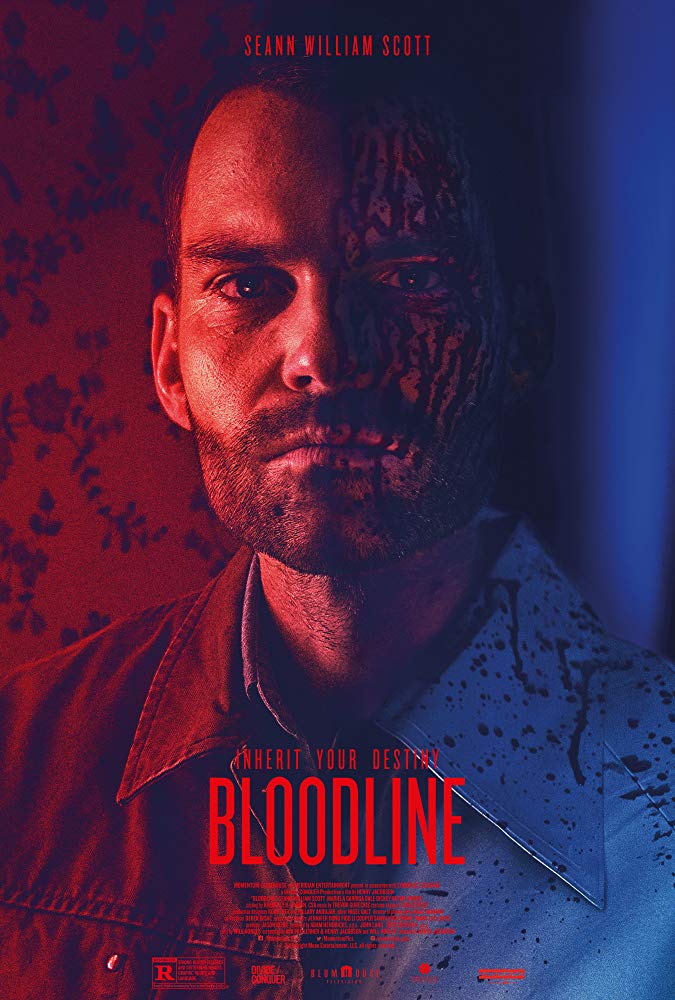
Bloodline (USA 2018: Dir Henry Jacobson) There's more than a whiff of the TV show Dexter in this ice cool study of psychopaths who keep it in the family, which concentrates on troubled new dad Evan (Seann William Scott) struggling to do the best for his new baby and his 'delicate' wife Lauren (Mariela Garriga).

Evan has grown up in an abusive household, his father violent and his mother over controlling (there's a faint suggestion of incest here too). In the film's prologue we see a nurse being knifed to death in the showers at work. The rest of the film takes place three months earlier (this plot approach is now as familiar as the omnipresent drone shot). Evan's attendance at the 'business end' of his wife's birth triggers flashbacks of people being killed, and we see the new parents struggle with their bundle of joy, a situation not considerably assisted by the arrival on scene of Evan's clingy mother Marie (Dale Dickey). Evan's a killer alright, but we learn that he focuses his murderous tendencies only on those who 'deserve' it. In his day job as a high school counsellor all those who seek him out have a story to tell, usually involving deadbeat dads being violent towards them. Using his role to give him access to information about the parents, Evan seeks them out late at night, using an empty housing estate as his killing room, and dumping their bodies in makeshift graves.

But this concentration of his victim selection is a little shortsighted, as it's not long before the police make a connection between the deaths. And the nurse we saw in the prologue? Well she's not so innocent, being the member of staff on duty after the birth, whose caustic tongue belittles Lauren's already limited confidence as a new mother. But is Evan the only murderer in town?

While Bloodline does fall apart a little in the last third - it sort of runs out of steam and the ending does it no favours - for the most part Jacobson's debut feature is a bone dry, darkly humorous study of a killing family - is Evan a natural born killer or, wait for it, a nurtural one? Superb performances from Seann William Scott - whose grin is a very sinister thing - and Dale Dickey as Evan's quite 'off' mum make this film. It's very watchable, and at times convincingly gory. I liked it a lot.

A Serial Killer's Guide to Life (UK 2019: Dir Staten Cousins-Roe) NEW WAVE OF THE BRITISH HORROR FILM 2020 Staten Cousins Roe’s debut feature is a kind of Nietzschean study of the self, filtered through Ben Wheatley’s Sightseers, in which we meet eternally drab Lou (Katie Brayben), a young woman who is the unofficial carer for her domineering mother. Lou is addicted to self help books, including those by Tony Robbins-a-like Chuck Knoah (Ben Lloyd-Hughes), although there are no signs yet of any self-improvement going on: but a mood board in her bedroom tells us that Lou desires a life beyond the four walls of her home.

While watching a flared trousered motivational speaker she meets icy Val (Poppy Roe), herself a self help guru, but with a difference: Val is also a serial killer. After a brief meeting/grooming session, Lou takes the drastic step of agreeing to accompany her new life coach on a road trip to meet Chuck Knoah in person. Lou abandons her mother and the pair take off. On the way to Knoah’s country retreat they encounter a succession of dodgy therapists, including an outward bound tree hugger and a couple using sound as their way back to health, who spike their drinks and get the dildos out.

Lou is rather slow to pick up on the fact that before they move on from each therapist Val (rather bloodlessly as it happens – it’s not that kind of film) despatches them, and the pair soon become the subject of a (wo)man hunt across the south coast area, as they move closer and closer to the self-important Knoah, who it seems isn’t quite the confident self-improver he makes himself out to be.

A Serial Killer’s Guide to Life is an uncompromising film that offers laughs when you feel you shouldn't be, with some killer one liners (pun very intended); set in a world of static caravans and the quiet beauty of the south coast of England (it was filmed in the hinterlands of Brighton) it has a decidedly 'off' charm. But as in any film where content is slender, it’s all about the performances really. As Val Poppy Rose remains staunchly one note in her performance, and if the audience were expecting Lou’s caterpillar to emerge as a self-discovered butterfly, well the director isn’t about to do that. What he does is to take the spirit of Thelma & Louise in capturing the freedom and nihilism of the girls’ trip. There may only be one way out for them, but they’re enjoying the ride on the way.

Harpoon (Canada 2019: Dir Rob Grant) In Rob Grant's aquatic chamber piece we're thrown in with three friends and an unnamed (and unseen) narrator, on board a boat. Munro Chambers is Jonah, a guy who, when we meet him, is trying to make ends meet after his parents have both died penniless and in debt. Along comes Christopher Gray as Richard (that name will be important later), a chap with full on anger management issues, intent on bashing several shades out of Jonah for - as he supposes - fooling around with his girlfriend Sasha (Emily Tyra). Luckily it seems that it was all a misunderstanding, and the three head off in Richard's boat to patch it all up, together with Rich's harpoon, a present from Sasha.

But what starts out as a reasonable pleasant afternoon trip turns into a nightmare when the trio find themselves snarking at each other again, and before we know it Jonah has a harpoon sized hole in his hand, and the boat has conked out and drifted into unknown waters with few provisions on board. With no hope of recovery, and Jonah's wound beginning to infect his arm, Richard mentions the story of his namesake, Richard Parker - a young shipboy in the 19th century sacrificed as food while adrift to feed two other sailors (the lot of the unfortunate decided by the drawing of straws) - and suggests they do the same.

This largely one set three hander draws on the hopeless waterlogged scenarios of Open Water (2003) and Adrift (2018), and the claustrophobia of Knife in the Water (1962) and Dead Calm (1989). Its cross and double cross plot makes the most of a limited setup, and the 'Richard Parker' story element lends a frisson of repeating history to the proceedings. Harpoon is graced with three strong central performances (it would be fairly tedious if that wasn't the case) and the narrator's voice and inter title cards hint that the whole thing could be read as one big morality play. It's quite fun while it lasts and some of the gore scenes (surgery by broken bottle neck, anyone?) had this reviewer's toes curling.

Mary (USA 2019: Dir Michael Goi) Goi has been around for a while but most of his directorial output in the last decade has been TV based (his last feature was the controversial 2011 found footage movie Megan is Missing concerning child abduction). Mary front and centres two A list-ish stars (Gary Oldman and Emily Mortimer) and dumps them into a well made but pretty trashy B movie about a haunted boat.

Oldman is David Green, a yachtsman keen to own his own rig. He's patching up his life after his wife Sarah (Mortimer) had an affair, and hopes that a boat trip with his family, which also includes teenage daughter Lindsey (Stefanie Scott) and her younger sister Mary (Chloe Perrin), will achieve this. At a boat auction Green ignores all the classier vessels in favour of a beaten up yacht. The family are appalled at the fixer upper he's purchased, but after a bit of elbow grease and the name 'Mary' applied to the craft to honour his daughter, the family, together with Lindsey's slacker boyfriend Tommy (Owen Teague) and David's first mate Mike (Manual Garcia-Rulfo) set sail; destination? The Bermuda Triangle.

Told in flashback from inside a Florida police station where Sarah and her kids are the only survivors, it's pretty obvious from the start that this is one trip nobody should have taken. and when Sarah explains to the rather incredulous agent carrying out the interview that "evil needs a body to exist, and the body was a boat", we know we're in the realms of the silly. For it appears that the craft has some history: previous crews of 'Mary' have all gone missing, and each time the boat has been chartered in the past it always ends up in the same Bermuda location, one where something awful has occurred. While Mary is full of the usual cliches (possessed crew members, watery footprints, lank haired spirits, that sort of thing) it's refreshing that the central characters are adults rather than teens for a change, and also that Mortimer's character doesn't succumb to the usual emotional distress that we're used to seeing in films like this; she's a tough cookie desparate to remain practical through the supernatural hi-jinx, and to convince her husband that she's back on track fidelity-wise. Goi should be thanked for not reducing the conclusion to a CGI fest (although he may have done if he had a bigger budget) and for only giving us glimpses of the creature haunting the boat. "The thing about boats is that there's nowhere to run" explains Mortimer at one point; but while Oldman and Mortimer give it all they've got in generating the claustrophobic tension needed, their classy turns can't disguise the essentially thinness of the whole thing. Nevertheless Mary remains a bit of a guilty pleasure.

Stalked (UK 2019: Dir Justin Edgar) A remarkably well constructed and tense thriller shot on a micro budget that conjures something out of, well, not much at all really. Stalked is the story of marine commando Sam (Rebecca Rogers); single mum with a feckless ex, landed with a sick child, she leaves the baby home alone while making a dash to the chemist. Only to find herself abducted and imprisoned in a factory that turns out to be home to Epsilon Military Solutions.

The twist here is that her abducter is wearing a stealth suit, making him invisible to her unless she catches him on CCTV or her phone. Sam isn't the first person to be kidnapped by the (near) invisible man; she runs into others who are also trying to escape, none of them very successfully.

Most of Stalked is a cat and mouse between the resourceful, ultra limber Sam ( a very visceral performance by Rogers, particularly effective when she has to act against someone invisible) and her pursuer. Oh and a drone; we haven't had many killer drones before and then two come along at once (FrightFest's other murderous drone flick being, er, The Drone). The effects are a little shonky but that's what you get on a low budget and the now you see him, now you don't appearance of the guy in the stealth suit remains rather unbelievable. But it's mastefully edited considering it's mainly one woman running around something that looks more like the packing area in your local B&Q, and mask any inconsistencies well. It's not going to bother anyone's memories of similar setups in Predator (1987) or a myriad 'Invisible Man' movies, but Stalked is effective, not overlong, and gets the job done.

Tuesday, 23 May 2017

Poundland Lucky Dip Part 3 - Reviews of Haunted aka Bad Building (Canada 2013), Code Red (USA 2013), Demons aka Family Demons (Australia 2013), Evil Things (USA 2009), Salem Witch Hunters aka The Secret Village (USA 2013) and Halloween Haunting aka Hayride (USA 2012)

It's time for a round up of recent acquisitions from the shop which acts as my time machine to the golden days of VHS, when I'd pop into my local video emporium back in the early 1980s, choose some titles from the shelf in the 'six for £5' deal, then take them back home to find out what the devil I'd just rented. It goes without saying that these would all be horror movies, so now I can do the same in Poundland. Six films for six quid (one pound inflation over thirty five years ain't bad) - so what did I get, this time courtesy of Poundland Derby (I'm nothing if not well travelled)?

Haunted aka Bad Building (Canada 2013: Dir Philip Granger) Johnny Craig, host of a paranormal reality show, has been given one last chance by the TV station he works for to pull together an episode that actually features footage of a haunting, or face the chop. Luckily he's tipped off about Desmond Towers. an abandoned hotel in Victoria, British Columbia, with a dark past of murders, suicides and unexplained deaths on its premises. Via a couple of urban explorers Johnny and his team gain entry to the premises. It's not long before the supernatural activity kicks off, although their cameras repeatedly fail to record any of it. Soon they are trapped in the building as it starts to come to life and pick members of the team off one by one.

How relieved was I that this was not made in the 'found footage' format, despite its setup suggesting that this would be the case. Haunted (for once I concur with the distribution company's renaming of the film's terrible original title Bad Building for its 2015 home release) is actually very well photographed. The tortured history of the Desmond Towers reveals that successive owners had added to the original building, which explains why the floors look different when the team explore the hotel - although I suspect that this was really because Granger had to use several locations. The exterior shots are a sweet little bit of computer animation which could have been terrible had I not felt rather benevolently towards the film.

The cast - and there's a lot of 'em, many recruited from Vancouver's New Image college - are actually fairly competent if rather anonymous, and it's kind of difficult to keep track of who's alive and who's dead. A couple of them may need to lay off the biscuits if they want a career in film; the camera adds pounds, you know. There are some inventive and gory, if rather implausible kills as the hotel goes about its business - death by pigeon spikes anyone? - but the budget clearly dispenses with anything remotely ghostly, as the spirits on display are of the decidedly corporeal variety. But while I wouldn't go so far as to describe it, as one unnamed critic has, a 'rollercoaster,' this was a fun hour and a quarter, blessed with a very eerie soundtrack and some quirky touches. Best cast name - Havana Guppy!

Code Red (USA 2013: Dir Valeri Milev) Don't be fooled by the cover - there are one or two Nazi zombies in this film but only in the WW2 set prologue, where Stalin has apparently perfected a nerve gas which has the unique property of resurrecting those soldiers who have died after exposure to it. I'm guessing that the stormtrooper suit rental was charged by the day, because quick as you like we're in modern day Bulgaria (where Code Red was shot and where, one assumes, technical teams can be hired for peanuts) and it seems that supplies of the gas may have survived, pointed out courtesy of a recovered diary from the weapon's crazed inventor. Captain John McGahey (martial artist, stuntman and The Asylum flicks regular Paul Logan) is sent undercover by the US powers that be to find out what's been going on.

You won't be surprised to learn that the gas supplies get released, causing the whole of Bulgaria (well a run down housing estate in a tiny grimy part of it) to go zombie simple. Actually the zombie makeup is quite inventive, and the whole thing is filmed in that hyper real colour downgraded style beloved of directors who want to cover up their paltry budgets. By about the halfway mark Logan has become a kind of Steven Seagal lite action hero, and when the director wheels out the tanks and the hardcore armoury, the 'infected' have become a bit of an afterthought.

Competently directed but entirely lacking in charm, wit or purpose, this is about the worst travel ad for Bulgaria that I've ever seen. But I'm still worried that two films in, my Poundland haul is showing remarkable signs of...dare I mention it...quality?

Demons aka Family Demons (Australia 2013: Dir Ursula Dabrowsky) Clever old marketing companies - at it again. This is actually a 2009 slice of Ozploitation called Family Demons (although actually shot three years earlier), but they've dropped the first word of the title and put some woman with ragged hair on the cover - lead character Billie as it turns out - to make you think it's a horror movie. Well it is kind of a horror movie, and a pretty good one at that.

Billie lives at home with her crazed alcoholic mother, chained (literally) to the house. One day Billie makes a break for it in search of food (her mother spends all her money on booze and the occasional dress for when she picks up random guys) and meets neighbour Sean. In a struggle Billie's mother is hospitalised, but when she returns home, after a vicious argument, Billie kills her. But Billie's mother continues to haunt her daughter from beyond the grave...or are the apparitions just a figment of Billie's increasingly unhinged mind?

As you can probably tell laughs are few and far between in Demons. It's pretty much a two hander with great performances from Cassandra Kane as Billie and Kerry Reid as Mother. Cheaply made (just over $6,000 Australian) and shot entirely on location in Adelaide, it's let down by a very limited structure and a really cheap string synth score - I would have loved one of those soundtracks of noises and glitches with this one. Apparently well received on first release, winning a few awards at festivals, it's a shame that it's been repackaged this way. But it's worth seeing if downbeat domestic psycho dramas are your thing.

Evil Things (USA 2009: Dir Dominic Perez) A trip back to the previous decade, when 'found footage' was king. Yep, we have a fairly nondescript group of young New Yorkers off to stay in a country retreat upstate. On the way the would be party posse encounter a people carrier with blacked out windows that cuts them up, then slows down in front of them, and generally menaces the group. Arriving shaken at the destination, they find that the people carrier knows where they're staying, and its occupants may already have been in the house. After three...one...two...three...scream and run (while still holding the camera, obviously).

Anyone who has read my reviews will know that my critical faculties are severely reduced if a director uses an authentic snowy location. So yes, some of my bonhomie towards Evil Things can be attributed to the white stuff that makes the upstate New York woodland locations look rather beautiful. The other thing this movie has going for it is that the threat isn't supernatural. It isn't that scary either but the setup is believable (the premise is that these are tapes picked up by the police at the house following the disappearance of all of the group - nice of the cops from the precinct's music department to add some droning sounds when they assembled the footage).

The last twenty minutes or so is a total mess, but until then Evil Things does a reasonably good job of conjuring up a good foreboding atmosphere in a chilly setting. This was Dominic Perez's first film - his next, 2015's Saving Borshia, a comedy about the pitfalls of independent filmmaking (and six years between films suggests this is something the director knows a bit about), is streaming on Amazon Prime now and may be worth a look.

Salem Witch Hunters aka The Secret Village (USA 2013: Dir Swamy Kandan)  Swamy Kandan's directorial track record isn't that great. One previous movie - 2009's Catch Your Mind - which seems to have tanked. Kandan also produced and wrote that one, and takes on similar duties for the appalling Salem Witch Hunters (and by the way distribution company - the new title makes no sense whatsoever). The film is set in a small village in western Massachusetts (spelled incorrectly in the end credits, fact checkers), whose history includes frequent outbreaks of poisoning through ergot, a fungus found on crops.

Skinny saucer eyed Rachel, an investigative journalist, has moved into a friend's house in the area to find out more about the infections. Unbeknownst to her she's joined by heavy browed square jawed Greg, who has been booted out of his flat by his ex and needs somewhere to crash.

Greg forms a closeness to Rachel but she becomes increasingly concerned as her researches seem to show the involvement of a clan of people (possibly witches) and a strange building close by which may be keeping people prisoner. Greg has to leave for town and alone in the house Rachel is persecuted by the very people whose stories she is uncovering.

Kandan's decision to convey Rachel's increasingly fractured state of mind by increasingly fracturing the narrative construction of his film may have been a good idea on paper but needs great execution (Nic Roeg, Christopher Nolan, Quentin T take a bow) to pull it off. Salem Witch Hunters has tragically awful execution, a lumbering intrusive score (surprisingly by the normally reliable Robert The Slayer Folk) and a denouement that sets the eyes rolling in the sockets. Strangely you'd expect a movie of this calibre to be staffed by a cast of unknowns, but Greg is played by Jonathan (Mean Girls) Bennett and Rachel by Ali Faulkner, who was in one of the Twilight movies. I can only think that Kandan must have rich benefactors, for I feel that both actors will be replacing this entry on their CV with the words 'career break' any time now. Awful.

Halloween Haunting aka Hayride (USA 2012: Dir Terron R. Parsons) Apparently hayrides are a hallowe'en thing in the US. You and a group of friends sit on the back of a truck which is towed through fields, while various iconic characters leap out from time to time and scare you - a sort of rustic ghost train. Terrifying, right? Well I can tell you something - Hayride is not a scary title for a film. Halloween Haunting is better, but no haunting takes place in this movie - only someone having a slash. Ahem.

We get terrible 'teen' acting by people who have long since forgotten their teenage years. We get the legend of Pitchfork, who stalks the countryside looking for his lost daughter. We get an escaped serial killer who assumes the role of Pitchfork as a disguise by nicking the costume intended to scare the kids on the Haunted Hayride. We also gets lots of walking around and talking, CGI rain and blood spatters, and people dying very anaemically. So anaemically in fact that it felt like watching a good old VHS copy of a 1980s slasher flick after the BBFC got hold of it.

Director Terron R. Parsons went on to make Hayride 2 which by all accounts rehashes many scenes from the first movie and proves that the director has learned nothing from the mistakes of his first feature. All very very tedious.