Showing posts sorted by date for query bone breaker. Sort by relevance Show all posts

Tuesday, 27 October 2020

NEW WAVE OF THE BRITISH FANTASTIC FILM 2020 #10: Reviews of The Haunting of Margam Castle (UK 2020), Devil in the Woods (UK 2020), Witches of Amityville (UK 2020), House of Shadows (UK 2020), Harvest of the Dead: Halloween Night (UK 2020) and Awakening the Nun (UK 2020)

The Haunting of Margam Castle (UK 2020: Dir Andrew Jones) Jones is back! His third release this year (a fourth, A Killer Next Door, has yet to surface on these shores), after The Cabin Murders and The Jonestown Haunting; this guy certainly does churn them out.

A US team, headed by doctors Annie Holzer (Amy Quick) and Daniel Barron (Ashton Spear) are carrying out expensive studies in ESP and parapsychology within a New York academic facility. But their funding is about to be curtailed by Dean Michaels (Garrick Hagon) unless they start generating a bit of publicity for the college; and he has the perfect solution. He wants the team to travel to Wales for a day (!) to investigate Margam Castle, which has a history of hauntings, and capture a ghost on camera, whether or not they have to fake the footage.

Now it's worth mentioning at this stage that Margam Castle is a real place in Wales. It's open to the public, mainly in the form of overnight ghost hunts, so bizarrely Jones's film is like a kind of extended publicity brochure for the pile. He even includes the ghost who's said to haunt the place within his screenplay, hence the 'Based on a true story' strap accompanying the film.

So the team travel from New York to Wales, stopping off en route at a 'friendly' Welsh pub for an extended chat with the landlady (Caroline Munro, the first of many british horror actresses from back in the day who put in an appearance here) for a culturally confusing conversation about what exactly goes into a welsh rarebit. The air cools a little when the group announce where they're headed; another Brit horror lady, Judy Matheson, is also on hand to ominously warn: "they're waiting for you. They've always been waiting."

When they arrive they meet the owner Hugh Morgan (Derren Nesbitt, pretty sprightly at 85, and last seen being brilliant as a drag artist in 2018's Tucked) who is accompanied by Edith Withers (Jane Hands of the Ripper Merrow), a medium, who rabbits on about the Pendle Witches and Matthew Hopkins, the Witchfinder General. Morgan gives an account of the history of the house (which actually is the history of Margam Castle), and its ghosts; a woman and her daughter, who died in a domestic tragedy, and Robert Scott, a gamekeeper with a filthy temper, who dies in an altercation with a trespasser.

For most of the movie, things move very slowly; something Jones is a dab hand at, which you'll know if you've seen any of his other films. But the last third, where the psychic phenomena kicks off, is quite un Jones like: it's actually quite exciting and spooky. I won't say any more but The Shining was clearly an influence on story development.

Despite the usual pacing problems (something that affects most of his films) and English actors doing US accents with varying degrees of skill, I did like the atmosphere in this one, helped enormously by the location, which is skilfully lit and photographed, and a bigger than usual budget. There's a lot of stories within stories which enriches the plot, and while the last third is rather bonkers it's great fun ("Psychological warfare!" exclaims Withers at one point). No points though for brandishing a copy of the Necronomicon, which, rather than the fabled 'Book of the Dead' mentioned in HP Lovecraft's writing, is actually a volume of HP's stories given that title on the cover. Oops!

Devil in the Woods (UK 2020: Dir Terence Elliott) - Four young students, Tess (Francesca Howe), her friend Julian (Dan Wale), and their other friends Jen (Amy Joy) and Chris (Alex Sleigh), have come together to make a final year film for their media studies course. None of them really know what they're doing, although Tess and Julian are serious about the project; Chris on the other hand is a hopeless stoner and his friend Jen is easily led.

Tess has been working on a screenplay for her sister Alison (Dani Thompson) so clearly has some skills in the script department; no surprise then that when the roles are allocated, she's the scriptwriter, Jen's the director, Chris is the producer and Julian is the editor because he's good with computers.

Elsewhere in the town of Dunwich (yep!) the police are dealing with the disappearance of a young man, Duncan (Glenn White). Duncan's dad Russell, a nasty bit of work who's just been released from prison for assaulting a police officer, has been up to his old tricks again, and after taking out another copper he runs off into the woods - yep, the same woods in which our four are planning to shoot their film. But Russell has even darker plans; he's laid his hands on some black magic texts and is keen to summon up a demon or two. But guess what? He needs a sacrifice. As Tess, Julian, Jen and Chris soldier on making their movie (which Chris wants to turn from a drama into a found footage horror), the forces of evil are summoned. Who will survive?

Devil in the Woods was shot overlapped with Elliott's other film this year, Harvest of the Dead: Halloween Night, reviewed below. Both used some of the same cast and crew and were filmed in the New Forest (the Hampshire area seems to be a hotbed of local Brit horror filmmaking, rather like the Kidderminster House of Horror). This is, be warned, a very rough round the edges production, which is blessed with an extraordinary orchestral score from Andriy Sovetov which is lush, impressive, really loud (at times it drowns out the dialogue) and really pretty inappropriate for a low budget movie based around a living room, and office and a patch of woodland.

But did I like it? Well yes, actually. The cast are, I'm guessing, not professional, and a lot of the 70 minute movie is spent watching the four students trying to get it together. But once they reach the woods, and the horror kicks in, this is pretty impressive stuff, surprisingly nasty and gory and with a downbeat ending I wasn't expecting. As you'll know the NWoTFF reviews are here to celebrate the low/no budget world of independent British horror film making, and there is, as I've mentioned before, just no point holding Devil in the Woods up against a bigger budgeted film - or even The Haunting of Margam Castle, come to that. But from little acorns do mighty oaks grow, and so I say well done Mr Elliott, cast and crew (what there is of them) and let's see some more.

Witches of Amityville (UK 2020: Dir Rebecca Matthews) Another prolific director in the field is Ms Matthews, this being her third feature in 2020 after The Candy Witch and Bad Nun: Deadly Vows which is reviewed below.

In a prologue, set at at some imprecise point in history, three witches are strung up and hanged. Cut to the present day, and two burglars target a house where three women live alone - but they've bitten off more than they can chew. The three women are witches (the same witches we saw in the prologue); Lucy (Donna Spengler), Sam (Kira Reed Lorsch) and Elena (Brittan Taylor). They use their powers on the burglars, wiping their memories by the power of suggestion to avoid being discovered. "Can I keep him?" one of them asks playfully.

Meanwhile young Jessica (Sarah T. Cohen) has been offered a place at the local academy, studying drama and the arts, which is nearby to the witches' house. She meets the head of the school, the indomitable Dominique Markham (Amanda-Jade Tyler) who asks Jessica to sign a rather ancient looking contract in order to be enrolled: "Sign, and belong to something," Miss Markham urges. One of the other students spies on Jessica in the shower and confirms to the Head that she has a tattoo of three horns on her back. Later that night Jessica is snatched from her bed and brought in front of the coven, headed up by Dominique, who we just knew was bad. Things don't look so good for Jessica, but she's rescued by the three witches we met earlier; it seems that they are white witches whose powers are used for good or defence, whereas Dominique represents the dark side, and her plan involves getting hold of Jessica, who is also a witch with incredible powers, as a means of bargaining with a demon called Botis (Toby Wynn-Davis). 

Matthews is known for making rather chaste horror movies, and this is definitely PG friendly; no swearing, little violence and definitely no nudity (something which other filmmakers would definitely have introduced bearing in mind the setup, and the fact that one of the witches (Reed Lorsch) has a porn past). But the fact that all three of them are American women of a certain age gives their characters much more gravitas than English actors trying on fake US accents. Their presence does, however, show up the prosaic nature of the film's locations; having lots of talk from seasoned actors while sitting in the living room of a suburban English semi does rather cool the mood, no matter how many candles the set dresser lights (and it's a lot); more gothic would have been better. 

Matthews' film is a bit of The Craft, a bit of the remade Suspiria (one scene is a direct steal) and a little American Horror Story: Coven. It's ambitious, competent and moves at a reasonable pace, but I'm still not convinced that Matthews knows what to do with her actors. The presence of professionals Spengler, Reed Lorsch and Taylor slightly transcend this problem, but Cohen is left to do a lot of standing around and the movie still has points where it almost grinds to a halt. But I liked the imagination on display; and a final scene which hints at a possible Stateside sequel will be interesting.

The House of Shadows (UK 2020: Dir Nicholas Winter) Not 'House of Shadows' as it states on the DVD cover, nor 'The House Beyond Time' as the end credits suggest (although that title is probably more accurate), this is Nicholas Winter's third film for 2020 after Bone Breaker and A Dark Path. Sarah (Romanian actress Elena Delia sporting a pretty good American accent) inherits a house after the death of her thought to be penniless mother, to whom Sarah has a strong resemblance. She takes up residence with her boyfriend Jared (Luke Bailey) in her newly inherited gaff. Oddly the house's location is Spain (something not referred to in the script) which tonally jars.

Sorting through her mother's things, she finds a notebook filled with crude drawings and messages like "What have I unleashed?" Good question. One evening Sarah receives a phone message from her sister Megan (Yvonne Mai) which sends her into a bit of a tizz; understandably as Megan died five years previously. The property's housekeeper, the rather odd Anna Sofia (Harriet Madeley), tells Sarah that Megan is in great pain and that something has control over the house, a spirit who preys on the weak and collects souls. Determined to remain, Sarah and Jared realise that a presence has indeed invaded their lives, and it has the power not only to mess with people but indeed time itself.

For most of The House of Shadows' running time very little happens; much of the drama is derived from the tense relationship between Sarah, Jared and Anna Sofia, and Delia, Bailey and Madeley are all effective in their roles. The last third of the movie is where it gets tricksy and, sadly, more than a little confusing. But it's an ambitious attempt to make a haunted house movie that's a little different to the endless walking along corridors/jump scares outings, even if I could have done with a little more pep in the thing. 

Harvest of the Dead: Halloween Night (UK 2020: Dir Peter Goddard, Terence Elliott) It's helpful, but not essential, for you to have seen Goddard and Sam Mason-Bell's first 'Harvest of the Dead' movie, 2015's, er, Harvest of the Dead, which introduces the viewer to some of the more out there plot points in Goddard and Elliott's sequel.

This is a movie that starts with one of the cast topless and ends with, well, the end of the human race. Sally (Dani Thompson) is preparing for a Halloween party. Meanwhile nearby out on the moors a blood covered woman crawls away from danger. She's assisted by a passer by who takes her back to her car, but before she can drive off, a masked man - The Plague Doctor (Elliott himself) and a woman in a hospital gown with horrible facial scars attack and kill both women, one of whom is beheaded in a rather impressive bit of latex work. When the police discover their bodies they think that the murders may be the work of one Trent Hodder, who was tried for his crimes but got off on a technicality. The policemen, porn addict Detective Bava (Dean Jovi) and Detective Faust (Kevin Hallett) are managed by the ball busting Wes Mason (Lee Macdonald, who older readers will remember as Zammo from Grange Hill, and who was also in the first film.)

The party slowly gets going but is frankly a little lame. Sally's nice friend Laurie Pleasence (Rebecca Jean) comes round to help and her awful friend Tia (Abby Wareham) turns up without costume or booze - her ex Ben (Matt Brackstone) is also due, but he doesn't know he's an ex yet: Tia's that kind of girl, and she makes immediate moves on another party guest, Josh (Nicholas Pearce), who's waiting for his girlfriend Melissa (Hannah Coley) who was in the 2015 movie.

The Plague Doctor makes it to Sally's house and hides upstairs, gradually despatching the party guests who want to use the loo or indulge in some seasonal rumpy pumpy.

But behind this all is a mad doctor, Henry Moore, struck off because of his insistence on messing with body parts, who has a grand plan involving transforming humans into zombies and summoning a race of ancient beings, 'The Old Ones.' Sally's party house becomes a house of horror as the zombies also arrive, and no-one is safe.

Whew, it's all in this one! Halloween Night is terrific fun, quite a step up from the already rather bonkers 2015 original. The vaguely Lovecraft-esque story arc with the mad Moore is nuts, sitting awkwardly with the soap style drama of the partygoers' various tiffs and romances. I get the feeling that this was a lot of fun to make. One of the zombies is filmed laughing and several keep looking at the camera (their numbers swell the cast list); the gore scenes are impressive and properly old school splattery, and the script offers up some nice 'story within a story' moments. 

While the events are set at Halloween (although the house's internal decorations only seem to comprise a couple of signs and a cobweb), the night street scenes clearly show Christmas decorations on some of the houses, and there's a few script gaffes along the way (notably Macdonald, who says 'parameters' instead of 'perimeters' at one point); also using names like 'Bava', 'Hodder' and 'Pleasance' is a bit old hat these days.

But you know what? It does not matter; in fact this stuff endeared me to the film even more. And the good news is that the final scene suggests there might be a sequel, and I am so up for that. Well done people - very entertaining.

Awakening the Nun aka The Watcher 2 aka Bad Nun: Deadly Vows (UK 2020: Dir Scott Jeffrey, Rebecca Matthews) Matthews' second movie in this round up is the sequel to last year's Satanic Nun aka The Watcher aka The Bad Nun, directed by Jeffrey. 

Becca Hirani (aka director Matthews using her 'actor' name) returns (briefly) as Aesha Wadia from the first instalment. For those who haven't seen it, Wadia is a University student who encountered the titular nun while on a getaway in a B&B. Wadia learns that the nun has a more prosaic identity than first thought; it's Dan, ostensible owner of the B&B, who was abused by people of the cloth as a child and now dresses as a nun. Wadia escapes with her life, but as the sequel opens she's trying to make a new life, before being cruelly despatched by the returning nun in the first ten minutes.

A new group of victims, the Seers family, move into a house in the countryside (Norfolk doubling for the Cotswolds): gran Pam (Nicola Wright), mum Mandy, who has separated from her husband following his repeated infidelity (Stephanie Lodge), and her daughter, university student Cathy (Sarah T. Cohen ); oh and their Pomeranian, Julie. Things begin quickly: while Mandy's out getting a takeaway, the nun turns up announcing that she's Sister Cindy Lamb (voiced by genre regular Kate Milner-Evans) and that she's brought them a moving in gift. They wisely refuse to open the door but the nun leaves her present; a basket of maggot infected biscuits.

The arrival of Sister Cindy gives Pam the wim wams, and no wonder; her past is directly linked to the nun and to the events of the first film. 

Mandy meets the neighbours, Ted (Ricardo Freitas) and his daughter Nancy (Chelsea Greenwood), who Pam thinks would make a nice partner for the sapphically inclined Cathy - progressive grandparent! Meanwhile Pam tries to find out what's going on. She visits the local church and asks about the nun, but the local vicar, who's a bit shifty himself, thinks Pam looks familiar, and that she might be....Cindy Lamb!

Meanwhile the phantom nun proceeds to 'haunt' the Seers family as Pam gradually falls apart and plucky Cathy starts to put the facts together, after she receives a phone call telling her that her family aren't wanted in the area. Events escalate, with the entire family under threat from forces that may either be supernatural...or very real.

By the end of the movie the plot has rather cleverly merged the stories of the two 'Nun' films, but it does leave the question as to why Pam should have allowed her family to have moved to the area in the first place, knowing what she knew and what we find out. Nevertheless I enjoyed the peeling away of the 'onion skin' layers of the story, and the cast do a good job of ratcheting up the tension. Production wise Awakening the Nun avoids the 'flatness' of many similar low budget productions by concentrating on the actors rather than the English Country Cottage rental in which they are acting; good use is made of the countryside too, but I'm afraid that the 'ghost' nun, whose look is clearly borrowed from the infamous Armchair Thriller figure, is way too athletic to be spooky. Good fun though.

Monday, 19 October 2020

NEW WAVE OF THE BRITISH FANTASTIC FILM 2020 #9: Reviews of Ravenstein (UK 2020), A Werewolf in England (UK 2020), Saint Maud (UK 2019), Markham (UK 2020), A Dark Path (UK 2020) and Rose: A Love Story (UK 2020)

Ravenstein (UK 2020: Dir Eveshka Ghost) One look at Ghost's 'how to make films on a budget' videos confirms a director who knows the limitations of low cost movies and how to work within constraints. Ravenstein, made for less than £400, is certainly not without its problems, but it's also a very impressive scare movie.

Two friends, David (James McClusky) and image obsessed Marky (Nik Kaneti-Dimmer), trespass onto a yard containing an abandoned glazing factory. While investigating the ruins of the facility and thinking that they're on their own, they come across mead swilling Jack (Chris Wilson), a homeless guy who sees the ruined factory as home, and who, for reasons we'll find out later, is unable to leave.

Marky goes off exploring on his own and encounters, first a flurry of dark feathers and then a life sized terrifying bird man: the 'Ravenstein' of the title (the feather thing is a nifty side effect of the creature's ability to move very quickly). An incoherent Marky struggles to communicate the source of his fear to David.

Meanwhile two stoners, Andy (Thomas Walters) and Charlie (Seth Easterbrook) stumble across the same abandoned factory, and after a lot of drunken farting about, get slain by Ravenstein. Soon David, Marky and David's dad Ray (Martyn Eade) who comes looking for his son, end up cornered by the birdman. But where has Jack gone?

Don't look for oodles of plot in Ravenstein, and what there is - about the birdman slowly killing off the factory employees, and a powerplay between Ray, who used to own the factory (and right hand man Jack; yes, the same homeless Jack) - is a tad confusing. It's also way overlong and many scenes outstay their welcome (often a problem with one writer/producer/director gigs). But oh goodness there's also so much to love about it.  

First off, the whole movie is shot at night. Now the odd night scene can be a challenge to a low budget director without the means to really carry the footage off, but Ravenstein is spectacularly lit and framed, making the junkyard setting way more spooky that it would have been in daylight. Second, the birdman is genuinely freaky, looking like a lifesize satanic version of that thing whose arse was regularly penetrated by Rod Hull, and with some genuinely eerie sounds emanating from it. And on the subject of sounds, particular mention should be made of Chris Wilson's diverse and hugely atmospheric soundtrack. From symphonic grumbles through stabs of shock synths and then cacophonous metal pieces signifying the arrival of Ravenstein; it's no wonder that the whole thing will shortly be available on the Rusalka Records website. So yes, this is a very good film. Shorter and tighter edits would have made it a great one, but it's a movie Ghost should be proud of.

A Werewolf in England (UK 2020: Dir Charlie Steeds) The prolific Charlie Steeds is back with his third feature this year, after the creepy An English Haunting and the rabble rousing Death Ranch. This time the director turns his attentions to a period horror piece, evoking memories of classic Hammer films, but also injecting an element of comedy hitherto missing from Steeds’ output (and doesn’t that title reference another rather famous lycanthropic shocks and yocks movie?).

Archie Whittock (Reece Connolly) is being transported for trial, almost certainly likely to hang following his murder of a man: except Whittock maintains that the person he killed was a werewolf. Whittock is handcuffed to his protector, Parish Councillor Horace Raycraft (Tim Cartwright), and the pair are travelling by coach. They’re forced to stay overnight at a coaching inn, appropriately named ‘The Three Claws’ and run by blowsy Martha Hogwood (Emma Spurgin Hussey). The area, Grittleton Marsh, is steeped in local legend, including being home to wolves.

But the inn they’ve happened on has its own secrets; not only do the Innkeepers have their own sideline in chopping up bodies, but it looks like the stories about lycanthropy are true, and worse, these two facts are connected. So Whittock is vindicated, but as the werewolves gather to attack the inn, will he last long enough to protest his innocence?

Steeds’ skills here – of creating something out of not much at all – are in abundance. Most of the movie takes place in a two room set (the inn is a real location in Cornwall but I’m guessing the owners feared for the soft furnishings) but so inventive is the camerawork and the interplay between the quirky cast that you barely get time to acknowledge and limitations of the interiors.

And let’s hear it for the werewolves, courtesy of the US SFX company Midnight Studios! There may not be enough money for a full on transformation scene, but with nary a CGI moment visible, A Werewolf in England’s ketchup and grue is authentically grisly; although I’m not entirely sure about the ingredients that went into the wolfman diarrhoea which features in a scene worthy of Peter Jackson’s early movies.

You can tell that Steeds is having fun here: the The Evil Dead visual references fall over each other, and the cast look like they’re enjoying themselves too: Barrington de la Roche, a fixture of all of Steeds’ movies, in particular turns in a super ripe performance as one of The Three Claws’ shadier staff. The director once again shows his versatility at turning out quality product which doesn’t break the bank but looks a million dollars. I do not know how he does it, but I’m damn glad he does.

Saint Maud (UK 2019: Dir Rose Glass)
Maud (an astonishing performance from Morfydd Clark), a carer for the sick, has been appointed by her agency to provide palliative care to Amanda Kohl (Jennifer Ehle), a former dancer, who lives in a large but rundown house on the edge of a coastal town.

Maud is recently religiously converted and her passion to help is divinely inspired: the conversion was triggered by an earlier incident, briefly glimpsed at the beginning of the film, when she was responsible for a serious medical error with fatal consequences. Her religious conviction and seriousness of intent amuses Kohl, a figure who was once famous but is now ill, lonely and craving better company than the crowd of sycophants who regularly flock to her home to share her drugs and booze. In return Maud increasingly sees Amanda as a project for salvation. She  refuses to be publicly shocked at her client's substance use or lesbian lifestyle: but her attempts to assert control, ostensibly to protect her charge, backfire when she tries to dissuade Kohl's companion and lover Carol (Lily Frazer) from visiting, resulting in Carol ratting on her; now out of favour, a further incident leads to Amanda dispensing with her services. Maud freefalls, briefly lapsing into promiscuous behaviour, before regathering herself into something stronger and more lethal, inspired in part by the images from a book on William Blake given to her by Kohl, but equally to answer her inner calling.

Glass's extraordinary film is made even more so by virtue of it being her debut feature: there's an assuredness of tone, look and feel that recalls early Andrea Arnold, Lynne Ramsay and Peter Strickland. Taut, economical and beautifully controlled, Saint Maud contains an almost constant threat of violence on the part of the title character, undercut with a painful vulnerability. 

We can never know exactly what Maud's motivations are, and Glass gives us precious little to play with here. While it's obvious that she's fundamentally damaged, and arguably channels this into a created religious fervour (we learn that after the incident referred to earlier she changed her name from the more prosaic Kate to 'Maud'), her moments of self harm might be dressed up as something more devotionally profound; but they could also be cries for help. 

Glass wisely holds back on the more upfront horror, adding to the tension of the piece; when strange things - well stranger than the rest of the film - happen they are more shocking as a result of the restraint. Much of the power of Saint Maud is down to Clark, who has already established an unusual acting CV of which Tilda Swinton would be proud. She's in every scene of this film, and her otherworldliness - which can never be accused of feyness or pretension - hits all the right notes. Ehle too is so good as the dying ex-dancer, amused and bored with life and finding true fascination in Maud's company. This is an exceptional film, and Rose Glass is clearly a director to watch.

Markham (UK 2020: Dir Matthew Cooper)
 This is the second time today I've seen a film which re-uses uses the old 1990s VHS classification public warning footage, the first being South African weird fest Fried Barry. And while both movies are mind fucks, Cooper's film, supposedly 'A tale told in four tides', is a beast entirely its own.

Cooper mentioned to me that "Markham was... improvised in a manner which was very labour intensive and then the plot was built in the edit over 18 months (we'd then go back and shoot other scenes to connect the narrative up)." That sounds like an insane way to shoot a film, and the results are understandably bewildering.

From what I can understand of the plot, filmmaker Rob (Ashe Russell) is putting together a unique feature within the horror genre; while all of the action will have been worked out beforehand, using a cast of actors, the protagonist will be an unsuspecting member of the public, and their reactions to the events around them will be the substance of the movie. Rob sends his unnamed accomplice (played by Cooper) location scouting, to the same are scoped out by two previous filmmakers who have mysteriously disappeared. One of this pair, Matt (Gareth Parry) had written a Lovecraft influenced script involving a race of sea dwelling beings related to the infamous Cthulhu (Lovecraft's infamous interstellar beings). While scoping out the locations, Rob's assistant is approached by Tony (Tony Coughlan) who tells him about the missing men and the humanoid fish creatures that emerge from the sea onto the land. Later at his digs, the assistant finds film equipment left by the previous pair, and settles down for a night's sleep.

What he doesn't know is that Rob has decided that his assistant is to be the first test of the previously described setup. It appears that Tony is an actor and the meeting has been pre-arranged. Rob has also ensured that the tea bags are laced with LSD, and when that takes effect, co-ordinates various sound effects and all round orchestrated eeriness to provoke a reaction. Unfortunately this goes wrong; the assistant, now crazed, leaves the room and heads off to the coast, where he lays his hands on the village monolith. This action, 2001: A Space Odyssey style, alerts a race of interstellar beings on Star Spawn base: the Sekurig Cthulhu Watch Station. This then seems to cause a number of the creatures to rise out of the water.

Writes Cooper "It was a mad thing to try, as was shooting portions of the film on Super 8mm - we often waited three months or more for the footage to come back from the process people. It was a very real learning experience."

Markham is an extraordinarily bold mess; it has about thirty different ideas all fighting for prominence, and no one concept ever claims primacy. It's amusing, baffling, often incomprehensible, and inventive as hell, with masks, animation and some effective CGI. You can keep your multiplex blockbusters or your costume dramas, this is inventive, nuts guerilla filmmaking, which fractures its own narrative on several occasions and challenges the concepts of cinematic storytelling. There's a great doomy score by Mariella Nelson Renaud which works well with the often sumptuous photography of northern coastal locations; again Cooper adds that "we shot in places which are dangerous and are well known for fatal rock falls," which is no more or less bonkers as an idea than the rest of the film. Brilliant. 

A Dark Path (UK 2020: Dir Nicholas Winter)
 Uptight Abi (Makenna Guyler) is in Eastern Europe with her rather more carefree sister Lilly (Mari Beasley) at a hen night for friend jess (Annabelle Mackinnon-Austin). But she's not having a lot of fun, being the designated driver and everything, and having to deal with a hungover Lilly the morning after. They have to make an evening return flight, whiling away the time on the long road back and bickering, as sisters do. But as evening falls they're still a long way from the airport, and worry that they might miss the flight; a flat tyre on a lonely country road, with no mobile phone signal, about sums up the whole excursion for Abi. But it gets worse; the hire car spare tyre is flat, so they decide to walk to find help. 

Abi's uptightness in the face of a party stems from an experience at Uni where she and a friend were attacked; when locked in she freaked, escaped and hadn't talked about it since: there's a sense that this story might be preparing us for something. Lilly goes for a wee and gets lost, and Abi finds another English girl in the woods. She's Hanna (Thomasin Lockwood) and she has a serious injury to her leg, but is unable to articulate how she sustained it. Abi and Hanna find shelter in a woodlands hut, but their place of safety is interrupted by the arrival of a something...they must fight to stay alive.

In the grand tradition of creature feature B movies, A Dark Path is 80% conversation, 10% beginning and end credits and 10% monster action. Winter builds the characters of Abi and Lilly well but to little effect as the peril element of the movie is so brief. There's some great night-time photography going on - the films looks far better than it plays - and the director opts for a less straightforward ending than the viewer is expecting, but A Dark Path is a very slight film with some real pacing issues. Winter's previous movie, Bone Breaker, had its problems but was better than this. His latest released work, House of Shadows, will be reviewed in NWotBFF #10 coming soon. 

Rose: A Love Story (UK 2020: Dir Jennifer Sheridan) Sheridan's debut feature is arguably a horror film that doesn't want to be called a horror film, leaving its ultimate story reveal almost until its closing moments. 

Rose (Sophie Rundle) and her husband Sam (Matt Stokoe, the film's writer) live, as it were, off the grid. Rose is ill; the specifics are withheld but what appears at first to be a self sufficient lifestyle (Like a Survivors version of Tom and Barbara Good) is in fact a need to remains secluded. She's writing a book, suggesting another reason for their remote life, while Sam sets traps and hunts dinner.

The film charts their day to day existence; as such by its nature the movie is a slow burner, charting the cycles of day to day living; the snowy Welsh landscape provides a diverting backdrop to the carefully shot but patience testing scenes of rural domestic life. Hints are offered regarding Rose's condition (which genre fans will pick up) - she eats odd looking, bloody food, which turns out to be mashed up leeches, of which there are a number of jars around the cottage - and it's clear that Sam's temper is barely in check.

When a young girl, Amber (Olive Gray), gets caught in one of Sam's traps, the two hander becomes three. Amber's arrival, which threatens exposure, changes the dynamic, and Rose's secret stands to be exposed.

Rose: A Love Story is a bold, almost Tarkovsky like attempt to integrate nature and surroundings into a story about human dilemmas. Stunningly shot, and with subtle but powerful performances from real life husband and wife Rundle and Stokoe, the final reel reveal almost felt unnecessary; this is a film that deals with abstractions and nuances, and I personally didn't need anything spelled out. I was reminded of Dominic Brunt's 2013 movie Before Dawn (also about physical breakdown and featuring a husband a wife team on screen) but Sheridan's movie is more careful, narratively occluded, and possibly too polite.

Thursday, 4 June 2020

NEW WAVE OF THE BRITISH FANTASTIC FILM 2020 #1: Reviews of Bone Breaker (UK 2020), Wolfwood (UK 2020), Clown Doll (UK 2020), The Droving (UK 2020), Skullz (UK 2020) and The Cabin Murders (UK 2020)

In an earlier post I mentioned that I had agreed to take the baton from writer MJ Simpson, who over the past 20 years has chronicled pretty much every UK horror film ever made, from big productions to £20 iphone mini epics. Simpson hung up his 'British Horror Revival' spurs at the end of 2019 in favour of other projects, and so for at least the next ten years I'm accepting the challenge. Various reviews on my site have now been tagged with the 'New Wave of the British Horror Film' label to denote their inclusion in the growing list, but this is the first (of oh so many) posts dedicated to round ups of new Brit movies.

Bone Breaker (UK 2020: Dir Nicholas Winter) Here's a pared down, brutal 75 minutes of your life, directed by someone whose previous directing credits have included three movies with the word 'Hooligan' in the title - I'd say that was a record.

Rachel (Sophie Jones) is a clean living, slightly all over the place girl who lives in a squeaky clean flat and has just got engaged to her equally squeaky clean boyfriend Stephen (James G. Nunn); she's all self help homilies and sloppy work goals, so when she does an online audition to assist a couple of YouTubers with exercise videos, she's delighted when they accept and arrange for her to meet them the following morning at a woodland location.

The social media stars are in reality quietly at each other's throats: Emily (Rachel Wright) has built up the business and has over 2 million followers, while younger partner Ruby (Lucy Aarden) feels it's only so long before Emily's supporters will see her as old and out of touch. Into this rather unhappy arrangement steps Rachel, but being Rachel she's late and has to catch her potential employers up. Her way is guided by landowning Grace (Jade Colucci) who provides all three girls with tracking devices in case they get lost. But hang on: doesn't Grace sound a little like the woman in the prologue who arranged for two soldiers to fight each other to the death and promptly killed the winner?

In case you're thinking that this is another of those films that wishes instant - or even prolonged - death to social media millennials everywhere, you'd be wrong: "I just don't like people," concludes the mallet swinging killer, as it descends to shatter another pair of legs. The film is firmly in torture p*rn territory, and while not overly gory, it's relentlessly violent.

Apart from some juicily over the top performances, apart from some opening schenes shot in Rachel and Steven's flat,most of the film was set outdoors in the Bedfordshire and Buckinghamshire woods in winter. The weather was clearly atrocious, although not enough is made of the snow and sleet which slowly drenches the cast; a shame, as Winter could have used the inclemency to make the film even more bleak than it was. Bone Breaker has a slight premise and is executed (arf) with brutal simplicity. There's not much going on but it's a nasty ride, all the same.

Wolfwood (UK 2020: Dir Harry Boast) Boast is a director who appears in his own films. He's also a director keeping the spirit of 'found footage' - a sub genre now in its third decade - alive and well in this odd little microbudget effort.

Dom (Boast), his girlfriend Tasha (Mandy Rose) and cameraman chum Sam (James Bryant) are visiting Dom's childhood friend Ferall (Rhiann Williams). Ferall is, as we find out later, on the spectrum, hence her rather muted response to the arrival of the group, one of whom is documenting everything on camera.

Some years previously Ferall's father went missing, presumed dead. Ostensibly the reason was that he was running away from her mother's mental health issues, but she believes differently: and she's on a mission to go back to a place in the woods where he was last seen.

The group decide to follow, much to the annoyance of Tasha, who isn't clear exactly what the taciturn Ferall means to her boyfriend. The group camp out in the woods, having lost the location of their car. But the realisation that the current date - 13th May 2016 - is precisely 11 years since Ferall's father went missing, comes with an increasing sense of unease. Something is about to happen in the forest of Wolfwood which will endanger all their lives.

Boast's film is both frustrating and interesting in equal measures. It utilises rather tired alien abduction themes, and borrows some of its story from Predator (1987), but its execution is well done; it's one of the few 'FF' movies that didn't eventually bore me. Partly that's down to the economic 73 minute running time, and also the sheer awkwardness of what's happening. The director avoids the narrative route of using the opening scenes of his film to establish characters. Apart from the knowledge that Dom and Tasha are an item, it's completely unclear who these people are, or why they should follow a clearly unwell woman into rain sodden woods. This makes the movie disjointed, but not in a bad way; it actually becomes quite disconcerting, and any explanation as to what's going on is reserved for Wolfwood's final scenes.

The economic use of effects also works in its favour. At one point there's a suggestion of a huge alien craft, rendered via some lights and noise, which is remarkably effective; similarly sparing are the glimpses of the craft's occupants. This all works in the movie's favour. Sadly the cast are largely unremarkable, although Williams as Ferall remains suitably enigmatic. But this is a much better than expected little film which has some great ideas and is at time genuinely unsettling.

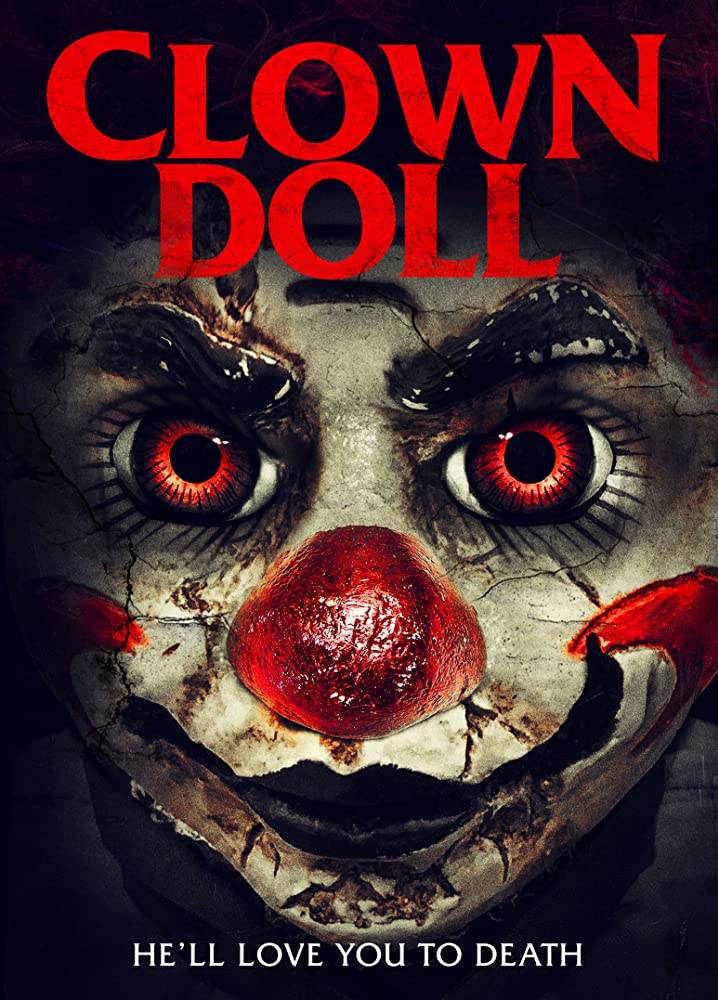
Clown Doll aka Joker Clown aka Meet Oliver (UK 2019: Dir Scott Jeffrey) Jeffrey's second feature this year, following the release of the rather good Don't Speak, is another film that's rather better than its cover and premise might suggest. Like DS it has UK people speaking with American accents, but although we never find out why they pitched up in the home counties, it is only one family, and everyone else (mercifully) gets to use their own voice.

The Americans are Lane (Sarah T Cohen), her brother John (John Scott-Clark) and mum Dee (Kate Millner Evans). Lane is acting as a surrogate for John and his partner, the ultra prissy Lisa (Kelly Juvilee) and is heavily pregnant. This might not be such a wise idea, as we learn later that Lane's mental health is a rather fragile thing, not perhaps built to handle the psychological upheaval of giving your baby away to your brother and sister-in-law. They compensate by over-doting on her and renting Lane a swish flat in a converted church for her final trimester.

One day while out antiquing with mum, Lane finds a rather hideous 4 foot high doll which the shop owner can't wait to get rid of. In a tense prologue, we've seen a couple desperate to get rid of the same toy and come a cropper at its hands. Looks like Lane is going to have the same problems. And indeed the murderous doll hides in plain sight, despatching (and stashing away) the bodies of Lane's best friend Jamie (Carmina Cordelia) and then various members of her family. When the police arrive to investigate, it's the same story with each 'misper': Lane was the last one to see them, and the suspicion seems to fall on her. Meanwhile Lane has started getting phone calls from someone identifying themselves as Oliver. Initially he sounds nice and she's rather flattered, but as the calls continue it's fairly apparent that something is rather amiss, and all roads lead back to the doll - or should we call it Oliver?

There are some really interesting touches to Jeffrey's film that lifts it above the usual 'killer clown' hokum. The psychological impact on Lane - convincingly played by Cohen - is quite plausible, and there's an almost Hitchcockian element to the persecution she suffers (I really liked the riff on the film's 'he's-phoning-from-the-extension' moment, which has the audience questioning Lane's sanity, even when we know who's responsible for the carnage. Some of the murder set pieces are also surprisingly effective and there's a great build up of tension towards the end: a rather bleak conclusion seals the deal on this one for me: 2 out of 2 for Scott Jeffrey.

The Droving (UK 2020: Dir George Popov) Popov's debut feature, 2017's Hex, made great use of countryside scenery and a small cast in its atmospheric genre mashup of A Field in England and The Witch. Popov repeats the formula with The Droving: a handful of characters, some impressive Cumbrian scenery and a story which fuses elements of The Wicker Man and Dead Man's Shoes.

This movie's Sergeant Howie is soldier Martin (Daniel Oldroyd, who was in Hex) who travels to Penrith in Cumbria, serendipitously at the time of the annual Droving festival, to find out what happened to his sister Megan (Amy Tyger) who disappeared at the previous year's gathering.

But Martin is no passive Christian interrogator. He has the inner anger of Richard in Shane Meadows' 2004 film, honed by a career extracting confessions from prisoners in the Middle East.

After meeting Megan's friend Tess (genre regular Suzie Frances Garton, who has cropped up in a few of Andrew Jones's features and was also in Hex), from whom he learns that his sister was a keen hiker, he runs into a group of young troublemakers, collectively called 'The Clan,' who have arrived in town to take part in the festival; they in turn point him towards a recluse (Jonathan Lawrence Risdon) who lives deep in the woods. The further Martin delves into the heart of the countryside, the more he learns, and the more his anger is sharpened. The truth about Megan's disappearance taps into local myth, but is also steeped in reality.

As with Hex, the location's the thing here, but while Popov's first feature was set in the past - specifically the Civil War - The Droving situates itself in contemporary Penrith during preparations for the famous Droving festival. With the High Street chain shops providing a prosaic backdrop to the fiery procession at the film's climax, all the while Martin is pushed, like Howie, inexorably into the rural heart of the area, as he discovers more about the myths surrounding the place.

In a less talented director's hands, the film's obvious influences could have overwhelmed any originality on offer. But The Droving scores highly in its interweaving of myth and reality and in particular the character of Martin, coming to terms both with the scars left by his military career and the truth about Megan's disappearance, and veering between quiet determination and bouts of unrestrained violence. Atmospheric, tense and yet strangely lyrical, The Droving is very impressive.

Skullz (UK 2020: Dir Deanna Dewey) Bit of a change of pace here. Skullz is a kids' movie, but its subject matter makes it suitable for inclusion in DEoL and under the 'NWotBHF' banner.

Scott Collins (Reid Hillwood) is a schoolboy prone to getting into trouble. On a class trip to a museum, he drifts away from his year group and, skulking around the basement, comes across a strange transparent skull; once touched it forms an instant psychic connection with him, and delivers a vision where he sees his grandmother collapsing on her motorbike and delivering a warning.

On reaching home he hears that gran has died following a heart attack - he was given a premonition of her death. Scott's mum and dad are in severe financial hardship and facing eviction, so a note through the door, offering them caretaking and nursing employment in a large family house in the New Forest, seems like an offer too good to miss, even if it is a strange one.

At the New Forest house the Collins family, mum, dad, Scott and his little sister Trish (Niamh Blandford) are introduced to Trelwaney (Henry Douthwaite), his wife (Amy Loughton) and their elderly confused 'mother' (Julia Savill) to whom they are to assist with care. But when Trelwaney shakes hands with Scott it's clear that a bond exists between them, and the skull at the museum, which Trelawney knows about and wants to liberate, holds the key to all their futures.

On an estimated budget of £100,000 Dewey and her writing partner James DeMarco have put together a story which is half a modern Children's Film Foundation movie and half a 1970s kids Sunday teatime TV mystery. It's refreshing to see a film fashioned for younger kids which remains resolutely UnAmericanised; of course the real test will be if kids take to it, although its limited release in the UK may hamper that. But Skullz is full of the kind of things I used to love as a kid: mysticism lite; comedy criminals (Tim Faraday as on the make Trevor and Judy Norman, very sprightly at 70, as the interfering Mrs Banner, are both great value); kids finding things out; and there's even a health and safety conscious car chase. Skullz is great fun and everyone involved should feel very proud of themselves.

The Cabin Murders aka The Utah Cabin Murders (UK 2020: Dir Andrew Jones) The prolific Welsh director now has 25 directing credits under his belt with a further two in production - not bad for a 36 year old. Having watched most of his movies, there's a real sense of Jones improving as a director, and learning from past issues.

The Cabin Murders is based on real life events back in 1990 in Oakley, Utah, and has a direct link to one of Jones's previous movies, Cabin 28 (2017). That film also concerned a real life event, the slaughter of a family back in 1981 in California, and the link between the two is the same investigating officer, Deputy Brad Wilkes (Jason Homewood). All names have been changed to protect the innocent, we are assured.

Wilkes, whose nagging regrets about the outcome of the 1981 investigation still haunt him, is working in the Oakley area when he becomes aware of two crimes, which may be related: the murder of a woman and subsequent theft of her car; and a holdup at a local shop where money, masks and outer clothing were stolen.

Meanwhile elsewhere in the area a family have come to stay in a lodge for Christmas, the family made up of dad Richard (Erick Hayden), mum Patricia (Anna Ruben), her mother Delyth (Lucy Aley-Parker), and Richard and Patricia's late teenage daughters Linnea (Teffany Ceri) and Tina (Jennifer Sims).

While Richard and Tina drive to town for some shopping, the rest of the family are disturbed when two masked and armed men force their way into the lodge. Ostensibly asking for cash, it's pretty clear that they have murder on their mind; proud Delyth is first to die and on dad and daughter's return the whole family is terrorised.

Like other UK indie horror directors, in the past Jones has been guilty of having his cast speak with American accents while in recognisably UK locations, something that constantly irks me. But this time he has disguised his location well. We're still in Wales (it's the same lodge - thanks Luxury Lodges - as the one used in Cabin 28) but this time there's a paucity of local colour to ruin the effect, into which is spliced some footage of an authentic US town. It might even be Oakley, Utah. And Jones' casting of actors who can hold north American accents, together with an authentic US actor (Hayden) means that belief is suspended.

Derek Nelson and particularly Lee McQueen are nastily effective as the killers Edward Deli and Von Taylor, but Jones still needs to work on pacing. He often fails to build sufficient tension, letting scenes run too long, and there's an end coda which just falls flat. As I've mentioned before, his films nearly always look good but are let down by poor content and a lack of style. But I'm pleased to report that this, along with 2019's The Curse of Halloween Jack, shows a director growing in confidence.