Friday, 30 March 2018

The Facebook reviews! Part 1

Over the last few years as well as running this site I've posted up on social media a number of micro reviews for a range of films across many genres, but mainly focusing on horror and sci-fi. In an irregular feature I'll be posting them up, six reviews at a time, on DEoL. So pull up a coffin, snap open a can of AB Negative and have a read!

Hell Night (USA 1981: Dir Tom DeSimone) Apparently the power of a very jittery MPAA severely impacted on the amount of explicit gore on show in Hell Night. But the relative lack of the red stuff actually helps this movie along. Marti (Linda Blair) is one of a gang of freshmen students who have to spend the night in a house with a macabre history as part of a hazing ritual. The grim legends turn out to be true, with one of the deformed children of the original occupant remaining hidden in the mansion, ready to prey on unsuspecting students.

The first part of the movie provides the usual studenty hi jinks as actors way beyond school years fool around fairly annoyingly. It then settles into something a lot more interesting when it's basically Blair and her BF running around the basement of the house pursued by a giant misshapen killer who in close up seems to be facially modelled on the subliminal demon glimpsed in The Exorcist.

Of particular interest is the presence of Suki Goodwin, playing Marti's friend Denise. Goodwin's English accent sounds rather odd against the rest of the US cast, and a little research shows that she is the daughter of the late Denis Goodwin, one time scriptwriter with Bob Monkhouse, who took his own life at the age of 45. Apparently Goodwin was happy to do nudity in the film, but was acting as the girlfriend of the rather more reserved Vincent Van Patten, who insisted they both kept their clothes on in the spirit of decency.

The Mutilator aka Fall Break (USA 1984: Dir Buddy Cooper) Somebody asked me why I would rewatch terrible films? Just subjected myself to what I think is the fourth viewing of this movie. It's a difficult one to answer because, well, this film is dreadful. Firstly you know who's doing all the slaying and mutilating so that fun is taken away from the viewer. And then there's the acting, which improves as the body count rises (less terrible acting to deal with) but in the opening scenes is excruciating. 

But look a little closer. This is good old fashioned independent film making, supposedly shot in 29 days, with lots of local colour (and local people fleshing out the cast). There are some terrific old school effects on display courtesy of then fledgling Mark (From Beyond, Evil Dead II) Shostrom. It's got an at times faux musique concrete soundtrack and an ace theme song. And the killer looks like a mentally disturbed Rock Hudson! An indefensible waste of 90 minutes of my life? No, no and indeed no.

Beyond Skyline (UK/China/Canada/Indonesia/Singapore/USA 2017: Dir Liam O’Donnell) For those who don't remember, Skyline was a 2010 aerial alien invasion movie directed by brothers Colin and Greg Strause. The film delivered top notch effects but bottom notch drama, an uneasy mix with much of the human cast trapped in an LA apartment building watching the CGI carnage through a telescope. The brothers Strause haven't directed anything since, preferring to fall back on their SFX skills (they also did the visuals for Skyline) for movies like Into the Storm (2014) and Geostorm (2017). Liam O'Donnell, the producer of the first film, has chosen to move into the director's seat, for the first time, for a belated and not particularly needed sequel - actually, it's more of a big budget reboot.

At the end of the first movie, the tentacled aliens had asserted their hold on New York City as well as LA, and had just perfected the art of transferring the brains of their victims into ambulatory alien but human shaped bodies, presumably to extend their invasion from airborne attack to ground combat. Beyond Skyline develops the ground combat idea, and chucks everything into the mix, including martial arts, kaiju creatures, exotic locations, a baby who grows up in two days, and some effective CGI work. It's pretty dumb but looks good, and O'Donnell leaves room for a third movie, which if it's anything like this might be worth catching.

The Possessed aka Demon Witch Child aka La endemoniada (Spain 1975: Dir Amando de Ossorio) This one sometimes gets left out of the discussions on post The Exorcist euro cash ins, but is a demented classic from Mr 'Blind Dead' himself, Amando de Ossorio. Veteran actress Tota Alba looks extraordinary as sweary old Mother Gautère, who is persecuted for her crimes of witchcraft, killing herself before she can be dealt with by the authorities. Her coven arrange for Gautère to possess the body of the police commissioner's young daughter Susan, and before you can talk about somebody sucking something in hell, the young girl gives local sailors a run for their money in the cussing stakes.

Marián Salgado as Susan (who dubbed Linda Blair in the Spanish version of The Exorcist) is as game as her American progenitor and particularly vile looking when she transforms into a pint size Mother Gautère, all wispy hair and challenging dentistry, with a side order of castration and random cackling. de Ossorio takes his usual side swipes at organised religion and the nature of good and evil, and the soapy and often wildly theological plot goes off in all directions before the final showdown. This is great value film making from a director never afraid to show his influences, but who rarely turns in a boring film.
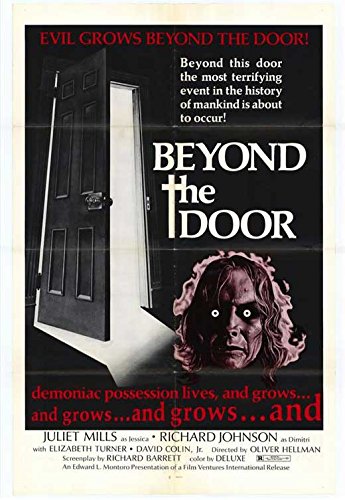
Beyond The Door aka The Devil Within Her (Italy/USA 1974: Dir Ovidio Assonitis) The second The Exorcist knock off this week, and by no means as entertaining as Demon Witch Child. I remember this one getting blanket coverage on commercial radio back in 1975 under its UK title The Devil Within Her (much as Suspiria did a year later), which was an indication even then that it wasn't exactly box office gold. Juliet Mills, who had thus far made her fortune in rather wholesome TV roles, plays Jessica, pregnant and undergoing all kinds of disturbances both at home and in her own mind. Her husband Robert (Gabriele Lavia) seems powerless to help, and only former flame Dimitri (Richard Johnson) has the necessary credentials to battle Jessica's possessed soul and stop the creamed spinach exiting from her mouth.

This is a long, drawn out movie with very little narrative tension and some terrible performances. Assonitis' first directorial outing did not bode well for future outings - he would continue to bore with mutated Octopus vehicle Tentacles (1977) and the equally baffling Madhouse (1981) - his lumbering exposition giving way to a frankly silly climax and incomprehensible denouement. Mills is quite game and looks the part, and the San Francisco locations are pretty (all interiors were shot in Italy though) but it's unintentionally funny in places (Mills's wonky eye effects and a scene where a harassed Richard gets hassled by some serenading buskers stand out) and it's all a far cry from the movie that started it all. A sequel of sorts followed with Mario Bava's 1977 movie Shock being retitled Beyond the Door II because of its possessed child storyline, but I wouldn't recommend a double bill.

The Cloverfield Paradox (USA 2018: Dir Julius Onah) I was considering a single DEoL entry for this one but in the end couldn't summon up the enthusiasm to write more than a few sentences. Directed with hod carrying finesse (apologies to brickies) by newcomer Julius Onah, this finds a space station full of scientists from around the globe testing out a solution to a worldwide energy crisis, who all descend into stereotype when faced with an on board catastrophe, rather like an interstellar version of Mind Your Language.

Of course things go wrong (and the going wrong provides a kind of Lovecraftian 'why' to the events in the first movie). Chris O'Dowd as the Irishman of the group gets all the gags, including some limp one liners when his arm, which has been severed in an accident, takes on a life of its own. I will admit that some of the FX look rather good (thanks to what looks like the entire eastern branch of IL&M judging by the credits) and it's a blessing not to have any on board robots, but it's all really silly with a script that is more than unusually sucky for this type of thing.

American Gothic (USA 2017: Dir Stuart Connelly)

"Killing is easy. Terrorism, on the other hand, takes a bit more finesse."

Stuart Connelly's second feature is one of those films where disclosure of much of the plot is likely to spoil the viewer's enjoyment. A litter picking detail of prisoners, being transported by van, is involved in an accident. Two of the convicts survive the crash and attempt a getaway, but as they're chained together, any real hopes of escape are limited. Coming across an isolated farmhouse, the pair effect entry, to the surprise of a husband and wife couple living there. But when the prisoners menace the pair to help them free themselves from their chains, the tables are decidedly turned.

As the title suggests, American Gothic hides layers of nastiness under its veneer of respectability - there's a quote by Kafka at the beginning of the film which doesn't make much sense until recalled at the end of the movie, which subtly hints at what's to come.

Supposedly based on a true story (but I'm not entirely sure if this is based on fact or an attempt at verisimilitude by the director), the movie packs more twists and turns into its 75 minutes than features twice that length could cope with. And with a cast of five (six if you count a police officer) and a fairly mundane location, the actors have to work very hard to build levels of creepiness and surprise.

And it works! As seemingly nice couple Bill and Sarah, Ned Luke and Rochelle Bostrom carry the film, with the two prisoners Nick and Guy (Slate Holmgren and Mark Barthmeier) enjoyably morphing from hunters to hunted; the fact that they're in prison for 'white collar' crimes adds a level of sympathy to their plight. The soundtrack by the enigmatically named Caesura Institute is bleepily tense and the whole thing comes together really well, with a satisfyingly open ended conclusion, and more than a whiff of EC Comics.

Connelly's first feature, 2013's The Suspect is also highly recommended (at the time of writing it's available to watch on YouTube) and American Gothic is an admirable follow up. A tense, at times darkly comic slice of Americana - I really liked it. Recommended. 

Saturday, 24 March 2018

The Carmilla Movie (Canada 2017: Dir Spencer Maybee)

So if you're over 40 the chances are you may never have heard of Carmilla, the insanely popular Canadian web based show which at the time of writing has clocked up 70 million plus views on YouTube, with a massively loyal fanbase. The series, which ran for three seasons from 2014, was created by Jordan Hall, Steph Ouaknine and Jay Bennett, and is another version of the much adapted Joseph Sheridan Le Fanu novella of the same name, featuring a centuries old vampire turning up in in a contemporary high school.

Picking up on the story's lesbian themes (although the author punished his heroine in the novella by having her beheaded for her Sapphic tendencies) Carmilla's strength is in its normalisation of gay characters and its female fronted cast being funny, strong and there for each other - this is a show which doesn't so much observe the Bechdel test rules as screwing them up into a ball and kicking them into the nearest waste paper basket.

Carmilla the web show introduced us to perennially perky Laura Hollis (Elise Bauman), a journalism student whose dorm buddy disappears and is replaced by dark and mysterious Carmilla Karnstein (Natasha Negovanlis), Laura's TA Danny Lawrence (Sharon Belle), and friends LaFontaine (Kaitlyn Alexander) and Perry (Annie M. Briggs). It's the interplay between these characters, and particularly the developing romantic relationship between Laura and vampire with a heart of gold Carmilla that really made the show consistently watchable, overcoming its major visual hurdle of being set pretty much in one room for all the episodes.

The show's themes of friendship, loyalty and courage in supernatural situations will of course bring to mind Buffy the Vampire Slayer, which covered the same ground in its seven seasons between 1997 and 2003. But of course most of Carmilla's viewers were either babies or a gleam in their parents' eyes during Buffy's heyday, and it's absolutely right that they would want their own version. But Carmilla is more than Buffy on-a-budget. The female cast, producers and writers have locked into something very much 'now' - at the screening of the movie I attended (and yes, I'll get to the film in a moment) the most important thing for the largely queer audience was simply to show gay characteristations uncoupled from traditional coming out narratives. Laura, Carmilla and the gang have got all that out of the way and are just living their lives. Albeit lives that include rampaging demons, evil faculty members and of course vampires.

So after the decision to end the web shows after the third season, it was a surprise and a delight for fans that Carmilla The Movie was announced. And make no mistake, this is a film for fans. I was quite privileged to see it on the big screen as, while I liked it, its commercial draw for those who are not already fans of the show ('Creampuffs' as they are known) may be limited and it seems likely to find its distribution options via streaming than the cinema.

The film opens five years after the events at the end of season 3. Carmilla has been transformed from vampire to human, and she and Laura are living a life of near normalcy and very much in love. Except that Laura keeps having troubling Hammer horror style dreams in which Carmilla is still a vampire, and a mysterious woman called Elle skulks around in the background. Turns out that Elle is Carmilla's ex and she's a whole heap of trouble, so the new Scooby gang must travel back to Carmilla's home country to face the evil.

Oddly, although the film opens up the rather restrictive single point camera approach of the web series, the talk straight to screen approach of the show has been retained. This keeps the intimate, confessional feel that regular viewers have valued but for a new audience, unaware of the show's history, it makes the film feel rather stilted. Would viewers get much from Carmilla The Movie if they hadn't seen the web shows? Possibly not. However the cast make the transition from small to large screen well, and the script loses none of the smartness of its web origins. It's good to see the team working well together and enjoying themselves in the gothic set pieces (including a Dance of the Vampires style ballroom scene).

Carmilla The Movie probably isn't for the casual uninformed viewer; although there is some backstory, it's not enough to immerse the uninitiated, and the film's pace may seem a little leisurely for the popcorn crowd. But I loved the movie as a thank you to the fans. And if the scores of young women who queued up just to say thank you to Negovanlis (who was present at the screening I attended and seemed to embody the spirit of the whole enterprise as a smart, funny and upbeat human being) is anything to go by, the movie has already done its work.

There were hints at the screening that the show may be optioned for a more mainstream series, and there's some doubt as to which actors, if any, will be ported across from Carmilla 1.0. Hmmm.

Thursday, 8 March 2018

Sweet Country (Australia 2017: Dir Warwick Thornton)

Based on a true story, Warwick Thornton's tough, uncompromising film about the relationship between indigenous people and white settlers in the rural Australia of 1929 revolves around a small group of people eking out a living in hostile terrain.

Benevolent land owner and preacher Fred Smith (Sam Neill) loans out two of his Aboriginal workers, husband and wife Sam and Lizzie Kelly (Hamilton Morris and Natassia Gorey Furber, both excellent) and their niece to help a neighbouring farmer, alcoholic and war traumatised Harry March (Ewen Leslie) for a few days. During this time March rapes Lizzie, a fact she keeps from her husband when they return home.

Smith leaves Sam and Lizzie at his farm while he goes out of town on business, taking their niece with him. A drunken March arrives at Smith's house looking for Philomac (a light fingered mixed race son of another white landowner), who has escaped being chained up. An enraged March fires on the house, and Sam, defending himself, shoots and kills the drunk man. Sam and Lizzie, the latter who is now pregnant with March's child, escape into the Outback and are hunted by the troubled and borderline psychotic police sergeant Fletcher (Bryan Brown) and a team of vigilantes.

"I think I'm in the family way" confesses Lizzie to Sam at one point in the movie. The phrase sounds strange, but one of the themes of the film is about the need to keep family together whatever the circumstances. The anger and disappointment of Lizzie's revelation, which comes after March's death, never leaves Sam's face from that point on.

One of Sweet Country's greatest strengths is its sense of place, locating a small but endlessly circulating group of characters within the timeless sweeping landscape of the Outback (the title is uttered genuinely in the film, but the reality is anything but). Thornton and the film's writer David Tranter both grew up in central Australia, members of the Kaytej and Alyawarra tribes respectively, which is reflected in the assured use of the film's setting; Thornton also served as Director of Photography. This is a terrain that has featured in Thornton's work before (specifically his 2009 movie Samson and Delilah) and also recalls Peter Weir's Picnic at Hanging Rock (1975) and Nic Roeg's Walkabout (1970). Thornton also borrows Roeg's temporal shift approach, giving the audience glimpses of scenes yet to happen, imbuing the film with an eerie feeling of prescience. There are hints of mysticism too: in one scene Sam catches a scorpion under glass, while at the same time Fletcher gets stung by a similar creature (or is it the same one?) hiding in his boot, an incident which triggers the policeman's extended bout of poison fulled mania under the desert sun.

The bleakness of landscape and narrative almost threatens to overwhelm but is saved by some very human performances by Morris and Furber, and also twins Tremayne and Trevon Doolan, who intriguingly both play Philomac; it's a triumph of casting that all are acting in a feature film for the first time. If there is one criticism it's that the white characters can be little more than cyphers against the indigenous cast, although the inner demons of Harry March and Sergeant Fletcher are given some nuance by Leslie and Brown. Praise too for deciding to render the movie music free, the sounds of the natural world being the only accompaniment to the events onscreen, and for keeping the pacing slow, which accentuates the moments of sudden violence. It's a trick borrowed from the Spaghetti Western, but effective none the less.

Sunday, 25 February 2018

The Demonic Doll (UK 2018: Dir Richard Mansfield)

The last of Richard Mansfield's micro budget horror films set in London (the director has now relocated to Nottingham), The Demonic Doll continues his trend for luridly titled movies which are in reality much more subtle than their names suggest. This one is a kind of sequel to his last year's The Demonic Tapes; it's even set in the same house (although a different location but the same borough), turning Haringey into an north London version of Amityville.

Rose is a separated mother of two having a couple of weeks on her own while the kids are at dad's. She's trying to get her life together after the split, and is doing some work for the local church magazine, so one assumes there might be a spiritual side to her - there are crosses on the walls of the house. In the same way as the unnamed sole male occupant of the previous film, Rose also discovers a tape recorder plus a spooky antique doll while rummaging around in the basement. And like the previous incumbent, she starts listening to the tapes obsessively. They record sessions with a little boy called Simon, supposedly possessed by a demon, who talks of a malevolent spirit called 'socks' and also 'Mr Sheets.' Rose also finds that the doll she retrieved mysteriously moves itself around the house, and she also half glimpses a cloth swathed figure which also follows her - could it be the same spirit talked about by Simon? Father Matthew from the local church provides support to Rose but is initially not convinced that she isn't making things up. But we know the London semi and its ghostly occupants mean business.

You have to hand it to Richard Mansfield. He does have the ability to create a chilling hour and a bit of screen time out of shadows, some nifty camerawork and some effective sound design (score again enigmatically produced by the mysterious 'Pig 7', and if the anonymously credited musician also turns out to be Mansfield I'll be very envious). The Demonic Doll, perhaps even more than its predecessor, looks to BBC TV's Ghostwatch for its suburban thrills - the director has even stolen that programme's subversive behind the curtains stunt - and as the camera moves stealthily around the house, the viewer is constantly on the lookout for something supernatural at the edge of the frame, catching little details like upturned crosses and mysterious messages. Mansfield doesn't really go in for big jumps, although the score, with its distinctive Mica Levi style shrillness, suggests this might happen.

Castwise this is basically a two hander, Rose being played by Jennie Fox, doing a good job to convince as a middle class mum slowly realising that her home is a haunted house. Confusingly Mansfield regular Darren Munn, who was the stalked man in the same house in The Demonic Tapes, returns here as Father Matthew. But apart from that it's just glimpses of people and disembodied voices on tape.

Look, this won't be everyone's cup of tea, and a certain amount of 'adjustment' is required to view this as conventional entertainment. But I like what Mansfield does with a camera, I applaud his chutzpah, and he's clearly having fun. But I'm slightly relieved that the Haringey horror franchise has ended with the director's move out of London; however I am keenly looking forward to what comes next - maybe a series of Nottingham Nightmares? And you can have that title for free Richard.

Monday, 19 February 2018

The Ritual (UK 2017: Dir David Bruckner)

Ah the problems of adapting horror fiction for the big screen. Director David Bruckner's previous genre credits (segments in 2015's Southbound and 2012's V/H/S) demonstrate that he's no stranger to creating an eerie mood in his films, and although The Ritual has plenty of atmosphere, it's arguably less than the sum of its parts.

A group of old friends are planning a boys weekend away, one of the suggestions being a hike along a Swedish hill range. Group leader Luke dismisses the idea, but when the hike proposer dies after being caught up in a bungled shop robbery (Luke is also in the shop, but hides and does nothing when his friend is attacked) they feel duty bound to honour the suggestion as a tribute to their departed friend.

Six months after the incident, with Luke still wracked with guilt, the party embark on the hike. As inexperienced outdoor types, they quickly fall prey to the horrendous weather and difficult terrain, eventually getting lost in a dense forest. But after camping out in an abandoned hut and experiencing a night of sheer terror, they realise that something very big is in the woods and may be stalking them.

I've not read Adam Nevill's book on which The Ritual is based, but I've consumed enough genre fiction to recognise from the structure of the film that Bruckner is probably following the novel fairly closely. And therein lies the problem: although the movie is not overly complex, there are a number of different strands to it which, while they may be visually appealing, don't really add up to much, and probably were more intriguing in print form. And just as the book probably canters towards its monstrous conclusion, so too does the film, in the process moving from the atmospheric and un-guessable to a predictable scenario with a group of guys getting picked off in the woods, accompanied by the ever present thundering score letting the audience know just how scared they should be.

Bruckner also allows us, after playing the old game of tease but don't show, plenty of scenes of the creature. Glimpsed in the trees it's quite something; in plain sight it isn't (have film makers learned nothing from the lessons of the 1957 movie Night of the Demon?).

Castwise the friends are convincing enough as a group of guys whose connection - college in this case - is increasingly tenuous, and their subsequent loss of trust in each other understandable. As Luke Rafe Spall is the natural leader and his guilt hangs over his character very believably - but he deserved a better script. Sadly I lost interest in nearly all the characters in the last half of the movie when they become little more than beast fodder. The other star of the film is the forest itself, with Romania standing in for Sweden. Now on a personal note I once travelled to Romania with my school, and spent quite a lot of time feeling homesick and walking through forests just like the one in the film, with the echoes of teachers' warnings about people you might encounter in them ringing in my ears; so the dense woods and mist laden valleys brought back quite a few memories.

Ultimately The Ritual is a rather disappointing film, which promises a lot but then is unable to sustain our interest. It should have been a creepy, unpredictable flick, but it felt like a squandered opportunity. Shame.

Thursday, 1 February 2018

From the archive - reviews of The Blood Harvest (UK 2016), The Pack (Australia 2015), Survivors (UK 2015) and The Slayers (UK 2015)

A selection of reviews that either didn't make it to 'print' or are no longer available.

The Blood Harvest (UK 2016: Dir George Clarke) - director/writer/producer Clarke’s latest movie is a solid two fingers up to people who don’t think that films shot on DV can be any good. The Blood Harvest is a tense cat and mouse thriller with creative and occasionally stomach churning gore scenes, a solid cast and great use of rural locations. It also looks way better than its estimated £10,000 budget would suggest.

A serial killer is stalking the countryside of County Down in Northern Ireland. Not only does he wear a strange mask while murdering his many victims, but he cuts their Achilles tendons and eats their eyeballs too – using a fork, no less. Chaplin, a cop who has been sacked but is still determined to solve the case, specialises in mythology and thinks that the killings may be the work of a vampire (the truth turns out to be odder than that).

His former partner Hatcher suspects a more prosaic motive, but it’s in his interests to put Chaplin off the scent. Separately the two cops close in on the killer’s (or is it killers plural?) country hideout, where Chaplin learns the strange truth both about the murders and his partner.

I confess to not having seen Clarke’s previous films, but on the basis of The Blood Harvest I’ll be rectifying that as soon as possible. This is a really inventive movie which starts at a breakneck pace with the rather disturbing murder of a young girl, and doesn’t let up even at the jaw dropping denouement. It’s a tightly edited film which builds the tension well, and it’s not a movie that is afraid to be out there. I liked it a lot – highly recommended.

The Pack (Australia 2015: Dir Nick Robertson) - films about dogs who’ve had a rethink on the whole ‘man’s best friend’ concept have been around for a while. Back in 1977 a movie also called The Pack had a load of dogs made angry by being abandoned by their owners. 1982’s superior White Dog dealt with a racist German Shepherd, and of course there was rabid Cujo who gave Dee Wallace a hard time in the 1983 adaptation of the Stephen King book. 2006’s The Breed had a bunch of similarly infected pooches chasing after partying teens and 2014’s White God had more dumped beasts getting annoyed.

The difference between those movies and Nick Robertson’s debut feature The Pack is that the dogs in this film aren’t programmed, necessarily abandoned or infected to the best of our knowledge. There are just a lot of them and they’re aware that they can throw their weight around with a bit of canine organisation.

Carla and Adam Wilson are having a tough time of it having recently moved to their farm in the Australian outback, which doubles as the local vets. Carla’s been treating a lot of stressed dogs recently and Adam is getting fed up with finding butchered sheep on his land; their kids are similarly cheesed off with their new rural existence and the mortgage company are threatening foreclosure. It’s all rather tense. As night falls a power cut plunges the farm into darkness and a pack of wild dogs seize their moment to launch an attack, forcing the Wilson family to fight for their lives.

That’s about it plot wise. Robertson doesn’t spend much time developing the characters of the family members, choosing to devote most of the film’s running time to the canine siege and generating quite a bit of tension in the process. The power cut makes things very Assault on Precinct 13, and he is clever not to show too much of the beasts, largely keeping the threat in shadow. Real trained attack dogs were used for the most of the scenes (the cast were apparently genuinely afraid of them) combined with sparing use of model work and almost unnoticeable CGI.

Apparently attacks of this nature are a growing problem down under, so this movie will probably have an additional frisson for Australian audiences. While I appreciate the assurance of the direction (not bad for a feature first timer) I didn’t really feel much of a threat - the family have guns for crying out loud - but their ethical code initially delays them inflicting any harm, and the dogs rather unrealistically spend a lot of time stalking when they probably would just have gone for throats. However I liked Robertson’s nod to the cinema of nature gone wrong (particularly the Aussie movie The Long Weekend) in his combination of animal sounds and well photographed outback scenery, and the refusal to explain why the dogs acted as they did.

Survivors (UK 2015: Dir Adam Spinks) - Spinks’ first full feature, 2014’s Extinction, was a valiant if overlong attempt to do something different with the found footage genre, featuring a group of explorers travelling deep into the Peruvian jungle (actually a well disguised Welsh countryside) and uncovering a nest of dinosaurs. Two years on and Spinks is back with more found footage action in Survivors, although this movie had actually been made before Extinction, but took nearly two years to see the light of day via a Crowdfunding initiative which helped stump up some of £10,000 budget.

As the title might suggest Survivors tells the story of the aftermath of a viral attack, centred around Kate Meadows, a journalist trying to get to the bottom of a story about human drug testing behind closed doors, and the potential after effects of the trials. This is cleverly cut with scenes clearly set following a viral outbreak, showing that the inevitable has happened. Spinks is much less concerned with showing us scenes of the infected on the rampage than the human cost incurred by those left coping in the wake of the event. Similar to the BBC series of the same name which is surely an influence here, it isn’t long before certain people assume dominance and power, when clearly the population should be uniting (an optimistic politician’s voice is heard on the radio talking about how the country will be able to pull together and recover from the infection, but having seen some of the characters in the movie that looks extremely doubtful).

As in Extinction some of the actors are much better than others (with so much acting talent out there I’m not sure why directors end up casting people who are so terrible at conveying character or emotion) but there is a sadness and fatalism in this movie that I wasn’t expecting. Unleavened by any real action it’s quite a depressing experience, enhanced by Buz Kohan’s sweeping melancholic score.

I’m not sure whether I really liked Survivors but maybe that’s the point. It certainly punches above its low budget origins though - and Spinks is an interesting director who clearly invested a lot of thought into this movie and is well worth watching.

The Slayers (UK 2015: Dir John Williams) - £15,000 in the hands of some movie directors will buy you lunch and maybe half an hour in the editing suite. Given to film maker John Williams it can net you a whole comedy feature film, as this is what The Slayers cost to make – all 1 hour and 40 minutes of it.

Nigel and Job are both members of a cult embracing the soon come arrival of a comet that will wipe out the world. When their Jim Jonesesque leader advocates drinking poison and the congregation duly oblige, Nigel and Job choose life. Faced with two weeks to go until the end of the planet, they make up a bucket list and proceed to tick it off. This list isn’t particularly startling though, including things like ‘going fishing’. However their life of relative hedonism is ruined when they run into a gang of vampires and a crusty vampire hunter.

The Slayers is half The Inbetweeners and half Dumb and Dumber. Nigel and Job are an Abbott and Costello for a new generation, and it took me a long time to appreciate Abbott and Costello. Williams’s film is inventive, fast paced, but…wait for it…not very funny. Sorry John, maybe I just wasn’t in the mood for the pratfalls, goofiness and occasional The Mighty Boosh touches. Sure, I bet it was a lot of fun to make, and the enthusiasm of the cast (who include the director in five different parts, the 2014 winner of Britain’s Strongest Man and ‘troubled’ 2006 Big Brother victor Pete Bennett) shows through. It’s nicely filmed, showing off the Stoke-on-Trent locations well, and the special effects are amazing considering the budget. But at over an hour and a half it very much outstays its welcome, although it does become much more interesting once the vampires show up. Apparently fifteen minutes of the film were trimmed after the first screening, so I’m not sure if I’ve seen the longer version, or it originally ran for nearly two hours (!).

Ultimately whether you go for The Slayers (and I’m sure there’s an audience out there for this) depends on how many people you’re watching it with and in what state you are when you do. I’m sure Williams would be the first to say “Look, we’re not making Kurosawa here!” but I didn’t find Nigel and Job a particularly appealing pair of layabouts, and The Slayers spends an awful lot of time in their company.