Sunday, 20 November 2016

The Wailing (USA/South Korea 2016: Dir Hong-jin Na)

Hong-jin Na's epic story of supernatural magic is one of the more extraordinary films of 2016. Easily justifying its near two and a half hour running time, this is a rich if at times impenetrable movie which provides no easy narrative answers and allows for multiple interpretations.

Jong-Goo is a rather luckless police officer in the South Korean village of Goksung. We first meet him investigating a bizarre murder, where the perpetrator remains at the scene of the crime, blood-soaked, dazed and covered in a strange rash. This is only the latest in a string of strange killings in the village, which coincide with the arrival of an enigmatic Japanese man who has taken a house in the hills. Jong-Goo as a village policeman is clearly unused to this level of violence. Suspicion falls on the Japanese visitor (who some locals think is a ghost), but even when confronted with seemingly incontrovertible evidence the cop fails to arrest him - is this a comment on the inability of South Korea to 'police' the presence of Japan in their country? Also under suspicion is a strange almost wordless young girl who seems to taunt the police and who holds her own secrets.

Jong-Goo's daughter Hyo-Jin falls ill, showing signs of demonic possession and becoming covered in the same rash as earlier victims of the strange village sickness. Her mother, fed up with the inability of the authorities to handle the situation, summons a smooth, well dressed, 4-wheel drive owning shaman to drive the devil out of the village. This action sets off a chain of increasingly odd events, where no-one is to be trusted and it becomes impossible to tell who, or how many, are hosts to the evil presence which causes the dead to return and attack the living.

The Wailing can be read in many ways; political allegory; a state of the nation look at communities in South Korea; family drama; wonky ghost story; and even as broad social comedy. For the film resists any particular categorisation and often veers crazily between all of them. However at its root this is a very tightly directed movie which rarely loses pace, moving slowly from amiable comedy to histrionic tension and some impressively horrific set pieces. But despite the often bizarre events on screen, Hong-jin Na consistently frames the action within a very believable village community, with sleepy police, jumped up authority figures, and people going about their business amid the mayhem. The weather is frequently appalling and much of the action takes place on rain sodden hillsides or surrounded by low level disorienting cloud cover, rendering the village even more isolated and its occupants trapped.

The Wailing has one set piece after another; the exorcism scene is a standout, with both the smooth shaman and the Japanese stranger battling it out for control of the situation in a riot of drumming, fire and precision editing. There are also some stand out performances here. Do Wan Kwak as Jong-Goo transitions from amiable village cop to frustrated father, powerless to control the murders in his district or the demonic disobedience of his daughter. And as Hyo-Jin young Hwan-hee Kim is exceptional, ranging from little girl cute to authentically and scarily possessed in a matter of seconds (I had a similar problem with the emotional extremes that this young actress was exposed to as I did with  Kim Su-ann in the recent Korean movie Train to Busan).

Some critics have written that the director has failed to understand the horror genre in his sprawling epic. My own view is that we are in a golden era of horror movie making, where most of the more interesting takes on the format emanate not from the US or Britain, but from the east and other parts of Europe. The Wailing is a winner.

Sunday, 13 November 2016

Arrival (USA 2016: Dir Denis Villeneuve)

A while back I was complaining to a friend about the all embracing spread of emo-driven advertising at the cinema to sell anything from booze to banking. Well the trend has seeped into the sci fi genre as well. Swelling string sections and trembling bottom lips have recently found their way into metaphysical sci-fi outings like Interstellar and Midnight Special. Denis Villeneuve's ponderous Arrival also has metaphysics and emotion in spades, and sadly isn't the better for it.

Amy Adams, in a bravura performance, plays Dr Louise Banks, a lecturer in linguistics with a tragic past - a teenage daughter who died from cancer - called upon to assist when a series of huge oval spacecraft suddenly appear, hovering above a number of towns and cities around the world.

The authorities, in the shape of Colonel Weber (Forest Whitaker, whose age and acting style have finally found harmony) persuade Banks to join a small team of experts to travel to Montana, where one of the craft is located, and help decode the first messages from the aliens inside (the UK also have one, in Devon of all places, but we don't get to see that story). Also assisting is scientist Ian Donnelly (Jeremy Renner, smarmy as always) representing the yin of fact to Banks's yan of belief.

Much of the film is devoted to the pair's growing understanding of the language of the Cthulhu-like aliens, named heptapods (as well as a discordant moaning they write their messages in what looks like a cross between smoke and squid ink), while other members of the team monitor the reactions from Governments around the world to the arrival of the strange craft in the other visited countries - predictably China are first to turn from tolerance to aggression.

This is a fine setup - taking the germ of the last few minutes of Steven Spielberg's 1977 film Close Encounters of the Third Kind and making a whole movie out of it - but a rather thin one, and in its rush, or rather gentle trot, to replace content with emotion Arrival becomes rather laboured. By the end, Jóhann Jóhannsson's sweeping orchestral score had become so overpowering I wasn't sure whether I was still watching the movie or just more adverts. As an aside, Jóhannsson used to be a much more interesting composer (just listen to his score for The Miners' Hymns - it's on YouTube - and tell me if it isn't the most powerful soundtrack you've ever heard) but seems to have blanded out recently, possibly tantalised by the promise of more Oscar nominations.

The first part of the movie is the most successful. Villeneuve, a skilled director who gave us one of my favourite films of last year, Sicario, delays showing the spacecraft, cutting away from news items and reflecting the wonder of the alien vision via the reactions of his actors. And the final unveiling of the craft, about twenty minutes in, is a woozy mix of aerial and tilt shift photography that depicts the military activity around the craft as the aliens would see them, small and insignificant dots in the Montana landscape - it's a great scene. The craft's interior is simply designed, with its own gravity system (which provides the film's most obviously exciting moment) and as mentioned the tentacled heptapods are distinctly Lovecraftian.

But as the film progresses the promise of the first half subsides. The analysis of the alien language may be interesting but doesn't make great cinema, and Villeneuve's decision to show the world's varying reactions to the alien presence - from fervent prayer to looting and violence - via TV screens is clearly a deliberate attempt to tell a 'first contact' story from the point of view of one character rather than through spectacle. But in so doing it reduces the film to a rather one dimensional, almost soap-operaesque drama. I also couldn't help but notice that, once again, the only country to make the communication breakthrough was the Americans.

Arrival is based on a short story called 'Story of Your Life' by Ted Chiang, who also contributed to this movie's script. The story's themes of language, time and memory are arguably more suited to the printed page than the cinema screen. Here the awkward melding of aliens and sentiment just didn't work for me. I found Arrival at times very clumsy and forced, and if it wasn't for the casting of Amy Adams (a central character in some ways similar to Emily Blunt's flawed heroine in Sicario) it would scarcely be worth bothering with at all.

Thursday, 3 November 2016

The Girl With All the Gifts (UK/USA 2016: Dir Colm McCarthy)

This is Colm McCarthy's second feature film as director. His first, Outcast, from 2010, weaved magic and dysfunctional relationships in an uneasy and decidedly low budget mix. The Girl With All the Gifts, an adaptation of M R Carey's bestselling 'possible future' novel of the same name (Carey also wrote the screenplay) is similarly downbeat, a kind of paean to 1970s UK dystopian sci fi television, but with some bigger themes (and bigger stars) on display.

The Girl With All the Gifts opens with a group of young children in a classroom setting, somewhere deep within a secure facility. Unusually the children are manacled. One of them, Melanie, shows a high degree of intelligence and a connection with their teacher, Helen Justineau (a nicely downplayed performance from Gemma Arterton). Sgt Eddie Parks (Paddy Considine, slightly going through the motions) is wary of treating the children as 'normal' - he exposes a bare arm which is enough to set off the childrens' collective bestial behaviour. For these children are infected by the same fungal disease that has turned most of the rest of the country into crazed zombies nicknamed 'hungries' - the children display much more control and sentience, although they're feared by the military staff (who wear protective gel to disguise their human smell) and fed on a diet of worms to remind us of their genus. When the hungries break through the compound's barrier and into the facility, Melanie, Parks and Justineau all manage to escape in a truck also containing Dr Caroline Caldwell (Glenn Close, icy and not exactly redefining herself), a ruthless scientist who believes that the children bodily carry the infection's antidote via their brain tissue and spinal fluid, and therefore must be sacrificed to save the world. But Melanie has other ideas.

This is a zombie film which attempts something a little loftier than the usual. Don't get me wrong, it's still a B movie, albeit an expensively cast one - more than half of the film is devoted to the characters wandering the overgrown abandoned shopping arcades of our once great cities, for example - but in concentrating the story on the androgynous Melanie (a stellar performance from newcomer Sennia Nanua) rather than the zombie hordes it offers some more interesting observations about the relationship between infected and uninfected.

I liked the way in which the film slowly explained the relationship between the different factions rather than rushing to cram the exposition into the film's first fifteen minutes, and how it referenced the changing shape of the virus: as a fungus, it begins to sprout from the dead into huge, spreading growths containing seed pods that if broken will make the disease airborne. The generational aspect of the zombies is also interesting and probably the most frightening idea in the film - that the initially infected are the foot soldiers for something much more calculated. The film has a lot to say about what it means to be human and the division between human and beast, with a depth rare for such a genre movie.

It also offers up an ending (which of course DEoL cannot divulge) both apocalyptic and redemptive, a fiery climax in striking counterpoint to the washed out colour palette of the rest of the film, which concludes with a scene that is arguably more cinematic than plausible - but hey, this is a zombie film. Mention should also go to the immersive soundtrack of the Chilean composer Cristobal Tapia de Veer, which underscores the increasing tension perfectly. Not a masterpiece, but along with the recent Train to Busan, doing something very different with a genre that needed to diversify.

Wednesday, 2 November 2016

New Films Round Up #3 - Reviews of The Faith of Anna Waters aka The Offering (Singapore/USA 2016), Ghost Team (USA 2016), Tell Me How I Die (USA 2016), Lair of the Beast aka Chupacabra Territory (USA 2016), The Boy (Canada/USA 2016) and The Hatching (UK 2016)

The Faith of Anna Waters aka The Offering (Singapore/USA 2016: Dir Kelvin Tong) "Leviathan is using the internet to rebuild the Tower of Babel" declares one of the cast about half way through this daft blend of The Exorcist, The Da Vinci Code and every other urban haunting movie you've ever seen. The quote pretty much summarises the plot too, which revolves around saucer-eyed Jamie Waters, summoned to Singapore following the suicide of her sister Anna. Jamie doesn't believe her sibling is capable of such an act and stays on to super-sleuth her way to the truth, which involves objects moving, shadowy shapes, and a string of deaths suggesting her sister's demise was part of an overall plan by a demonic force with surprisingly good IT skills.

Primarily a Singapore movie with some US cash, the western cast suggests a remake of an Asian spook flick but no, this is an all original movie which actually is anything but. It's the kind of flick where a character tries to work out an anagrammatic string of letters really slowly, making the audience shout "FFS, it's L-e-v-i-a-t-h-a-n, it's not that difficult!" It might have had more impact had director Kelvin Tong not injected so many plot strands that the attempts to understand what's happening obscure any possibility of being scared or indeed anything but puzzled. As readers can see from past posts, I'm willing to give most stuff a go, but this was fairly painful.

Ghost Team (USA 2016: Dir Oliver Irving) Here's an amiable but not terribly funny indie comedy about a duo of gormless guys making an audition tape to apply for a vacancy on their favourite show, the fictional 'Ghost Getters.' Ambitious Louis suggests that as a location the pair check out a supposedly haunted barn, having been tipped off by the owner when he calls in at the copy shop where Louis works to order some 'No Trespassing' signs. His partner Stan, who has a lot of trouble staying awake and is the archetypal slob that's wandered out of an early Kevin Clark movie, tags along, his heart not really in it. The team are joined by perky fellow shop worker Ellie and jumped up store security guard Ross (Justin Long, a David Schwimmer for a new generation). The barn is staked out, there's a lot of goofing around, but then there's a Scooby Doo moment which provides a more prosaic explanation for the things that go bump in the night.

This movie's at its best when Louis and Stan are clowning around, slacker style. Long proves a bit too literal for comedy (a bit like Schwimmer freed from the comforts of the Ross Geller character) and there are long periods when nothing really happens, including laughs. The rest of the cast have a good comedy pedigree (Jon Heder as Louis, for example, was terrific in 2004's Napoleon Dynamite) but they're not helped by an uneven script. The whole thing is fairly unsuccessful, but not without the odd funny line.

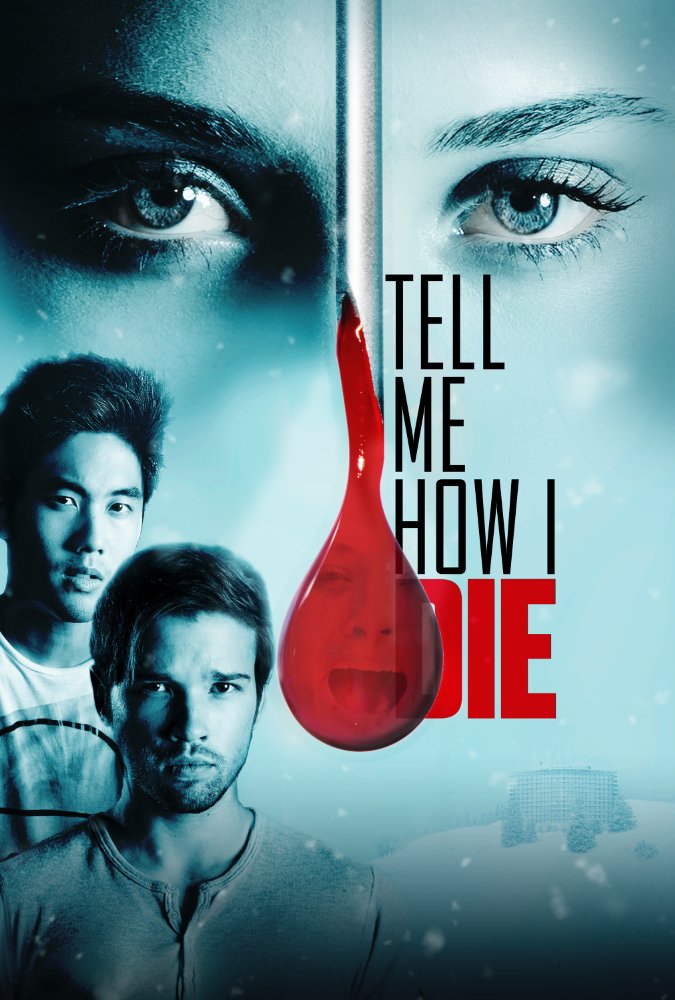
Tell Me How I Die (USA 2016: Dir D.J.Viola)  A group of young people sign up for a drugs trial in a remote medical establishment, presided over by the mysterious Dr Jerrems. The drug's properties are to enhance memory, but uh oh! there's side effects. Principal casualty is the already half psychic Anna, who starts getting visions of her colleagues' deaths. And there's a killer among them who has the same abilities. Soon the kids are being picked off, as Anna battles to stay alive and keep one step ahead of the killer.

Generic is the name of the game here. All of the cast could have wandered in from a million similar 'I-Know-What-Your-Final-Destination-Is' movies. The film is consciously teen friendly and as a result increasingly bland, despite attempts to whip up some tension in a snowbound cat-and-mouse (more like mouse-and-slightly-bigger-mouse) finale. 107 minutes is a long time to spend in the company of this lot, and unleavened by any real gore, violence or rumpy pumpy to distract the viewer from the fact that not much is happening, it's quite a slog: this is clearly a first feature from director Viola, previously responsible for the MST 3000 style Elvira's Movie Macabre series and various music promos. And it shows.


Lair of the Beast aka Chupacabra Territory (USA 2016: Dir Matt McWilliams). Well what do you know, it's a good ol' found footage film. But wait - come back! It's quite good! Writer/ producer/director Matt McWilliams's first feature delivers a lot more than the average FF movie in terms of content, gore and, well, gratuitous sex scenes. Three young kids head out to the woods to capture footage of the infamous Chupacabra (a blood draining beast reportedly sighted throughout the Americas since 1995 - the name is translated as 'goat sucker'). For a FF movie, our three hunters, Amber, Joe and Morgan, are surprisingly engaging. Warned off by the park police the trio ignore the advice and steal onto the trails, meeting another party along the way. But it isn't long before we realise that the Chupacabra is real - various mountain animals are found gored, with their necks bitten and entrails removed (the classic kill sign of the 'Chupa'), a fate which soon extends to the humans. Some Chupa goo gets onto Morgan's arm, which gradually turns into a festering mess. More bizarre still is Amber, who seems to get a bit possessed and walks off into the woods to pleasure herself. What's going on? I don't know but it's all strangely watchable. The gore is well handled (although CGI blood splatters are very annoying) and as mentioned the nudity is completely gratuitous, harking back to the days of 1980s 'lost in the woods' movies that had to include at least one scene where a member of the female cast gets nekkid, as Joe Bob Briggs would once have said.

Ok this isn't brilliant, yes there is quite a lot of running around in the woods and there's the usual moments where you wonder exactly who's doing the filming, but McWilliams deserves some credit for adding more elements into his movie than you would expect (and arguably than he knows what to do with), and his leads at least give us enough personality that you care a bit about what happens to them. Cautious thumbs up then.   

The Boy (Canada/USA 2016: Dir William Brent Bell) This got a bit of a roasting from critics when it appeared in cinemas earlier this year. I have to confess to liking it (well the first two thirds anyway). It's very moody and Lauren Cohan does an extremely good job at conveying a gentle and increasing unhingedness as Greta, an American nanny in England appointed to look after a dummy named Brahms. Brahms' parents of course treat the dummy as if it was a real person, introducing Greta to a strict regime of dressing and teaching the 'child' which the nanny is expected to comply with even after the couple disappear on holiday. Strange things begin to happen, with the seemingly inanimate Brahms shifting position when Greta's not looking. Is he real after all or is Greta losing her mind?

Local delivery guy and wet dishcloth Malcolm forms an attachment to Greta, who's in the UK to escape her violent ex Cole. Of course Cole turns up, and this viewer (wrongly) guessed that maybe there was a plot between Cole and Malcolm to drive Greta bonkers. The truth is sadly quite different, and disappointingly takes the movie in a more formulaic direction in its closing stages. But for a while The Boy achieves a rather stately menacing feel. The camera prowls around the house (located in British Columbia rather than the UK) watching Greta go through her strange routines, 'observed' by the glacial porcelain face of the dummy. Cohan doesn't have anything to act against for much of the film so its to her credit that The Boy is quite creepy. With The Devil Inside (2012) and Wer (2013) director William Brent Bell seems to be establishing a well made schlock career similar to Jaume Collet-Sera, whose 2009 film Orphan this film resembles in tone.

The Hatching (UK 2016: Dir Michael Anderson) Oh now this is a terrible film. Actually a 2014 movie only just now getting a release, and the delay is completely understandable - another ten years would have suited me fine. The Hatching is the story of Tim, who returns to his home village in Somerset after the death of his father where, as a child, he broke into the local zoo with some other kids to steal some crocodile eggs. The prank went wrong and one of his friends was fatally gored by a Crocodile. Seems that the eggs made it out though as there's a wild crocodile on the loose in the shadow of Glastonbury Tor. And as if that's not bad enough, local girls are going missing, supposedly at the hands of a serial killer. Who is it? There are so many choices, but our money's on the local butcher who lingers too long over the bloody carcasses in his shop.

Supposedly a comedy horror, The Hatching is neither funny nor frightening. It's certainly odd, but not in a good way. Further hindered by almost glacial pacing, the story features characters with no definition who seem at times to be on the verge of corpsing on camera. And don't get me started about the ludicrous fake crocodile. The cast features various TV 'stars' (Tim is played by television regular Andrew Lee Potts - looking considerably younger than his near 40 years - and Lucy by familiar small screen face Laura Aikman) and not very funnyman Justin Lee Collins is on hand doing what he does best - being a bit of a tool with a west country accent. Worse still, Thomas Turgoose, whose career seems to have stalled since his triumphant turn as Shaun in Shane Meadows' This is England saga, plays the Caesar the butcher, a role in which he looks distinctly uncomfortable. One entry on imdb, from a cast member, suggests that the film was originally targeted at the 15-25 group - presumably that's an IQ reference. Truly awful.

Sunday, 30 October 2016

Have a Poundland Hallowe'en! Reviews of A Night in the Woods (UK 2007), June (US 2015), Axe Giant (US 2013), Lake Fear aka From Beneath (US 2014) and Abominable (US 2006)

Who says £5 can't bring you happiness? I wanted to enjoy some Hallowe'en thrills, but I wanted to do it on a budget. So I went to my local Poundland in Brixton and hoovered up five of their most promising DVDs, to have me my very own Poundland Hallowe'en. Here's what happened:

Film 1: A Night in the Woods (US 2007 Dir Richard Parry) Richard Parry made the not very good South West 9 back in 2001, a drama set on the streets of Brixton. Ten years later he made his entry into the 'found footage' sub genre, about a trio of hikers who head off into the wilds of Norfolk and spend, you know, a night in the woods. Hang on, I thought, I've seen this before. I even wrote a short review about it for another site, which went something like this:

"A few tips for budding 'found footage' film makers: 1. By the very nature of what you're doing you're ripping off The Blair Witch Project. It isn't necessary to set up bits of your movie that directly copy scenes from the original film. Try to avoid ripped tents (also tents messed about by 'unseen' forces), and senseless screaming (both from your main characters and the 'disembodied screams in the night' variety). 2. Your cast are filming on camcorders. Do not therefore actually film on much better equipment as it spoils the illusion (unless you can disguise the professional camerawork to look like cheap camcorder footage). 3. Never forget who's doing the filming. If there's a scene where all three central characters are being filmed (ie the only ones supposed to be in the movie) and no-one has a camera in their hands, then someone else is filming. This is not good. Same advice applies in the 'action' scenes. 4. To paraphrase Steve Martin in Planes, Trains & Automobiles, have a fucking point to what you're doing. It makes it so much more interesting for the audience. 5. Not a great idea to have lots of different music over the end credits for a 'found footage' movie. The ending's bound to be a bummer. Let silence do the work for you."

Film 2: June (US 2015: Dir L. Gustavo Cooper) Actually dating back from 2014, L. Gustavo Cooper's surprisingly watchable if very silly June is certainly a step up from his last genre effort, 2013's overly talky The Devil Incarnate. In a plot which bears some similarity to this year's Midnight Special (and also harks back to 1984's Firestarter), a young baby conferred with special powers is snatched away from a cult. Nine years later, as a young girl pursued by shadowy authority figures, she is placed in the hands of foster parents who gradually realise how special their adopted daughter really is, what with her ability to mess up the house in seconds and speak in a funny voice. We learn that the powers are supernaturally endowed (the little girl is possessed by an ancient demon) - and essentially that's the whole plot of June. It's thin stuff but reasonably enjoyable provided you don't think too hard about what's going on and can cope with the bargain basement effects work. Casper van Dien (Starship Troopers (1997)) gets credits on both sides of the camera for this one - maybe he sunk some money into it. Kennedy Brice is pretty effective as June. As a young actor she already holds an impressive CV; in fact her first appearance was at her birth, the actual footage being utilised in the 2013 movie Crackerjack. Nice.

Film 3: Axe Giant aka Axe Giant: The Wrath of Paul Bunyan (US 2015: Dir Gary Jones) Hey, getting in the Hallowe'en spirit now! Or I was. Now I'm no expert on American folklore, but I thought the giant lumberjack of legend was a rather amiable fellow? So what the hell is this nonsense? Filmed in the rather beautiful California, Ohio and Michagan countryside back in 2013, the forest locations are about the only thing going for this. After the obligatory prologue set in the 19th century (although one guy's wearing a rather modern bomber jacket) featuring a group of hicks who get chopped up, we cut to the present day, where a bunch of young offenders are sent on an outward bound course as an alternative to imprisonment. The group is presided over by a 'yes sir no sir' ball buster and a counsellor. They end up staying at the very house where the prologue's massacre took place and pretty soon the giant form of Paul Bunyan rocks up (he's an average guy with a few warts but is filmed to make him look massive - he also gets to act against some terrible model work to unconvincingly emphasise his stature) and the CGI dismemberment begins. Axe Giant can't make its mind up whether it wants to be a comedy or a straight out horror movie and of course ends up being neither. Poor old  Dan Haggerty (The Life and Times of Grizzly Adams (1977-78)) is in it and Martin Sheen's younger brother Joe Estevez plays someone bonkers. Jones directed the better than average B movie homage Spiders back in 2000, so I was expecting more from this, but Axe Giant is a terrible, terrible film which even some casual nudity and a nine foot giant can't fix.

Film 4: Lake Fear aka From Beneath (US 2014: Dir David Doucette)  This is actually the 2012 movie From Beneath repackaged as something it isn't. What I think it is, judging from the regular scene fades, is a movie strung together from a number of webisodes. It's very uncinematic, the sound's all over the place, and the acting from the two leads is pretty awful, when you consider that apart from these two there's pretty much no-one else in the film.

Sam and Jason are heading out into the woods to visit Sam's sister and her newly acquired house. But when they get there, no-one's at home. Opting to take a dip in the lake, Jason gets bitten by a leech like creature which then burrows into his leg. Holed up the house, he begins to hallucinate. Sam meanwhile has found her sister, who is dead. And it looks like what killed Sam's sister has plans for Jason.

Lake Fear is quite a chore to watch, and despite David Doucette wanting to make something claustrophobic and unsettling, which is laudable, the movie is just plodding and silly. It also has a terrible soundtrack - I'm assuming the musicians were friends of the director.

Film 5: Abominable (US 2006: Dir Ryan Schifrin) Yep, we're at the end of my Hallowe'en five for a fiver mini odyssey, and we conclude with the oldest of the movies selected. This was Ryan Schifrin's first feature (he went on to write and direct one of the segments in 2015's enjoyable Tales of Halloween). It's got a pretty good cast too, including Dee Wallace, Jeffrey Combs, Lance Henricksen, and Troma regular Tiffany Shepis - ok a good cast if cheesy horror flicks are your bag. And as an added bonus there's some quality soundtracking from Schifrin's dad Lalo, which to be honest sounds like it's strayed in from a much classier movie.

Yep, Abominable is pretty, well, abominable maybe too harsh, so  I'll go with barely adequate. Despite that title hook, the beast in question is actually Bigfoot The creature itself is an impressive bit of costume and prosthetics (the guy in the suit is Michael Deak, who as well as making special effects behind the camera, is pretty much the go-to guy when you want someone tall in a monster outfit). However the story is pretty hokey. A group of girls from the city take a house in the woods for a hen weekend, watched over - via binoculars - by next-door neighbour, wheelchair bound ex-climber Preston Rogers (played by Matt McCoy in his second Bigfoot film, twenty years after Bigfoot - the Unforgettable Encounter, which of course everyone has forgotten about). When Bigfoot arrives and starts picking off the party-goers, Preston shouts commands at them to help the girls escape. He becomes the hero of the day, eventually rear-ending the beast in his car and trapping it against the tree. However, in the darkness more sets of Bigfoot eyes look on - the story is not yet over.

Neither smart or pacy enough to get by as comedy horror, Abominable limps along rather episodically, only managing a soupcon of excitement towards the end. Most of the genre cast are rather wasted, although Jeffrey Combs should at least be singled out for being almost unrecognisable, dressed up as a backwoods bum.

Wednesday, 26 October 2016

New Films Round Up #2 - Reviews of The Amityville Terror (US 2016), Evolution (France/Belgium/Spain 2015), The Possession Experiment (US 2016), They Look Like People (US 2015), Let's Be Evil (UK 2016) and The Evil in Us (Canada 2016)

The Amityville Terror (US 2016: Dir Michael Angelo) Any film with the word 'Amityville' in the title isn't headed anywhere near The Oscars, that much we all know, but it's certainly an inspiration for film makers. Last year we were treated to Amityville Death House and The Amityville Playhouse. In 2016 so far we've had The Amityville Legacy, Amityville: No Escape, Amityville: Vanishing Point and Amityville High. To which we add, completely unasked for, Michael Angelo's (no, I'm sure that's his real name) appalling The Amityville Terror.

Todd (Kaiwi Lyman-Merserau, whose credits include 'Surfer 2' in 2005's Frankenstein vs The Creature From Blood Cove) and Jessica (Kim Nielsen from this year's Zoombies and the accompanying video game 'Escape From the Zoombies'), together with daughter Hailey, up sticks and move in with Todd's fresh-out-of-rehab sister Shae (Amanda Barton from Dracula's Curse (2006) and the previous year's Frankenstein Reborn). Shae has rented a rambling house in the town of Amityville, hoping to make a new start, but the demonic spirits within have other ideas, gradually taking her over and causing a deadly threat to the rest of the household.

An unbelievably stupid film with a plot seemingly made up as the film progresses, the only remarkable thing in it (apart from a group of people who move into a house in Amityville with no knowledge of its history) is the inclusion of a load of nudity just as the movie watcher is convinced that this MUST be one of those anodyne cheapo cheapo made for Syfy offerings; watch for the scene where the evil estate agent dispenses advice to a co-worker mid, well you know, session. The demon make up is truly terrible, and the paucity of budget means that the final burning of the house (and just how many times has the Amityville house been razed to the ground in films?) is represented by some smoke and someone flashing a torch on and off. 

Evolution (France/Belgium/Spain 2015: Dir Lucile Hadzihalilovic) Ah, a return to arthouse monster movie making. A beautifully shot, glacially paced mood piece about a white-washed coastal village inhabited entirely by women and boys, focusing on young Nicolas (a great performance by Max Brebant) and his 'mother' (Julie-Marie Parmentier). Nicholas feels that all is not right at home. He thinks he sees a dead body on the beach, and witnesses his mum, together with the village's other women, indulging in strange seaside rituals. Along with the other boys Nicolas becomes sick and is confined to a sterile hospital, also staffed only by women who watch training videos showing how to perform Cesarean Sections. Nicolas is told his friends are being cured, but instead they go missing. Is his mother really who she makes out to be? Is she really a mother at all?

Very little is explained in Hadzihalilovic's serene nightmare. It's arguably too abstract to be truly gripping but there are enough bizarre scenes to hold the attention, with body horror elements suggested rather than over-emphasised, like watching a Bela Tarr movie filtered through early Cronenberg. The Lanzarote locations are both familiar and strange and the whole thing is decidedly odd. Cautiously recommended, and a film I'll certainly be watching again.

The Possession Experiment (US 2016: Dir Scott B. Hansen) Or 'Bill and Ted Go Ghost-hunting.' Scott B. Hansen's 2014 film Monumental was an above average road movie which featured some touching performances and beautiful photography. Two years on, The Possession Experiment couldn't be more different.

Brandon is a slightly strange, awkward high school student who hooks up with stoner classmate Clay to carry out an end of year assignment on exorcisms for their Religious Studies course. Clay's along for the ride while Brandon's the brains of the outfit - a relative term here. The goofy pair decide to investigate a twenty year old case of possession which was notorious because the footage of the exorcism survives as do two of the people involved. Tracing the house where it all took place, Brandon takes the rather severe step of holding a seance there in the hope of being possessed by the same spirit responsible for the original incident. Is he nuts? Yes indeed. Does it work? Uh huh.

Reading this synopsis I understand if you're tempted to roll your eyes and carry on to the next review. And indeed the film's prologue, featuring the 1994 exorcism, doesn't give you much hope of seeing anything new here. I was intrigued how Hansen's direction takes the movie from lark about stoner buddy flick to more sinister territory rather effortlessly, encouraged that surely some of Monumental's promise would filter through? But no, it's just a mess. Silly gore (a woman ripping her own jaw off) and clumsy pacing abound, and boy are you bored with Brandon and Clay by about the one hour point.

They Look Like People (US 2015: Dir Perry Blackshear) Here's a battle of the losers movie which spends nearly all its time in the company of Christian, a likable guy on the rebound, in love with Mara, the hire and fire HR manager at work, and long lost friend Wyatt, who Christian runs into on the street and persuades to move into his apartment. While Christian has a bit of a damaged past, Wyatt is the real deal, receiving strange phone calls from voices who tell him that humans are gradually being replaced by...well, it's not entirely clear.

A lot of They Look Like People is concerned with Christian's attempts to rediscover his friendship with the increasingly addled Wyatt, and the latter's preparations for an apocalyptic takeover of the world - is the conspiracy real or in his mind? There's some subtle laughs to be found in the duo's messing around, and Mara is a sweet character who's all-business sacking of Christian in an office shakeup suggests to us (and Wyatt) that she might just be a non-human. Perry Blackshear's debut feature is a slight, inconclusive movie which resists a big payoff, a bold move but one which left this reviewer feeling rather unsatisfied despite convincing performances from Evan Dumouchel and MacLeod Andrews as Christian and Wyatt.

Let's Be Evil (UK 2016: Dir Martin Owen) And you thought that Virtual Reality was killed off as a cinematic concept by 1992's execrable The Lawnmower Man? Think again - twenty odd years on the idea has now acquired some retro cache. Earlier this year UK director Charles Barker offered the VR shoot 'em up thrills of The Call Up. Now we have the inexplicably titled Let's Be Evil, in which a group of gifted children are chaperoned by three equally talented individuals in an underground facility which is actually a created VR environment looked after by the mysterious avatar called Ariel. This works out ok until the children start playing up and picking on Cassandra (the only one of the children who will engage with the adults), and the chaperones begin hallucinating.

Owen's budget doesn't allow for much detail in his rather scuzzy VR world - it's all out of date computer equipment and bulk rented neon lighting. I wondered if the British cast, who all sport US accents with varying degrees of success, would revert to natural tongues a la 1999's eXistenZ, but no, this just seems a way to sell the film across the channel. The key problem with Let's Be Evil is that it's just terribly boring. The character of Ariel, who carries the film's expository weight, is as engaging as a sat nav system from Argos. And the children, who could have been the real core of the film, are just a bunch of drama school poppets. Even Julian Scherle's soundtrack, very reminiscent of this year's Mr Robot series (which he also scored) and 2014's It Follows (which he didn't) soon starts to grate, suggesting as it does a level of sophistication which the film can't hope to match.

The Evil in Us (Canada 2016: Dir Jason William Lee) It took good old William Hurt a series of dunkings in an immersion tank and a night out on the peyote to find his inner beast in Ken Russell's 1980 movie Altered States. It takes a dodgy bag of cocaine to achieve the same effects in a matter of minutes in The Evil in Us - a sign of the march of disposable society I suppose.

Five friends meet up for a Fourth of July weekend, little knowing that one among them has become infected and will soon transform into a cannibalistic primal beast  - and then spread whatever he has to the others. Jason William Lee's film is basically 28 Days Later wrapped up in some weird science and a police procedural, the latter story strand singularly failing to find its feet. It takes a hell of a long time to get going, but when the beasts come out to play it certainly has its moments. The ending looks like it drifted in from another film altogether, with some extremely laughable make up and a political payoff that 'trumps' (and if you see it you'll know what I'm going on about) all the other storylines, and could lead you to read the movie's title in a slightly different way. A mediocre effort then but not without a sense of trying, even if it does feel like two or three separate films bolted together.

'O Whistle and I'll Come to You My Lad' Performed by Robert Lloyd Parry

Robert Lloyd Parry as M R James
One of the genuine pleasures of life, and an often forgotten one in a world of instant gratification and increasing self centredness, is having a story read to you. Robert Lloyd Parry knows this - he's also a great storyteller.

Fresh from a one man show realising HG Wells's The Time Machine, Parry has returned to his first love - a performance of one of the stories of perhaps the greatest English writer of supernatural fiction, M R James, which has been filmed for viral release on 31st October (see details at the bottom of this piece).

Parry, as James, performs one of the author's most famous stories, the 1904 tale "O Whistle and I'll Come to You, My Lad." Those familiar with James will know that many of his stories originated via Christmas recitals to pupils of the schools where he was provost, and it is this intimate setup, illuminated only by a solitary candle, that Parry recreates here.

We may not fully know the accuracy of Parry's lively creation of James - records of his style of storytelling are scant - but visually he is strikingly Jamesean. The story, about an academic who finds a whistle in an isolated coastal location and, blowing it, summons a dark something that stalks the scholar for its return, is familiar James territory, although less layered than some of the author's later stories. Parry is the voice of all - James himself, Parkin the academic, various pompous dinner guests and even a maid at the hotel where Parkin lodges. The gentle humour in the observation of humanity, an often overlooked aspect of James's writing, is beautifully rendered in this performance, but what everyone anticipates is the slow creep of unease as the academic, previously a denier of anything vaguely supernatural, gradually realises to his mounting horror that he is being stalked by an otherworldly entity.

"O Whistle" has televisual broadcasting pedigree: the 1968 BBC adaptation by Jonathan Miller with Michael Hordern as the wordless, bumbling academic (and arguably the scariest use of bedsheets ever on screen, although Parry stages an effective recreation of this in his performance); and more straightforward readings by Robert Powell and Christopher Lee in 1986 and 2000 respectively (I'll draw a a veil - pun slightly intended - over the 2010 adaptation with John Hurt as Parkin). But there's something about Parry's obvious love of James as a writer, his reverence for the material and enthusiastically theatrical performance which makes this version a worthy addition to the canon. And I defy you not to look over your shoulder at least once as the tale is told.

"O Whistle and I'll Come to You My Lad" will be available to download from midday 31st October (UK time) and for the first 12 hours will cost £2.99 to buy here: